Get Full Government Meeting Transcripts, Videos, & Alerts Forever!
Get email alerts on the Employee Benefits topic
No spam. Unsubscribe anytime.
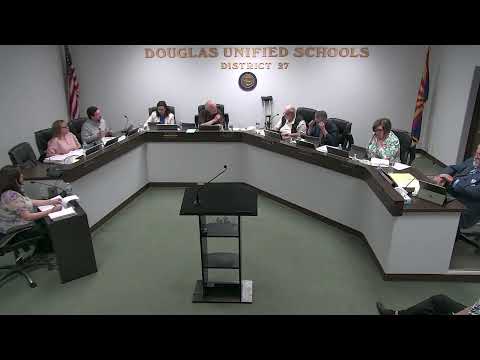
Douglas Unified board approves 90/10 health-insurance split for 2025-26 after debate
Summary
After extended discussion and public comment, the Douglas Unified School District board approved a 90% district / 10% employee contribution for the classic silver health plan for fiscal year 2025–26. The district said it will use non-capital funds to cover the additional cost for one year to avoid transferring capital out of reserves.
The Douglas Unified School District (4174) Board of Education voted to set the district contribution for employee health insurance at 90% and the employee contribution at 10% for a classic silver plan for the 2025–26 plan year, board President Breen announced after a roll-call vote.
Superintendent Nydia Samaniego told the board the recommendation was developed after legal and financial review of multiple options and community feedback. “We are looking at a 90/10 now,” Samaniego said during her presentation, describing the district’s effort to avoid transfers from capital that would raise red flags with auditors.
Samaniego laid out the plan’s basic terms: a classic silver employee-only monthly premium with the board contribution at $558.23 and an employee share of $62.03 per month (annual board contribution $6,698.81; annual employee contribution $744.31). The silver plan carries a $500 deductible for employee-only coverage and a $1,000 family deductible; coinsurance applies after the deductible. Employees may choose higher-cost options such as classic gold or copay gold at additional personal expense, and the district said Blue Cross Blue Shield will provide plan details during open enrollment.
Why it matters: Board members and staff said the change is intended as a one-year measure to avoid sudden, large out-of-pocket costs for employees while the district copes with projected declines in enrollment and associated maintenance-and-operations (M&O) revenue. Samaniego and Chief Financial Officer (CFO) Miguel Sotto said the 90/10 split will be funded this year in part by non-capital district revenues (for example, revenue from facility rentals and certain federal program funds) so the district will not transfer capital funds into M&O.
Public comment and board concerns preceded the vote. Martha Alonso, president of the Douglas Educators Association, urged the board to delay a decision because staff had received multiple, changing proposals in a short period and said the district had not provided consistent detail. “The ongoing flux of information has created uncertainty and widespread concerns across the district,” Alonso told the board, and she asked the board to postpone action.
Several community speakers echoed calls for more transparency and time to explore alternatives; others recommended community town halls to review the budget and enrollment data. Superintendent Samaniego and CFO Sotto said staff had repeatedly sought legal and Auditor General guidance about fund use and had revised options as new information arrived.
Vote and next steps: The motion to approve the 90% district / 10% employee contribution for the classic silver plan carried on roll call, 4–1. Board Member Smith voted no and said he preferred tabling the item to gather additional data. The district said the decision would be implemented through the May open-enrollment period and that staff will pursue an RFP for benefits vendors for future years. CFO Sotto reiterated the board’s intent to avoid capital transfers and to treat the funding as a temporary measure while further efficiencies and enrollment-recovery efforts are explored.
The board and administration also discussed that the 90/10 approach is not guaranteed beyond the coming year and flagged a planned solicitation (RFP) for benefit vendors next year; Samaniego noted that claims utilization and market trends could change the district’s options for 2026–27.
Ending note: Board members and staff repeatedly pointed to enrollment as the main long-term driver of district revenue and encouraged continued community engagement on enrollment and budget strategies. The board’s approval preserves the district’s existing provider relationships for the next plan year while staff continue a broader budget review.