Get Full Government Meeting Transcripts, Videos, & Alerts Forever!
Get email alerts on the Neighborhood Reconstruction topic
No spam. Unsubscribe anytime.
Public Works Committee selects streets for 2027 neighborhood reconstruction program
Summary
The committee approved a list of small, scattered neighborhood reconstruction candidates for the 2027 program and directed staff to proceed with design procurement; the 2027 program budget is about $9.4 million and larger budgets are forecast in later years.
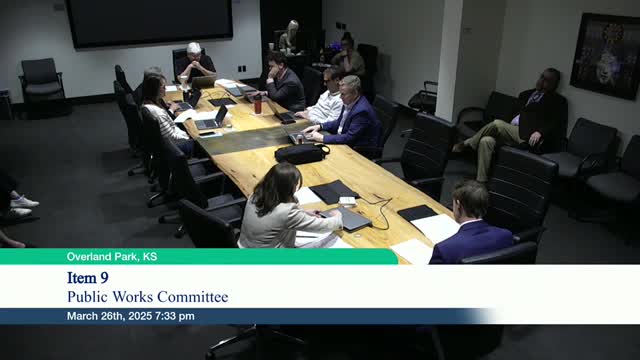
The Overland Park Public Works Committee on March 11 approved selections for the 2027 Neighborhood Street Reconstruction Program (project SR-2092), directing staff to advance design procurement and later return with a recommended designer and construction timeline.
The motion approved a package of smaller, spread-out candidates rather than a single large neighborhood. The motion (as moved and seconded during the meeting) listed the selected locations as: the 1 Second Street cul-de-sac within the Indian Heights Estates subdivision; Quail Ridge subdivision; Warrington Estates subdivision; selected cul-de-sacs within the Galway and Main subdivision; and Arrowhead and Beaver subdivision. The motion passed 6–0.
Staff described how selections were data-driven, using pavement condition index (PCI), failure frequency, age, prior maintenance history and other infrastructure elements (sidewalks, lighting, contiguous grouping) to identify candidates. Staff noted the 2027 program budget is $9,400,000 and that larger budgets are planned in later years (the 2028 program is shown at about $16,750,000 and 2032 at about $17,120,000 in the packet). Staff said the city has previously mapped useful-life needs (a 2021 map identified roughly 58 lane miles in need at that time) and that the city has made progress since then.
Committee members asked how overlay work and reconstruction candidates interact. Staff explained that overlay projects mill and pave the surface and that those operations can identify deeper base issues; if a segment requires full reconstruction it will remain on the reconstruction list rather than receive an overlay. Committee members also asked whether small areas shown in “immediate need” would be covered by neighboring overlay work; staff said scoping decisions are made to minimize cost-inefficient piecemeal reconstruction but noted isolated critical sections may require separate action.
Timing: If approved by council, staff will issue a request for proposals for design services, return to the committee with a recommended designer, and proceed with a design schedule intended to support construction in 2027. Staff said design will take roughly 1½–2 years.
Why it matters: Neighborhood reconstruction replaces failing pavement and associated infrastructure (curbs, sidewalks) and represents multi-year capital investment. The committee framed these selections as a way to address immediate needs while preserving capacity to tackle larger neighborhoods as budgets increase in later years.