Get Full Government Meeting Transcripts, Videos, & Alerts Forever!
Get email alerts on the Independent Expenditure Disclosure topic
No spam. Unsubscribe anytime.
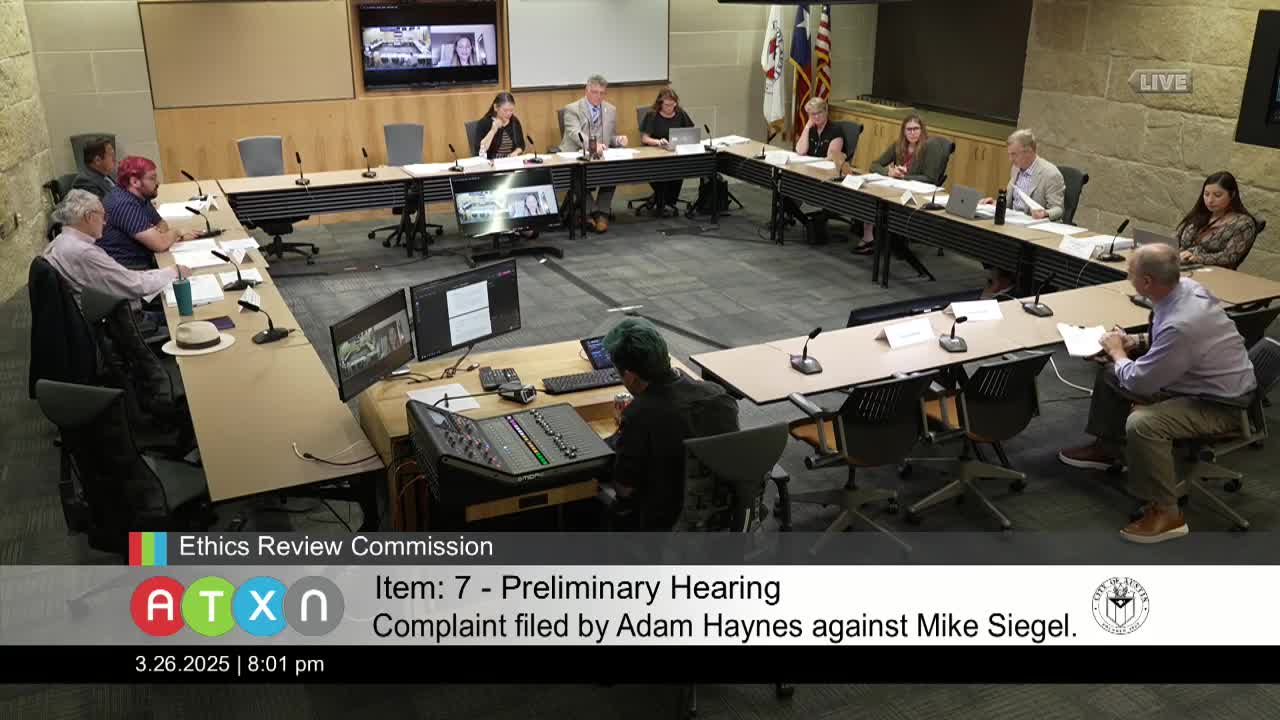
Ethics commission finds reasonable grounds to proceed to final hearing on complaint over Aura activities
Summary
The Austin Ethics Review Commission voted 8-0 to advance to a final hearing a complaint by Adam Haines alleging that Austin Aura/Aura for Austin made reportable campaign expenditures or coordinated political activity without required filings.
The Austin Ethics Review Commission on March 26 unanimously found there are reasonable grounds to believe a city campaign-finance violation may have occurred in a complaint filed by Adam Haines against Zachary John Scott Faddis (identified in the complaint as the person associated with "Aura"). The commission will schedule a final hearing to examine the evidence in full.
The complaint, presented by Adam Haines, alleges that the organization known as Aura (described in filings as both "Austin Aura" and "Aura for Austin") made direct campaign expenditures and coordinated electioneering communications in support of candidate Mike Siegel during the runoff. Haines told the commission he documented several instances of event promotion, block walks, flyers, and newsletter messages he characterized as express advocacy or electioneering communications, and he argued that those communications should have been reported and, if coordinated, require political-committee or in-kind reporting.
Respondent Zachary Faddis, appearing and representing himself, said the complaint misstated the responsible legal entity. Faddis told the commission there are two related entities: Austin Aura (a 501(c)(4) active since 2016) and Aura for Austin (a 501(c)(3) formed in 2024). He said the 501(c)(3) has not made expenditures and that the election activity referenced in the complaint was undertaken by Austin Aura, the 501(c)(4). Faddis described the group's work as volunteer-driven, said most materials were produced by volunteers and paid for personally by members, and said the group—spent approximately $69 on food at a few events mentioned in the complaint. "In total, in all the activities mentioned in the complaint, Aura spends around $69, as best as I can tell, on food across 2 of the events," Faddis said.
Commissioners questioned Faddis about whether volunteer-produced materials, organized block walks and newsletter communications should be treated as in-kind contributions or expenditures and whether such activity constitutes coordination under campaign finance rules. Faddis said volunteers paid for their own materials and that volunteers who printed literature listed their names and reported those expenditures as individual contributions.
Assistant City Attorney Caroline Webster clarified for commissioners that campaign reporting rules for city elections distinguish advocacy on non-ballot items from express advocacy and that the city code defines electioneering communications and reporting thresholds. The complaint cited multiple sections of the Austin City Code, and Webster noted the commission's role is to determine whether reasonable grounds exist under the city code definitions to warrant a final hearing.
After discussion, Commissioner Adam Matern moved and Commissioner Patrick Kiel seconded a motion that the commission find reasonable grounds to proceed to a final hearing. Chair Wynn Stanton Adams conducted a roll-call vote; all eight members present voted yes, with three absent, and the motion carried. The commission noted that the complaint named an individual (Faddis) rather than a corporate entity but that the commission's jurisdiction is to determine whether a person was alleged in a sworn complaint to have violated provisions within its jurisdiction.
The commission did not make any final factual findings at the preliminary stage; it determined only that a final hearing is warranted so the parties can present full evidence and testimony. Staff will schedule the final hearing and notify the respondent. The record will include the submissions Haines provided, Faddis—responses, and other documentary evidence the commission requests at the final hearing.