Get Full Government Meeting Transcripts, Videos, & Alerts Forever!
Get email alerts on the Telecommunications topic
No spam. Unsubscribe anytime.
Planning Commission approves AT&T antennas on SCE transmission tower near North Campus Avenue
Summary
The Upland Planning Commission on March 26 approved a conditional use permit and development plan review, voting 6-0 to allow AT&T to install antennas on an existing Southern California Edison transmission tower and construct a roughly 300-square-foot equipment enclosure approximately 600 feet east of Trail View Court and North Campus Avenue.
The Upland Planning Commission on March 26 approved a conditional use permit and development plan review, voting 6-0 to allow AT&T to install antennas on an existing Southern California Edison (SCE) transmission tower and construct a roughly 300-square-foot equipment enclosure approximately 600 feet east of the intersection of Trail View Court and North Campus Avenue.
The commission approved a resolution finding the project exempt from the California Environmental Quality Act (CEQA) under the small‑projects exemption and cleared the way for the carrier to restore wireless service in a documented coverage gap.
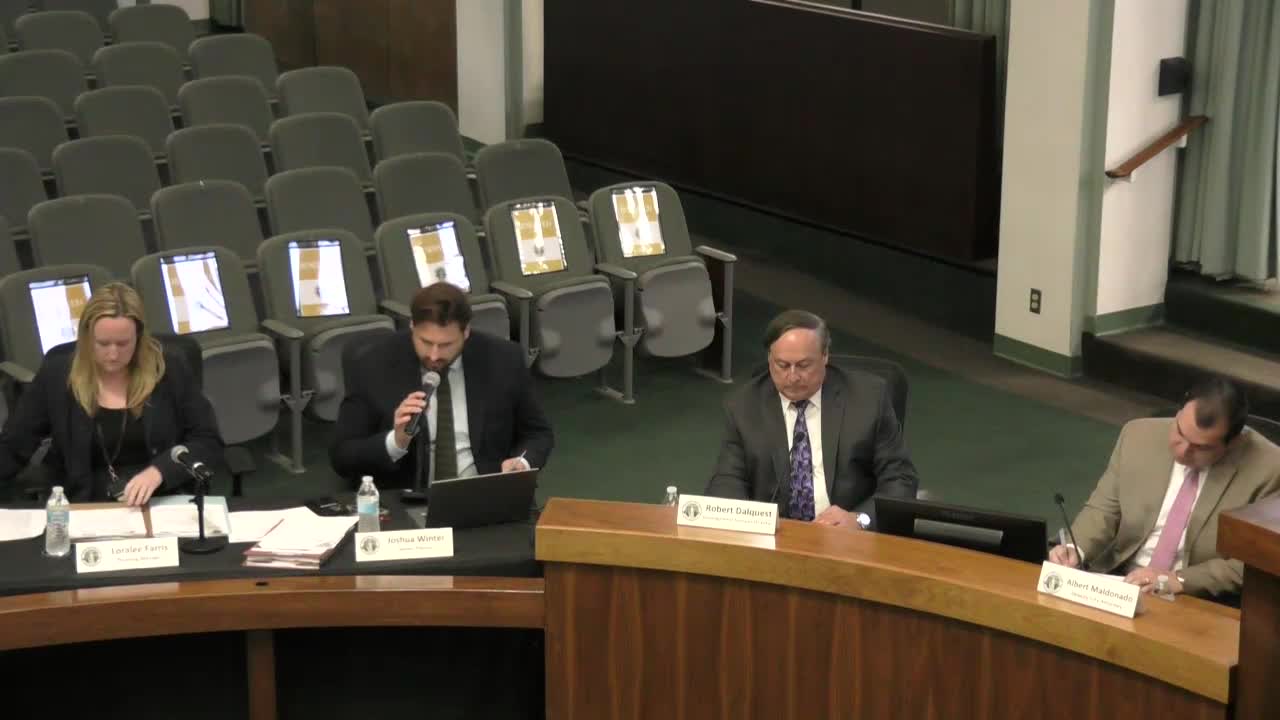
Staff planner Joshua Winter told the commission the proposal would mount antennas on an existing 120-foot SCE transmission tower and place a 300-square-foot equipment enclosure on a separate SCE parcel. "The project before you tonight is the telecommunications tower, it's an AT and T tower, an existing SCE transmission tower," Winter said during his presentation, describing site layout, parcel ownership, setbacks and required design controls.
The project does not meet two municipal-code separation standards: a 200-foot required residential separation (the antennas will sit about 160 feet from the nearest residential property line and about 174 feet from the nearest residence) and a 1,500-foot separation from another telecommunications facility (the nearest qualifying facility is about 1,200 feet away). Winter said federal law limits local authority in such cases. He summarized the effect of the Federal Telecommunications Act of 1996 and local rules: if a wireless provider demonstrates a significant coverage gap and that the proposed installation is the least intrusive way to fill it, a denial that effectively prevents service can be precluded by federal law.
Winter said the applicant provided propagation maps showing the coverage gap extending into Upland and onto neighboring Rancho Cucamonga and documented a stepped search for alternate sites. He said AT&T contacted property owners, reviewed roof‑ and building‑mounted options, and found SCE property the most feasible site. Winter also reported the city retained an independent consultant, CTC Media Group, which reviewed AT&T's coverage and RF reports and found them consistent with AT&T's materials. "They took a look at the coverage gap, and they found their maps to be consistent and warranting the goal of AT and T providing more service," Winter said.
The application includes visual‑treatment conditions: antennas, conduits and other attachments must be painted to match the tower; the equipment enclosure will be a block wall with anti‑graffiti coating, a green‑coated, 1‑inch‑mesh chain‑link fence and gate with a chain‑link topper. Winter said conduit between the enclosure and antennas will be installed underground.
Commissioners asked about fire safety, aesthetics and property values. Commissioner Borger asked whether new fire maps placing the site in a higher fire‑risk zone would affect the project; Winter said San Bernardino County Fire had no concerns and the project will undergo the department's plan check. Commissioner Johnson asked whether the facility would affect neighborhood aesthetics or home values; Winter responded that such economic impacts are speculative and noted a prior facility existed on the same tower. He said, "there's no new tower that will be built with this particular facility… these antennas are very similar and are located in the same place." Applicant project manager Jermaine Taylor added that SCE generally permits only one carrier per pole, which limited co‑location options: "SCE doesn't allow collocations on their other towers. They only allow 1 carrier per tower," Taylor said.
Staff also said the prior on‑tower facility had been decommissioned in 2022 and that the earlier conditional use permit became null and void after more than 180 days of discontinuation. CEQA review was handled as a Class 3 exemption for small structures (CEQA Guidelines §15303), per the staff report.
A motion to adopt the CEQA exemption and approve Conditional Use Permit No. 20-04-2 and Development Plan Review No. 20-04-1 passed 6-0. Winter noted a 10‑day appeal period following the decision.
The commission's approval imposes the staff‑recommended conditions, including design, anti‑graffiti and undergrounding requirements, and requires the project to comply with any plan‑check conditions identified by San Bernardino County Fire and other reviewing departments.
Votes at a glance: the motion to adopt the CEQA exemption and approve the CUP and development plan review passed with six affirmative votes and no recorded opposition.