Get Full Government Meeting Transcripts, Videos, & Alerts Forever!
Get email alerts on the Bond Programs Financing topic
No spam. Unsubscribe anytime.
Finance director: authorized but unissued bond programs and off‑cycle packages raise future debt service pressures
Summary
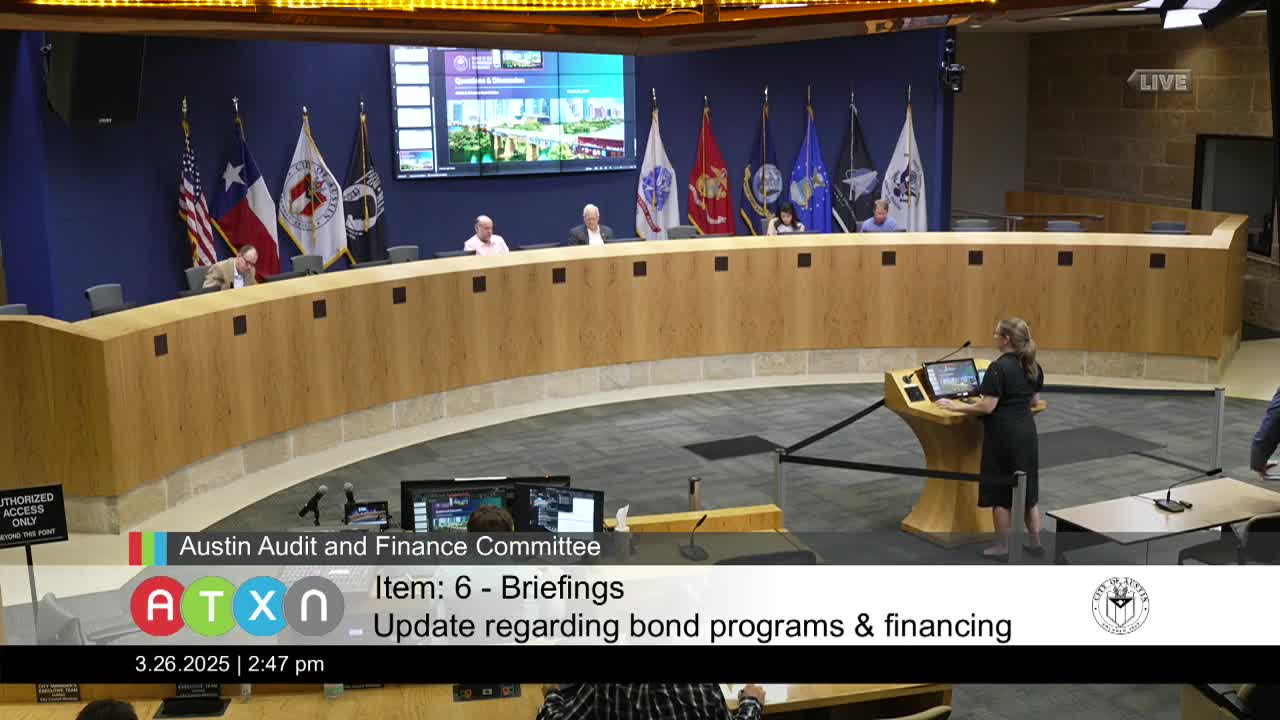
Financial Services Director Kima Lavaras updated the committee on Austin’s bond programs, noting large amounts of authorized but unissued general‑obligation debt and off‑cycle bond packages that have extended spending timelines and will raise future debt service for a typical homeowner.
Kima Lavaras, director of Financial Services, briefed the Audit and Finance Committee on March 26 on the city’s bond programs, issuance process and policy considerations.
Key points: Lavaras said the city’s GEO (general obligation) debt includes voter‑approved bonds and non‑voter instruments such as certificates of obligation. City departments plan capital expenditure across multiple funding sources; Austin Energy, Austin Water and Aviation also use commercial paper and revenue bonds for shorter‑term financing. Lavaras noted that historically the city aimed for a six‑year spending plan for bond packages, but recent off‑cycle and supplemental bond packages (2016, 2018, 2020, 2022 and others) have lengthened spending horizons for some programs.
Authorized but unissued debt and tax‑rate impacts: From existing bond programs alone (2006–2022) Lavaras said there remains nearly $1.4 billion of voter‑approved debt to be issued; more authorized but unissued GEO debt also exists. Because debt service must be funded, she said the combined profile of outstanding and unissued debt will increase the typical homeowner’s annual debt‑service burden in coming years. The presentation included a chart showing a projected increase of about $140 for a homeowner with a taxable value near $400,000 over the next four years based on authorized but unissued debt and scheduled issuances.
Timing, reimbursement resolutions and annual bond sales: Lavaras described that council authorizes capital appropriations and the city issues GEO debt once per year (bond sale in October) using reimbursement resolutions to preserve tax‑exempt treatment for earlier capital expenditures. She explained commercial paper use by utilities and the difference in maturity lengths between GEO debt (typically 20 years) and revenue bonds (often 30 years).
Policy and credit considerations: Lavaras reminded the committee that city financial policy recommends not holding an additional general obligation bond election until only two years of spending remain in an existing bond program. She said this is one reason staff has recommended not holding another bond election until 2026, although updated spending plans have stretched some projects further. The city holds high credit ratings (S&P AAA, Moody’s and Fitch ratings) and must manage debt levels alongside pensions and OPEB liabilities to preserve credit quality.
Committee discussion: Members asked whether mobility bond projects are a special case — many large corridor projects and drainage issues have extended timelines — and whether policy changes such as deauthorization of older, unissued authorizations should be considered. Members also asked for more granular issuance and project‑level schedules and whether the city’s project delivery capacity (staffing and contractor availability) constrains spending timelines.
Ending: Lavaras and committee members agreed staff would return with greater detail on mobility bond backlogs, project‑level spending schedules and options for deauthorization or reallocation where appropriate.