Get Full Government Meeting Transcripts, Videos, & Alerts Forever!
Get email alerts on the Public Transit topic
No spam. Unsubscribe anytime.
CapMetro updates committee on electric bus fleet, rapid chargers and supply‑chain challenges with Proterra vehicles
Summary
Capital Metro briefed the committee on battery electric buses, charging infrastructure and near‑term operational limits; officials said 104 battery electric buses exist but range and infrastructure gaps mean electrification so far fits about 30% of routes; Proterra bankruptcy complicates parts support.
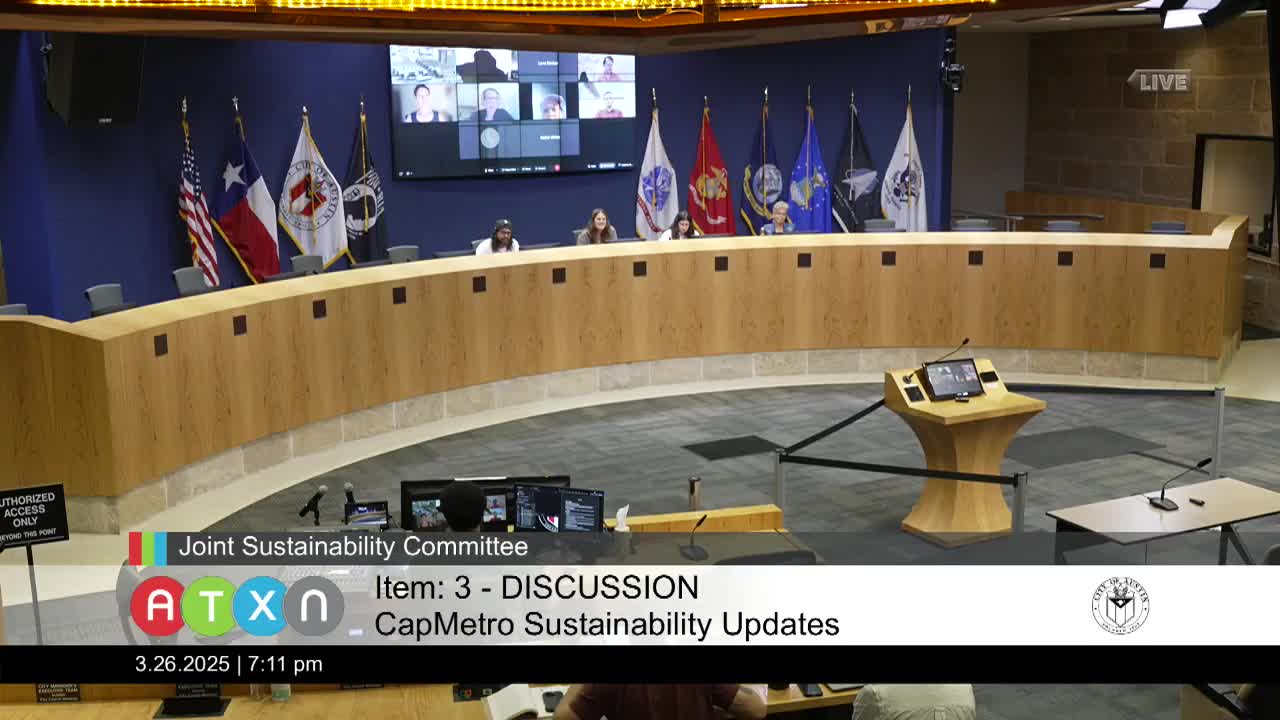
Capital Metro told the Joint Sustainability Committee that it has deployed battery electric buses and is expanding depot and in‑route charging infrastructure, but officials warned technology and supply‑chain limits mean electric buses currently fit only a minority of service routes.
David Carr, director of the zero‑emission vehicle program at Capital Metro, said the agency has 104 battery electric buses — 12 legacy vehicles purchased in 2021 and 92 newer vehicles recently received — and described charging installations at operating yards and on two upcoming Bus Rapid Transit (BRT) lines. Carr said South Operations and North Operations facilities now have or are building chargers and a solar canopy; North Operations will include a 4.35 megawatt solar array and a training pantograph charger due in January 2026. He also described in‑route pantograph chargers (450 kW units) that will be installed on two new MetroRapid routes to opportunistically charge buses during layovers and extend range.
Carr stressed operational constraints: existing battery buses “fit in the duty cycle for about 30% of our routes.” He explained some newer vehicles have different battery capacities (examples cited 440 kWh and 660 kWh packs) and that range varies with temperature, passenger load and route profile. For routes that require longer range, Capital Metro plans to use diesel‑hybrid buses as an interim solution; those hybrids can enable “green zones” where the vehicle runs on battery only in sensitive areas like hospitals and schools.
The agency is also managing vehicle vendor risk. Carr said one supplier, Proterra, declared bankruptcy, and that parts, warranty support and field service are limited; he described a traction‑motor recall and difficulty obtaining replacement parts. Capital Metro is operating New Flyer buses that the agency described as “solid” and said New Flyer vehicles are being placed into service now.
Committee members asked about timing for placing new vehicles into revenue service and whether BRT routes would operate with electric buses when they open. Carr said New Flyer buses are being commissioned now and that in‑route charging infrastructure needs to be completed for BRT service to operate reliably with battery buses. He said some Proterra units have operated in service but that recalls and lack of parts have delayed broader deployment of those vehicles.
Carr also reviewed longer‑term technology considerations, noting hydrogen fuel cells and other technologies are being watched but currently face prohibitive delivered fuel costs and infrastructure challenges; Capital Metro has deferred a hydrogen pilot until around 2030. He and committee members discussed opportunities to coordinate charging infrastructure with other city fleets, but Carr said transit pantograph infrastructure and the scale of bus chargers differ from light‑duty vehicle networks and that cross‑agency co‑location has limited applicability for heavy transit chargers at present.
The briefing outlined near‑term steps: continue placing New Flyer vehicles into service, complete depot and in‑route charging infrastructure for the BRT lines, use hybrid vehicles where battery range is insufficient, and monitor emerging battery, hydrogen and charging technologies before making large additional purchases.