Get Full Government Meeting Transcripts, Videos, & Alerts Forever!
Get email alerts on the Tax Rate Election Policy topic
No spam. Unsubscribe anytime.
City staff propose framework for property tax rate elections; council members press for flexibility and ARPA impact analysis
Summary
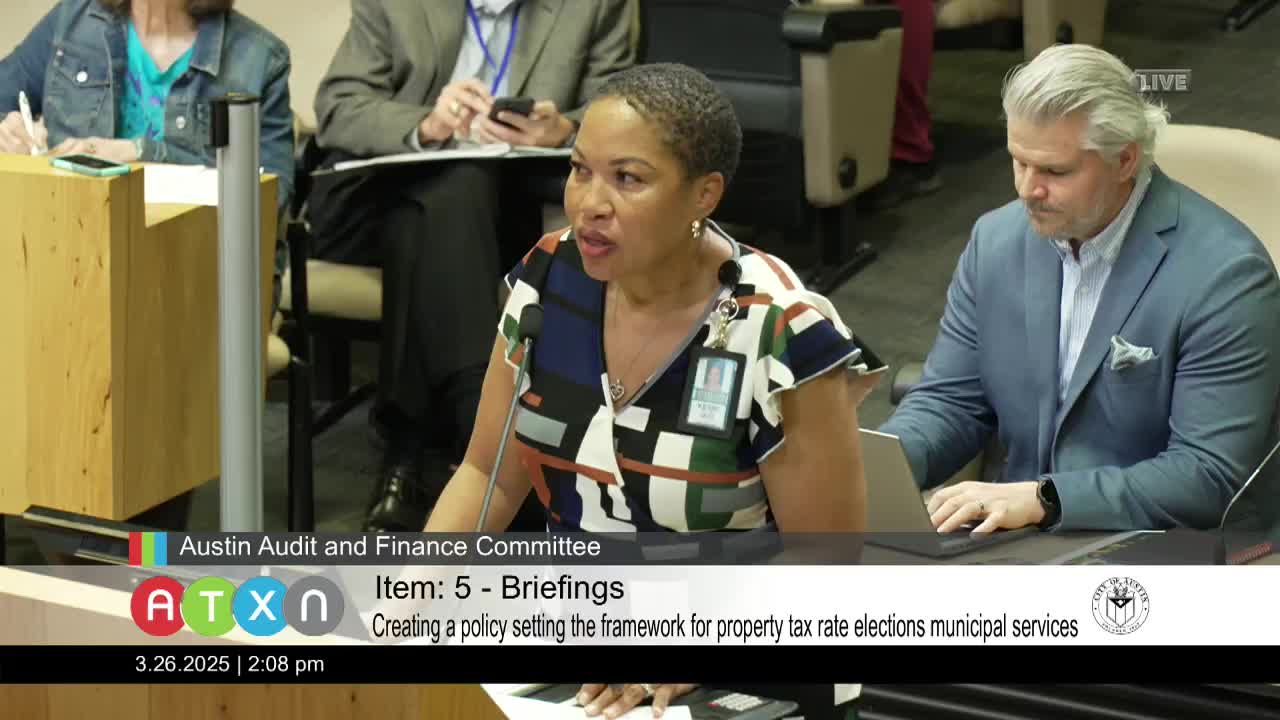
Carrie Lang, director of the Budget and Organizational Excellence Office, presented a proposed framework for property tax rate elections to the Audit and Finance Committee on March 26, recommending multiyear planning and prioritizing new or significantly expanded general fund services.
Carrie Lang, director of the Budget and Organizational Excellence Office, presented a proposed framework for property tax rate elections (TRE) to the Audit and Finance Committee on March 26, urging a holistic, multiyear approach that focuses on new or significantly expanded general fund services rather than offsetting baseline cost drivers.
Key features of staff proposal: Lang said an effective TRE policy should (1) be based on multiyear service planning rather than one‑off requests; (2) ensure the budget process evaluates whether proposed enhancements can be covered with existing increases prior to calling an election; (3) prefer a four‑year minimum interval between TREs to avoid voter fatigue while allowing flexibility for financial emergencies; and (4) include a mix of ongoing and one‑time expenditures to ensure sustainability in later years.
Why it matters: Committee members repeatedly raised the interaction between the TRE framework and recent one‑time federal funding (ARPA), long‑term property tax limits (the 3.5% cap on automatic property tax growth), and service priorities such as homelessness and mental‑health response. Council members asked staff to show how ARPA and recent sales‑tax volatility affected prior years’ decisions and to provide an “apples‑to‑apples” comparison of revenue under a prior 8% cap versus the current 3.5% cap for FY25 and across multiple years.
Council questions and requests: Members pressed for (1) flexibility in the TRE policy so the city can respond to time‑sensitive opportunities (for example, favorable market conditions for rapid rehousing); (2) a more granular breakdown of ARPA spending that distinguishes one‑time versus ongoing costs and what continuing costs will be required to sustain ARPA‑funded programs; (3) scenario modeling that shows manager’s proposed budgets at different tax‑rate levels; and (4) overlap and burden analysis showing how overlapping taxing jurisdictions affect taxpayers’ overall tax burden.
Next steps: Lang said staff will produce memos with the requested analysis — including an ARPA follow‑up showing programs that may create ongoing costs — and return to the committee in the coming months with a draft policy for committee review and, if appropriate, inclusion in the proposed budget cycle.
Ending: Committee members emphasized balancing long‑term planning and flexibility to address urgent needs. Staff said the draft policy will be refined and returned for further committee review before the budget proposal in July/August.