Get Full Government Meeting Transcripts, Videos, & Alerts Forever!
Get email alerts on the Transportation topic
No spam. Unsubscribe anytime.
Joint Sustainability Committee backs Austin Core Transportation Plan with amendments to study two‑way conversions and require protected bike lanes
Summary
The committee recommended the Austin Core Transportation (ACT) plan be forwarded to City Council with amendments to study one‑way to two‑way street conversions, prioritize street trees and require protected two‑way bike lanes on core downtown streets; the recommendation passed by vote.
The Joint Sustainability Committee voted to recommend the Austin Core Transportation (ACT) plan to City Council as amended, endorsing a study of additional one‑way to two‑way street conversions and directing the plan to include protected bike lanes in both directions on core downtown streets.
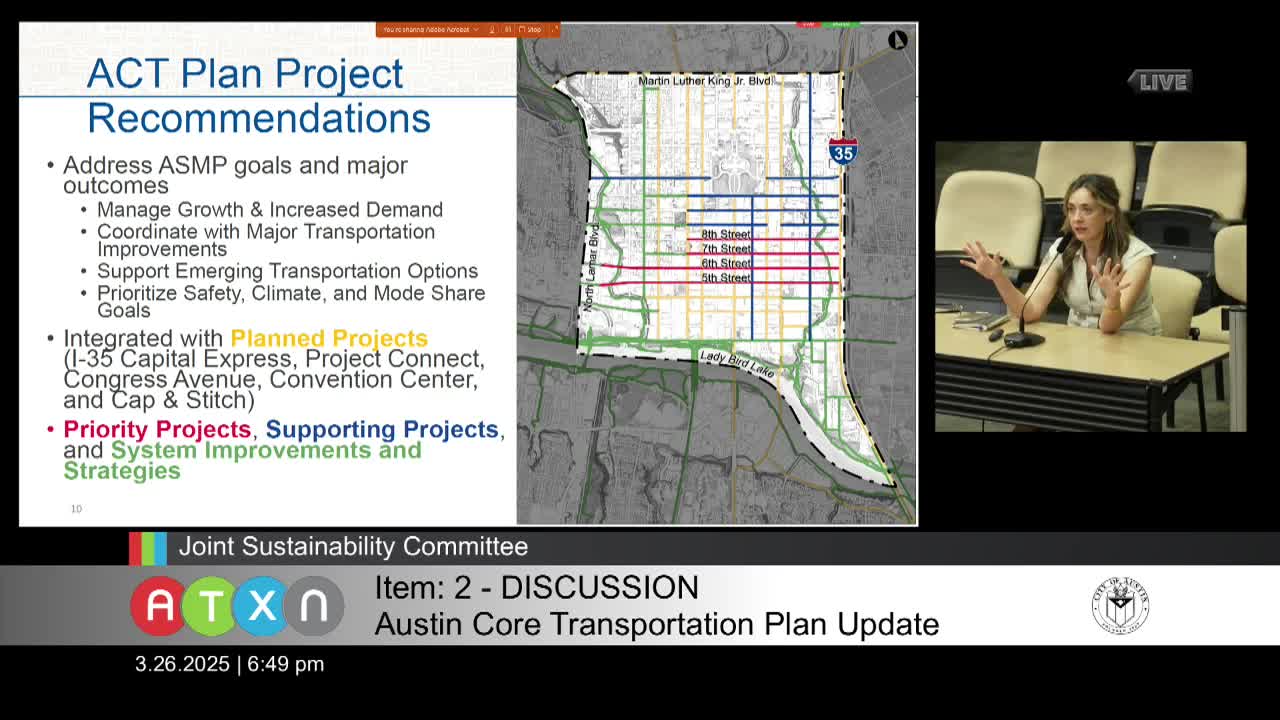
Committee members heard a formal presentation from Michelle Marks, a transportation officer with Transportation Public Works, who described the ACT plan as a “small area mobility plan” focused on downtown rights‑of‑way and multi‑modal allocations. Marks said the draft plan is built on prior studies and public engagement and “we received well over 4,000 public comments.” She described the document as conceptual — “not engineering design plans” — and said it identifies priority corridors (Fifth through Eighth Streets) and outlines cross sections and plan‑level views to guide later engineering and construction.
Public comment included Adam Greenfield of Safe Streets Austin, who told the committee that his group “commend[s] staff for all their great work” and urged converting remaining one‑way downtown streets to two‑way operation, arguing two‑way grids better distribute traffic and support slower vehicle speeds and local businesses. Zenobia Joseph, speaking during public comment, framed downtown transportation items in the context of Title VI of the Civil Rights Act of 1964 and urged the committee to consider equity and historic disinvestment in some neighborhoods when evaluating transit and pedestrian access.
Committee discussion focused on trade‑offs between one‑way and two‑way street systems. Marks and staff noted that one‑way grids allow signal timing progressions that can limit vehicle speeds in tightly spaced downtown grids; she cautioned that conversions are context dependent and require site‑specific engineering. Members proposed and adopted an amendment changing the committee recommendation to direct staff to “explore additional one‑way to two‑way conversions on Fifth Street, Sixth Street and other streets as is feasible and beneficial for pedestrian and bike safety.” The committee also amended the recommendation to explicitly call for protected bike lanes in both directions on core downtown streets and to prioritize street trees.
After amendments were incorporated, the committee voted to approve the recommendation as amended. The committee will forward its recommendation to City Council for consideration later this spring, as Marks said the department anticipates bringing the plan to council for discussion.
The committee’s action does not itself change street design; Marks emphasized the ACT plan is a conceptual allocation of right‑of‑way and that future detailed engineering will determine final lane and curbline layouts and address utilities and other constraints.