Get Full Government Meeting Transcripts, Videos, & Alerts Forever!
Get email alerts on the Extreme Heat Preparedness topic
No spam. Unsubscribe anytime.
City has plans to address extreme heat but lacks measurable targets and sustained funding, auditors say
Summary
An audit found Austin has multiple heat‑resilience plans and progress on some goals, but auditors recommended the city set measurable targets, assign responsibility and secure funding to implement the Heat Resilience Playbook.
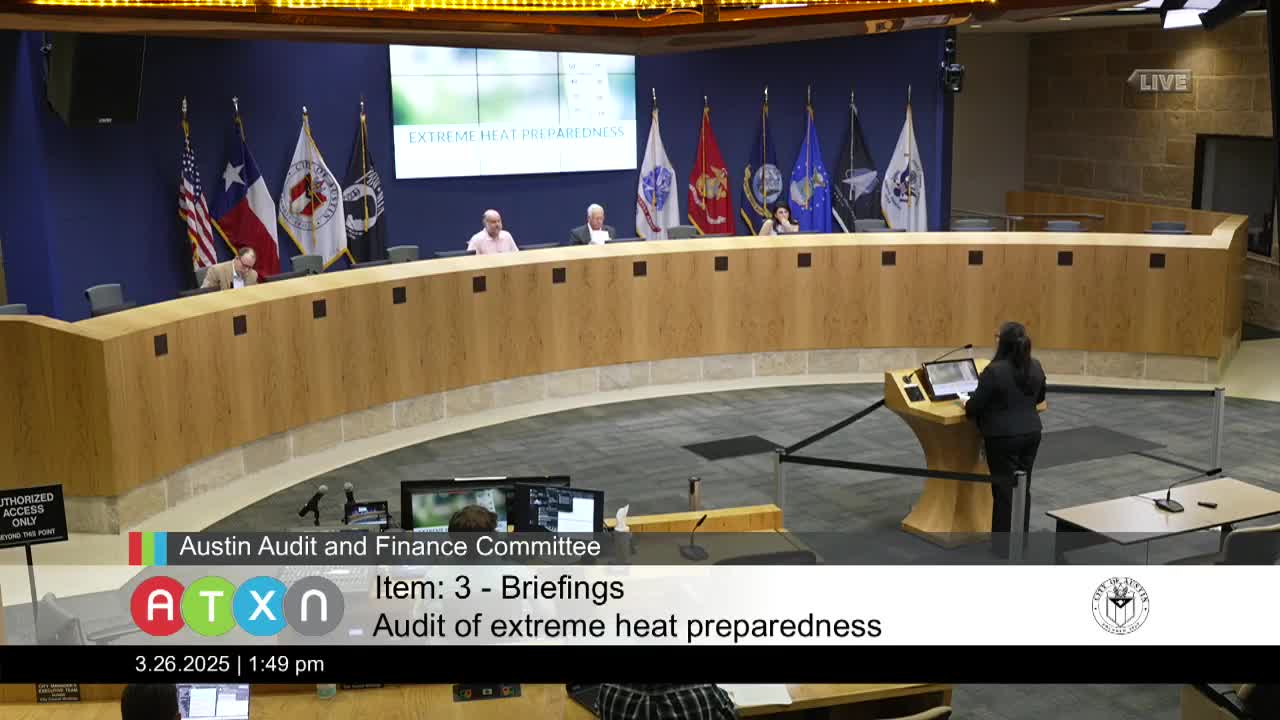
Kendall Byers, presenting for the City Auditor’s Office, told the Audit and Finance Committee on March 26 that the city has a variety of goals, strategies and plans to address extreme heat but faces three main challenges: evaluating progress, coordination and funding.
The audit examined the 2024 Heat Resilience Playbook and other citywide and departmental climate plans. Auditors said the city is making measurable progress on some goals — for example, a recent city canopy assessment (2022) showed canopy coverage near 41% — and staff said the city is ‘‘nearing the 50% canopy goal by 2050.’’ But the auditors found the Playbook is largely aspirational and “does not have measurable targets or timelines for the identified strategies,” making it difficult to monitor progress.
Why it matters: Extreme heat is a growing public‑health threat, and auditors said heat preparedness affects both people and infrastructure. The report compared Austin with 10 peer cities and found similar strategies and shared challenges; Phoenix stood out because it has a dedicated heat office that combines authority and coordination.
Recommendations and city response: The audit recommended the director of the Office of Climate Action and Resilience work with the city manager and departments to (1) prioritize actions in the playbook, (2) assign responsibility for each prioritized action, and (3) tie priorities to measurable targets and funding. Zach Ballmer, director of the Office of Climate Action and Resilience, told the committee the office agreed with the recommendation and is working with the city manager’s chief of staff and a consultant (Resilient Cities Catalyst) to prioritize projects and assign department liaisons and directors to funded actions.
Funding and implementation issues: Auditors said funding tied explicitly to heat resilience is limited and fluctuates; they cited the lack of a comprehensive tree inventory because of funding constraints. The audit urged linking priorities to dedicated funding streams and clearer department ownership to accelerate implementation.
Ending: Committee members asked about worker safety and the office’s coordination role; auditors said the audit focused on long‑term infrastructure impacts, and the City Auditor’s Office has prior work on short‑term responses such as cooling centers. The city director confirmed work is underway to develop prioritized, funded actions with assigned departmental leads.