Get Full Government Meeting Transcripts, Videos, & Alerts Forever!
Get email alerts on the Homelessness topic
No spam. Unsubscribe anytime.
San Antonio releases first annual homeless report; council presses for more prevention data
Summary
City Department of Human Services presented a FY2024 homeless response annual performance and spending report showing 3,372 people counted in Bexar County (2,484 sheltered; 888 unsheltered), a $32.3 million homelessness budget and calls from councilmembers for more upstream prevention data and clearer outcome metrics.
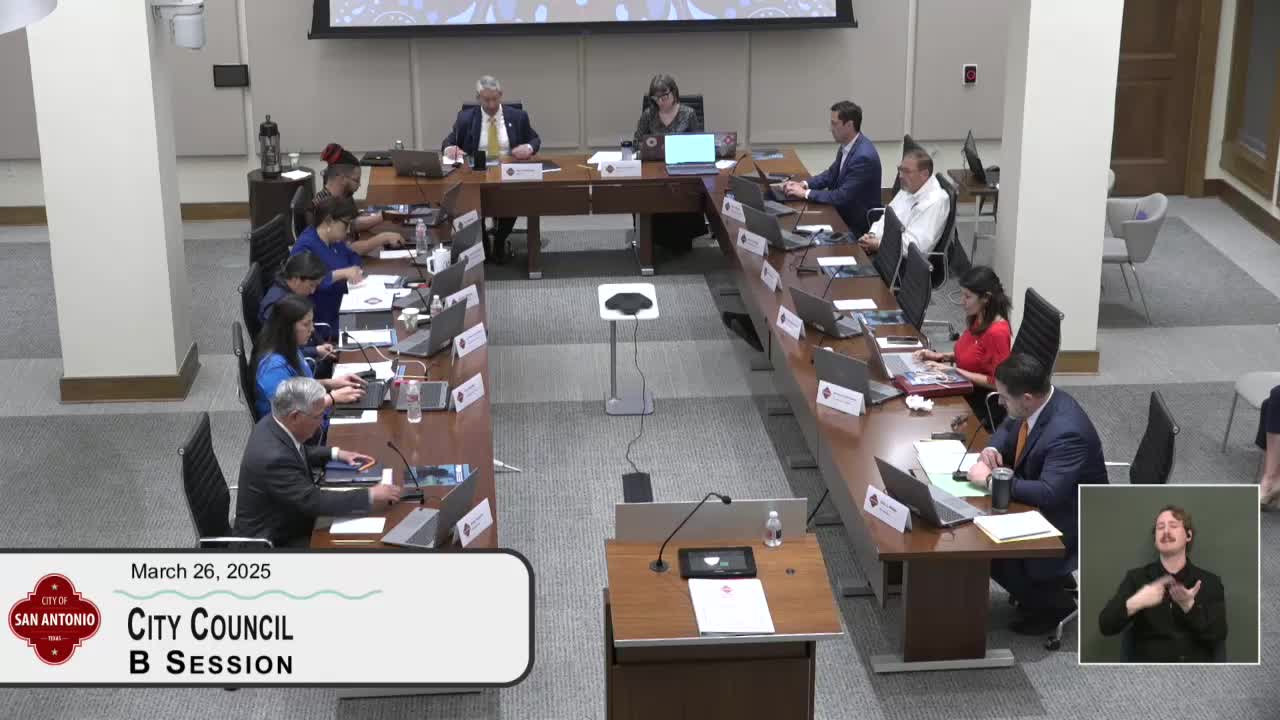
San Antonio Department of Human Services presented the city’s first fiscal year 2024 homeless response annual performance and spending report Tuesday, laying out system inventory, funding sources and outcomes while councilmembers pressed staff for more prevention-focused data and clearer outcome tracking.
The report, delivered by Melody, a Department of Human Services official, summarizes the structure of the coordinated homeless response system, federal and local funding flows and system achievements. It shows the city allocated about $32.3 million to homelessness in FY2024—roughly half from the general fund and half from federal grants—and reports that 2,484 people were sheltered and 888 were unsheltered in the Bexar County point-in-time count in January 2024.
Why it matters: the report is intended to make spending and performance more transparent and to provide a baseline for policy discussion as council and staff consider budget priorities, shelter capacity and prevention strategies ahead of next year’s budgeting cycle.
Melody told the council the FY2024 report “was developed by the Department of Human Services in response to a request from Councilmember White” and that it includes data on system governance, inventory and outcomes. The presentation noted coordination with Close to Home (the lead homelessness agency for Bexar County), Haven for Hope, Salvation Army, Bexar County, United Way and the Texas Department of Housing and Community Development.
The report shows San Antonio’s total point-in-time count in January 2024 was 3,372 people (2,484 sheltered; 888 unsheltered), an overall increase of 6.8% over 2023. Melody and staff emphasized that, when adjusted for population growth, the city’s per-capita homelessness rate has remained relatively flat since 2015. The presentation highlighted four programmatic areas: low-barrier shelter expansion (including a two-year ARPA-funded expansion of a Sam Ministries non-congregate shelter from 45 to 180 rooms), development of permanent supportive housing (PSH) units, coordinated outreach and data and communications work that supports a public dashboard.
Melody summarized the city’s FY2024 spending and balances: “The adopted budget included 32,300,000 to address homelessness about half from the general fund and half from federal grants. 12,000,000 of those grants are from COVID grants. 28,800,000.0 was expended during the fiscal year. The unexpended balances of 3,500,000.0 are primarily from multi year federal grants, and we are able to roll those dollars forward so that the nonprofits can continue their work.” The report also lists indirect costs—about $20 million—used as an estimate of police and fire responses related to homelessness.
Councilmembers broadly praised the transparency the report provides but repeatedly asked for more granular data linking causes of homelessness to outcomes and for clearer measures of success. Councilmember Mickey Rodriguez asked what data are collected on people who return to homelessness; Melody replied that providers use the HMIS intake form and the point-in-time survey to capture reasons and that “there is data that we can . . . run.” Several councilmembers requested a staff-produced analysis mapping reasons people enter homelessness (for example economic shocks, eviction, mental health, substance use or aging out of foster care) to the city’s interventions.
Councilmember White urged the council to define a clearer objective measure of success beyond point-in-time counts, saying the city must track whether people move into self-sustaining living situations. Other members pressed for more information on prevention investments—rental assistance, minor/major home rehab and eviction diversion—and asked staff to show evidence that those investments are reducing inflow to homelessness.
Staff reported system upgrades intended to support that work: a public dashboard launched in April 2024 that is updated monthly with HMIS-based flow data; centralized shelter coordination with Haven for Hope that enabled outreach workers to place 500 people into shelter beds last year; a small skilled-nursing pilot that connected three clients to 24-hour skilled nursing while benefits enrollment completed; and an opioid-settlement–funded RFP to expand treatment access for unsheltered clients.
No formal votes or ordinance changes were taken during the presentation. Instead, councilmembers directed staff to provide additional analysis and reporting: several asked for an analytic report on reasons for homelessness by demographic group, a status update on housing inventory and pipeline, and clearer tracking of outcomes tied to the city’s five-year homelessness strategic plan.
The session closed with multiple councilmembers stressing prevention. Melody and staff said they will continue monthly dashboard updates and will work with Close to Home and Haven for Hope to extract HMIS reports for council requests.
Community and funding context: the presentation identified ARPA and COVID relief funds as major short-term resources supporting shelter capacity and noted reliance on HUD grants, vouchers and state partners for long-term housing. Staff emphasized that several programs—permanent supportive housing through the Neighborhood Housing Services Department, outreach and centralized shelter coordination—are intended to reduce unsheltered homelessness and increase exits to stable housing.
Looking ahead: staff listed FY2025 priorities that include rebranding the hotline to Community Connections, expanding prevention, supporting NHSD to add PSH units, responding to encampments within two weeks, and issuing an RFP to expand opioid treatment access. Councilmembers asked for follow-up briefings and more outcome-oriented metrics to guide budget decisions.