Get Full Government Meeting Transcripts, Videos, & Alerts Forever!
Get email alerts on the Education topic
No spam. Unsubscribe anytime.
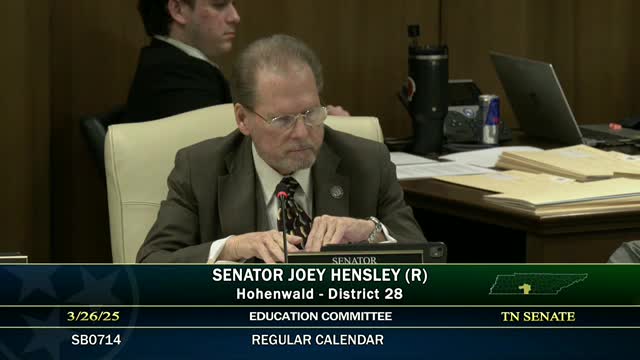
Senate Education Committee advances dozens of education measures; tense debate centers on Memphis school intervention
Summary
The Senate Education Committee advanced a slate of bills on Oct. 27 and sent several measures to the finance or calendar committees. The most contentious item — a measure that would authorize state intervention in chronically underperforming districts, including possible removal of school-board members — passed 8–1 after hours of public testimony.
The Senate Education Committee advanced a slate of education bills on Oct. 27, moving measures on higher-education scholarships, campus and K–12 protections, school safety, and athletics policy to later stages while a contentious proposal that would allow state intervention in chronically underperforming districts — including steps that could replace school board members and expand education savings accounts — drew hours of public testimony and passed by an 8–1 margin.
The committee’s longest debate centered on Senate Bill 7 14, carried by Senator Jeff Taylor, which would define "challenged" school districts and authorize the commissioner of education, with the state board’s concurrence, to recommend removing one or more school-board members and, in some circumstances, allow county commissions to appoint replacements. The bill also would expand eligibility for education savings accounts for students in qualifying districts by removing an income cap and would ease pathways for charter schools in those districts. The committee approved the measure 8–1.
"This system has got to have intervention or the data that I just read will only get worse," Senator Taylor said, arguing the measure targets districts with persistent low performance and frequent leadership turnover.
Why it matters
The measure prompted extended public testimony from community members, teachers and parents in Memphis and Shelby County, who gave sharply divergent views: some urged local solutions and opposed state takeover, saying local voters should remain in charge; others asked the Legislature to authorize stronger state intervention, saying long-term academic and operational problems have not been solved locally. Testimony included parents and students who said campus climate and safety concerns have worsened in other contexts, while local advocates warned a state intervention would disenfranchise voters.
Key votes and moves
- Senate Bill 7 14 (Taylor) — proposal to authorize state-directed intervention in chronically underperforming districts: Committee approval, moves to finance, recorded vote 8 ayes, 1 no.
- Senate Bill 13 87 (WGU Tennessee eligibility for Ben Atchley Opportunity Scholarship, Sponsor: Senator Watson) — committee approved and moved to finance, unanimous 9–0 vote. Lou Hanneman of the Tennessee Higher Education Commission told the committee that the change could put about 1,200 students into the Ben Atchley grant category if no additional appropriation were attached, and that the base Tennessee Student Assistance Award (TSAA) is about $2,000 per student.
- Senate Bill 12 09 (anti‑Semitism coordinator at K–12 and higher education, Sponsor: Senator Rose) — committee approved and moved to calendar, unanimous 9–0 vote. Supporters said the bill would integrate the IHRA working definition of antisemitism into codes of conduct and require Title VI coordinators at K–12 and higher-education institutions; witnesses described on‑campus harassment and argued the change would strengthen harassment response and reporting.
- Senate Bill 9 37 (limits on pronoun/name policies in public schools and employers, Sponsor: Senator Rose) — committee approved and moved to calendar, recorded vote 8 ayes, 1 no. The amendment adopted narrowed which entities are covered but preserved a private civil cause of action for certain violations in the text considered by the committee.
- Senate Bill 16 (student-athlete transfers / TSSAA alignment, Sponsor: Senator Lowe) — committee adopted amendments reflecting recent rule changes approved by the Tennessee Secondary School Athletic Association (TSSAA) and the committee sent the amended measure to calendar; the tally on the final vote reflected a 6–3 vote in committee.
- Senate Bill 270 (Universal Pre‑K Funding Act, Sponsor: Senator Oliver) — the bill did not receive a second on the committee floor and therefore did not advance.
Other bills moved to finance or calendar
The committee also moved a number of other measures with relatively little debate. These include bills that: - expand universal screening and literacy reporting on report cards; - permit the Department of Education to post and host fundraising-receipts reports for school-associated organizations; - continue the pilot mobile panic-alert program for schools and create a school safety alert fund (subject to appropriation); and - permit local taxing authorities to account for certain maintenance-of-effort and budget-reporting requirements.
What committee members and witnesses said
- On higher-education aid: Lou Hanneman of the Tennessee Higher Education Commission and Student Assistance Corporation said the TSAA account is "currently oversubscribed by students," and that designating WGU Tennessee for the Ben Atchley Opportunity Scholarship would make WGU students eligible for an additional $2,000 award category under current statutory structure unless the Legislature provides additional appropriation.
- On campus antisemitism: David Soffer of the Combat Antisemitism Movement and Jason Debner, a student who testified about experiences at another state's campus, urged the committee to adopt stronger institutional reporting and Title VI coordination. Debner said, "Never again is not just a phrase from history, it is a responsibility in the present."
- On athletics and transfers: Mark Rees, TSSAA executive director, and Rick Colbert, TSSAA general counsel, asked the committee not to codify eligibility rules into statute. Rees said the association "would respectfully urge this committee to vote no" on legislation that would move transfer eligibility rules from the association’s bylaws into state code, warning that such a change could invite litigation and inconsistent court rulings because judges would be asked to interpret eligibility standards across many local cases.
- On the pronouns bill and school climate: multiple witnesses and students testified on both sides. Damian Alexander Buglio, a Nashville educator, testified in opposition to SB 9 37, saying the measure would "dismantle" protections for transgender students and staff and worsen school safety for LGBTQ+ students. Senator Rose and other legislators said the bill’s purpose is to protect employees and students when pronoun usage conflicts with biological sex as defined in law and to define the applicable disciplinary standards.
Votes at a glance (selected items)
- SB 7 14 (Taylor) — State intervention/"challenged" districts: Passed committee; moves to finance — Vote: 8–1 - SB 13 87 (Watson/WGU) — WGU eligible for Ben Atchley Opportunity Scholarship: Passed committee; moves to finance — Vote: 9–0 - SB 12 09 (Rose) — Title VI coordinator / IHRA definition for campus antisemitism: Passed committee; moves to calendar — Vote: 9–0 - SB 9 37 (Rose) — Pronoun/name policies and civil cause of action (amended): Passed committee; moves to calendar — Vote: 8–1 - SB 16 (Lowe) — Student-athlete transfer changes (align with TSSAA rules; amended): Passed committee; moves to calendar — Vote: 6–3 - SB 270 (Oliver) — Universal Pre‑K Funding Act (privilege tax proposal): Did not receive a second on the floor; bill died in committee
What to watch next
- The most consequential items will next proceed to the finance committee (including the WGU scholarship eligibility and the plan to transition the Achievement School District) or the Senate calendar. The Memphis/Shelby County intervention plan now goes to finance where budget and implementation questions will be key; opponents in testimony stressed local control and due process, while supporters argued the existing local avenues have not achieved turnaround in the district.
Ending
Committee members and numerous outside witnesses said they expect further debate in the coming weeks as finance, calendar and other committees take up the measures the Senate Education Committee advanced. The committee also scheduled several study committees and directed agencies to develop guidance or reports that could shape follow-up legislation.