Get Full Government Meeting Transcripts, Videos, & Alerts Forever!
Get email alerts on the Public Funds Investment Rules topic
No spam. Unsubscribe anytime.
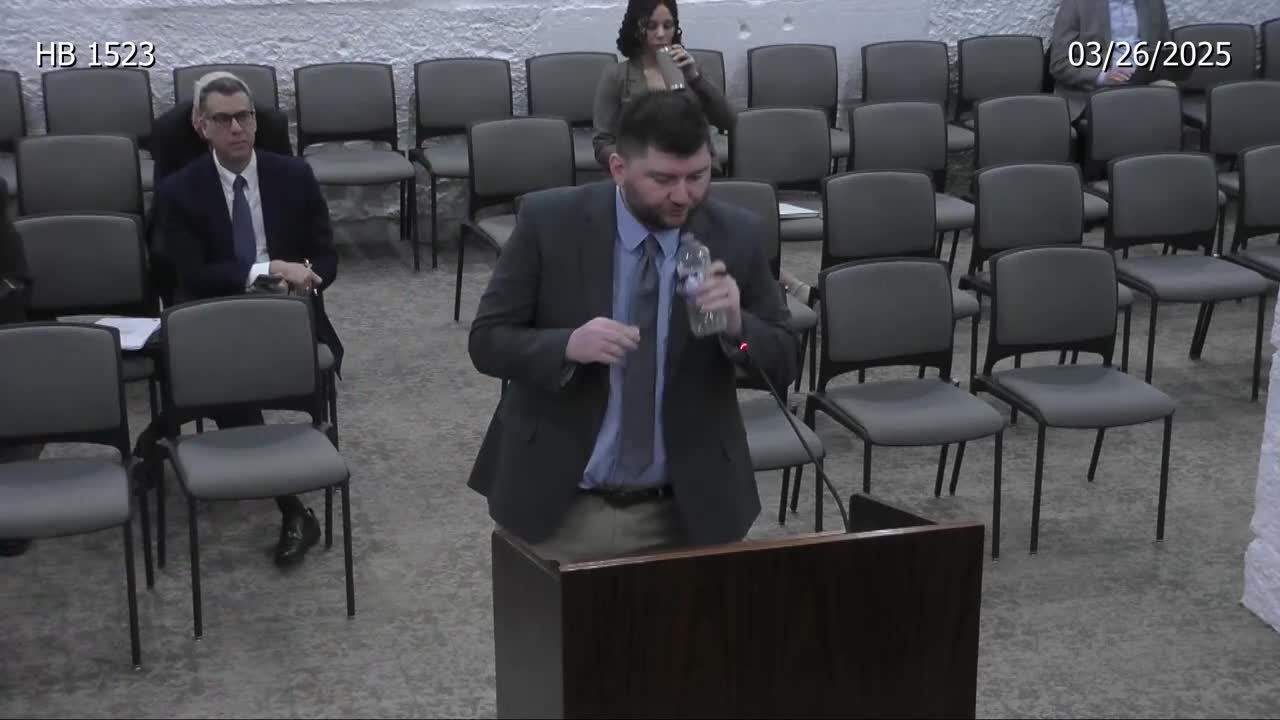
House Bill 15‑23 prompts debate over local units’ ability to invest public funds outside jurisdiction
Summary
House Bill 15‑23 would expand when and where local units can place insured certificates of deposit, retroactively protect certain investments made since 2018 from audit exceptions, and allow counties limited geographic expansions; bankers and the treasurer’s office offered differing views on scope and risk.
Lawmakers heard lengthy testimony and discussion on House Bill 15‑23, legislation that would change where local units of government may place insured public deposits and would retroactively deem certain out‑of‑territory investments lawful.
Representative Pierce, the bill sponsor, told the committee the measure would give counties, school corporations and library districts more flexibility to seek higher yields on insured certificates of deposit. Pierce said current law requires local units to invest in institutions with a brick‑and‑mortar presence inside the unit’s geographic boundary and that the bill would allow some units to use institutions located elsewhere in the county or, for counties, in contiguous counties. The bill also contains a provision intended to retroactively protect investments made since 2018 from audit exceptions tied to an earlier change in state law.
Mike Neal, executive director of the Indiana Board for Depositories and a staffer for the treasurer’s office, described the board’s role as insurer of public funds above FDIC coverage. Neal said the state fund stood at about $341,000,000 and the board has bonding capacity of roughly $300,000,000; he also said the board’s policy role is to implement whatever territorial limits the General Assembly establishes.
Testimony showed disagreement over how widespread out‑of‑territory investments had been. Baker Tilly and the Indiana Library Federation testified that the 2018 change produced a common interpretation that some local units could shop statewide and that a number of entities acted on that view; witnesses offered differing estimates of how many units are affected. Mark Schublak (Baker Tilly/Indiana Library Federation) and Scott Bowling (Indiana Association of School Business Officials) said many units acted in good faith under that understanding and urged retroactive protection to avoid audit exceptions.
Opponents and skeptics—including the Indiana Bankers Association and several county and city representatives—said the bill risks moving deposits away from local banks, which use those deposits to fund local loans and services. Dax Denton of the Indiana Bankers Association said current law permits cities and towns an exemption that lets them use banks statewide; other political subdivisions generally must prefer institutions inside their political boundaries unless they have no local brick‑and‑mortar institutions or meet other triggers. Denton asked for clearer statutory triggers governing when units may expand the geographic reach of solicitation for bids.
Witnesses also asked for technical clarifications in the bill text. Panelists requested explicit language limiting the change to certificates of deposit and asked the committee to clarify whether “invest” and “deposit” references apply differently to checking accounts versus term investments. Several speakers urged specifying that contiguous‑county provisions apply to Indiana counties only.
The treasurer’s and bankers’ representatives expressed different positions on the bill’s contingencies and the scope of retroactivity. Representative Pierce said the treasurer’s office had identified about a dozen entities with out‑of‑territory investments but other witnesses estimated a larger number; the sponsor said even a single instance of uninsured out‑of‑territory investment warranted legislative clarification.
Multiple stakeholders said they would continue technical work with the sponsor; committee leaders said they would not move the bill in the current hearing and expected a future amendment to address outstanding drafting and policy issues.
No formal committee vote on the bill occurred during the hearing.