Get Full Government Meeting Transcripts, Videos, & Alerts Forever!
Get email alerts on the Education Policy topic
No spam. Unsubscribe anytime.
Senate committee debates wide-ranging amendments to education deregulation bill; several amendments fail, bill advanced
Summary
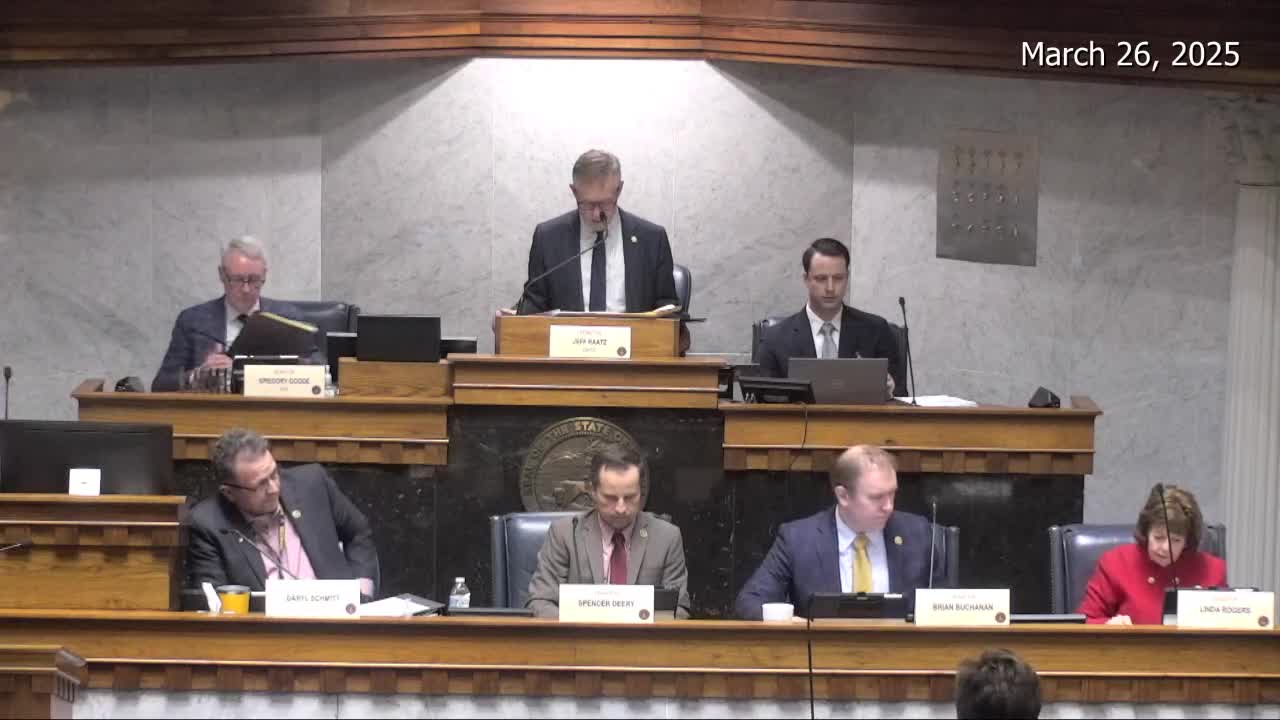
The Senate Education, Career and Development Committee spent its March 26 meeting considering numerous amendments to House Bill 1002, a broad Title 20 education deregulation bill; the committee adopted several amendments and advanced the bill to Appropriations, voting 8–4 to recommit it.
The Senate Education, Career and Development Committee spent much of its March 26 meeting debating amendments to House Bill 1002, a broad Title 20 education deregulation measure that the committee will recommit to the Appropriations Committee after passing on an 8-4 vote.
The bill’s sponsor in committee presented the measure as a cleanup and deregulation package covering dozens of code sections. Senators offered and debated more than a dozen amendments addressing topics including school facility planning, automated external defibrillators (AEDs) at practices and events, charter authorizer location, charter-board transparency, fees for non-curricular supplies, and removal of social-emotional learning (SEL) and trauma-informed-care (TIC) language.
The most prominent early amendment was offered by Senator Fadi Cadora. Amendment 20 would have required the Department of Education to conduct needs assessments on school buildings, asking the agency to collect and publish counts of students, charter, private and traditional public schools within districts before new buildings were approved. Cadora said the measure was intended to inform fiscal decisions and avoid duplicative building that raises overhead for school operations. The committee called the roll and the amendment failed (4 yes, outcome: failed). Senator Cadora spoke in favor; the bill sponsor opposed the amendment on cost grounds.
Senator Linda Rogers secured an amendment (No. 30) to require operational AEDs and site-specific action plans at athletic practices and events; the committee accepted that amendment by consent. Rogers said the change reset language from a prior 2023 Senate bill and moved a “may” to a “shall” so all schools would keep AEDs on site and maintain plans for student medical emergencies.
Senator Cadora also proposed an amendment (No. 21) to require that a charter-school authorizer be located in the same county or geographic area as the proposed school. He said local authorizers would strengthen community relationships; the sponsor of HB1002 argued against a county-residency requirement for authorizers. The amendment failed on a roll call (4 yes, 9 no).
Cadora later offered Amendment 22 to require charter schools to report board composition and selection practices; he described it as a first step toward making charter boards elected in the future. The committee defeated that amendment after debate and a roll call vote.
Senator Rogers later proposed Amendment 29 to allow school corporations or charter organizers to assess a reasonable fee for supplies and materials that are not defined as curricular materials in statute. Rogers said the change would clarify ambiguity for school districts about what they may charge families. Several colleagues voiced concern that the amendment’s “reasonable fee” language was vague and could reintroduce cost burdens for families; opponents asked for clearer definitions or examples. The committee approved Amendment 29 by roll call (9 yes, 4 no).
Senator Burn offered Amendment 32 to repeal codified social-emotional learning (SEL) and trauma-informed-care (TIC) requirements from the code, arguing teachers are not trained therapists and those mandates distract from core academics. Senators JD Ford, Andrea Hundley and others spoke against removing SEL/TIC, citing evidence they can improve academic and mental-health outcomes. The committee adopted Amendment 32 (8 yes, 4 no).
Other amendments were offered across the hearing: Senator Goode proposed language tied to local oversight of county funds for school facilities (accepted by consent); Senator Ford sought several amendments addressing secretary-of-education qualifications and residency (Amendments 25 and 26), both of which failed by roll call; and Senator Rotz placed a multi-part amendment (No. 34) that restored several provisions removed by the House and adjusted transfer and governance language; the committee accepted that motion and then moved the bill as amended.
After the amendment process, senators voted to move HB1002 as amended and recommit it to the Appropriations Committee. On the final recorded roll call the bill passed committee, 8 to 4. Senators who repeatedly voted in favor during roll calls included Ford, Kidora, Yoder and Hundley in some tallies; several amendments passed or failed along similar partisan splits during the lengthy hearing.
Why it matters: HB1002 touches many routine and consequential policy areas in K–12 and charter governance, from equipment and emergency readiness at school events to the role and oversight of charter authorizers and boards. Committee action means the bill will next be considered with appropriation implications; senators repeatedly flagged potential fiscal impacts for the Department of Education and local school corporations.
Discussion vs. decision: Much of the committee’s work was amendment-level debate. The committee distinguished discussion-only remarks (policy rationales, local concerns and requests for more study) from formal outcomes: several amendments were adopted (including AED and reasonable-fee language) while others were defeated. The final committee decision advanced the bill to the budget committee with an 8-4 vote.
Quotes from the hearing (selected): "All what this amendment does, ask the DOE ... to evaluate the number of students in each district so that they can tell us how many charter schools, how many private schools, how many public schools are in that district," said Senator Fadi Cadora during debate on Amendment 20. "There is absolutely no intent to take away any funding for curricular materials," said Senator Linda Rogers while explaining Amendment 29. "It improves academic performance. It enhances their mental health. It builds stronger relationships," said Senator JD Ford in opposition to removing SEL and TIC.
Next steps: HB1002 as amended will be recommitted to the Appropriations Committee for consideration of fiscal impacts and possible inclusion in the budget process.
Sources: Committee debate and roll-call votes recorded in the March 26 committee transcript.