Get Full Government Meeting Transcripts, Videos, & Alerts Forever!
Get email alerts on the Energy Transmission topic
No spam. Unsubscribe anytime.
Committee hears competing views on SB 355 to narrow utility right of first refusal for transmission projects
Summary
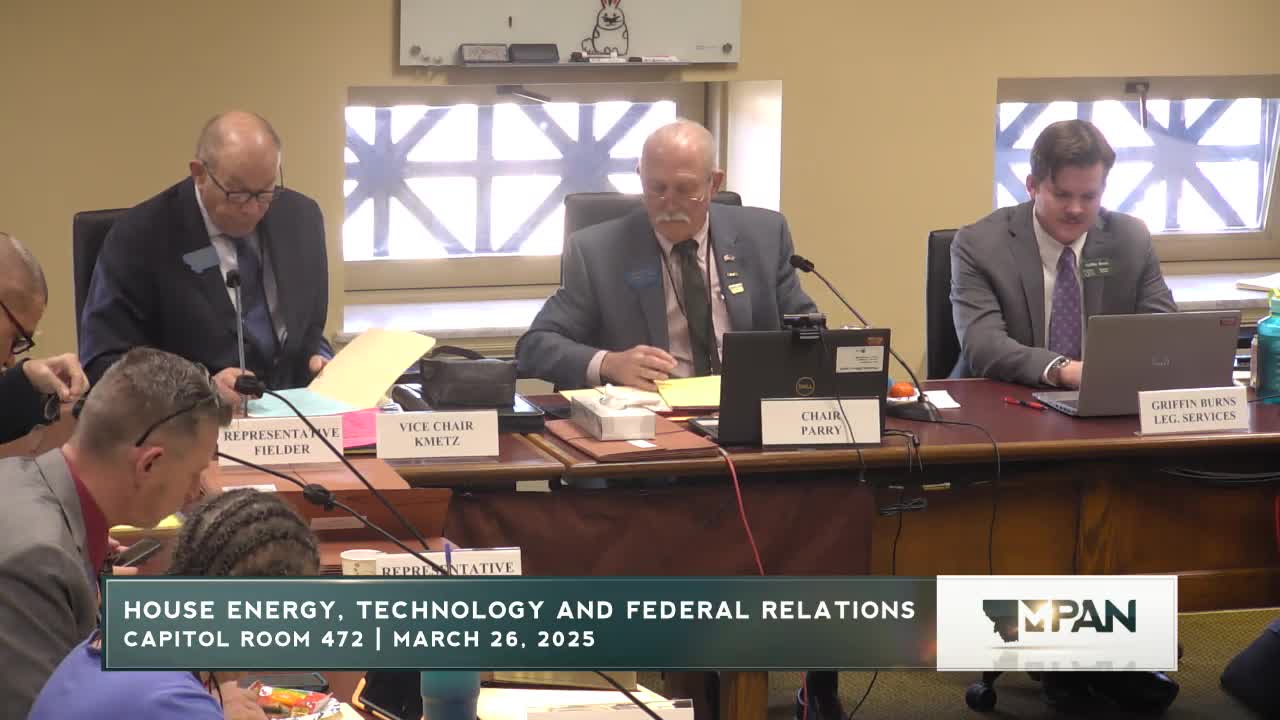
The House Energy Committee heard testimony for and against Senate Bill 355, a measure that would remove right-of-first-refusal protection for public utilities regulated by the Montana Public Service Commission while preserving it for electric cooperatives and requiring competitive bidding for major transmission projects.
The House Energy Committee on (hearing date not specified) heard testimony on Senate Bill 355, which would remove right-of-first-refusal (ROFR) protections for public utilities regulated by the Montana Public Service Commission while preserving those protections for electric cooperatives and creating a competitive-bid process for large transmission projects.
Sponsor Wiley Galt, a senator from Central Montana, described SB 355 as a compromise intended to preserve ROFR for cooperatives while opening competition on other transmission projects. He said the bill arose from prior debate over a broader repeal and aimed to address concerns from co-ops by retaining some building and ownership protections for them.
The bill would require incumbent electric utilities to conduct a competitive bidding process for transmission projects valued at $8,000,000 or more; awarded bids would have to meet incumbent utility standards for design, construction and materials, and the incumbent utility would assume ownership and maintenance responsibilities upon completion, supporters said.
Opponents, including counsel for Montana-Dakota Utilities, urged the committee to preserve the existing ROFR. Mike Green, an attorney with Carlyle Fleck representing Montana-Dakota Utilities, said the statute enacted in 2017 still serves the state’s needs. "We rise in opposition to the bill mostly because the the reasons for having right of first refusal on the transmission system exist today just like they did in 2017," Green said, adding that Montana-Dakota and federal entities such as the Western Area Power Administration have local personnel and experience necessary to maintain reliability in remote eastern Montana.
Green warned that excluding Montana-Dakota from ROFR could lead to multiple, disparate owners of interconnected transmission facilities and hurt system consistency. "You wanna have a consistent application," he said. "The transmission system functions as a single system."
Proponents argued the bill balances competition with reliability safeguards. Mark Lambrecht, director of government relations for the Montana Electric Cooperatives Association, described SB 355 as a response to concerns that a strict ROFR can be anti-competitive. "Senate Bill 355 was drafted to explicitly declare a competitive bidding process must be conducted by the incumbent electric utility for transmission projects valued at $8,000,000 or more," Lambrecht said, and he emphasized the bill requires awarded bids to meet utility standards and for the incumbent to assume ownership and maintenance.
Henry Kriegel, deputy state director for Americans for Prosperity, urged committee members to support the bill, saying it "promotes free market competition, can reduce costs for consumers, can ensure efficient infrastructure development." Anne Hedges of the Montana Environmental Information Center also backed the measure, saying competition has helped transmission projects get built at lower cost and pointing to past cases in which non-regulated entities built major transmission lines in Montana.
John Malia of LS Power testified as an informational witness, calling SB 355 a compromise, and David Herbst of Americans Powerplay voiced brief support.
Committee members asked about local impacts and future projects. Representative Kametz asked whether the measure would affect projects near Miles City; Mike Green replied that, at present, Montana-Dakota had no transmission additions in the pipeline that would trigger ROFR, but he maintained that local operations and rapid access to crews in eastern Montana are important to reliability. Representative Joy and others asked about the bill’s origins; the sponsor said discussions included the Senate energy chair and input from industry parties that have testified on related legislation.
No formal committee vote on SB 355 was recorded in the transcript. The hearing concluded without final action recorded in this transcript.
The testimony laid out the core trade-offs at issue: advocates said the bill introduces competition for major projects and potential cost savings, while incumbents warned removing ROFR risks fragmenting ownership and weakening the ability to respond quickly to outages in remote areas.