Get Full Government Meeting Transcripts, Videos, & Alerts Forever!
Get email alerts on the Healthcare Workers Comp topic
No spam. Unsubscribe anytime.
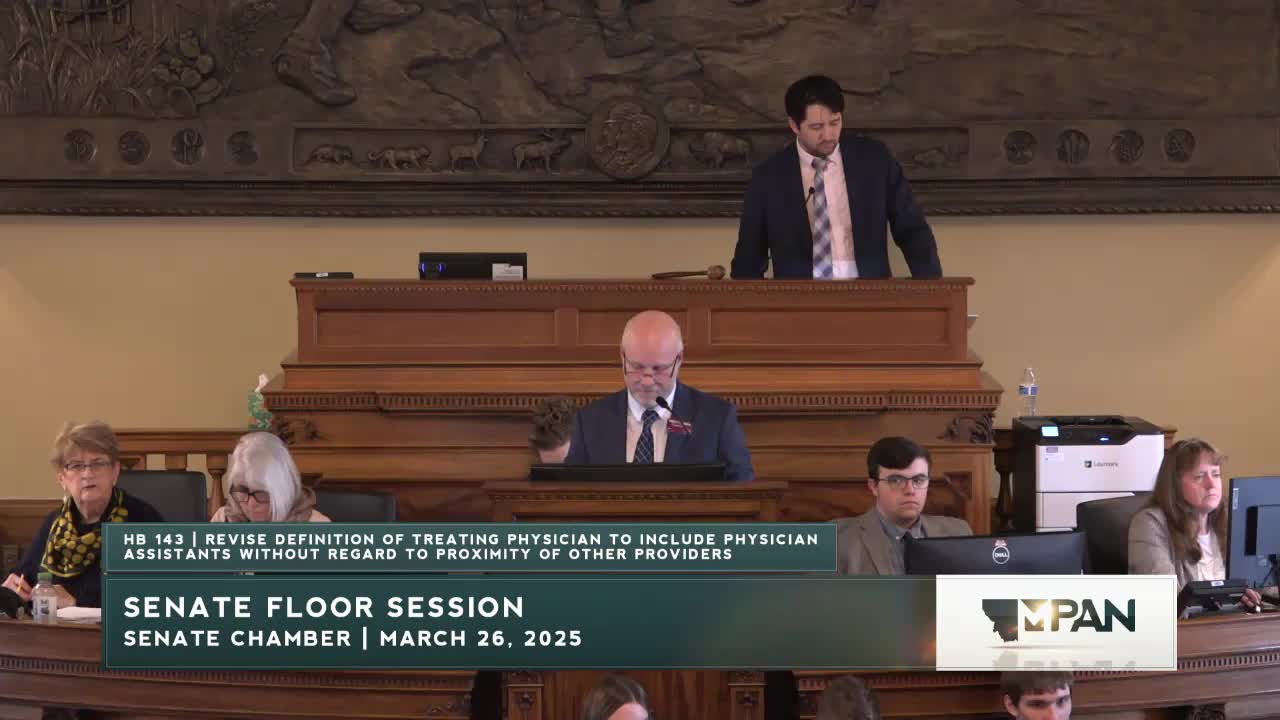
Senate concurs in bill allowing physician assistants to serve as treating physicians in workers' comp claims
Summary
The Senate concurred in House Bill 143, which expands the definition of treating physician under the Montana Workers' Compensation Act to allow physician assistants to serve in that role, sparking questions about PA training and prescribing authority.
The Senate concurred in House Bill 143 after floor debate focused on the scope of physician assistant practice and prescribing authority.
Senator Lehi introduced the bill as a cleanup to last session’s changes on independent practice for physician assistants, saying the measure "allows licensed physician assistants to serve as treating physicians in workers compensation claims regardless of the presence of another provider in the local area." He explained that without a treating physician a claim cannot advance and an injured worker’s medical treatment can be delayed.
Senators queried what functions physician assistants already perform and whether they can write prescriptions. In response, a floor participant identified in the transcript as Carrier confirmed PAs can prescribe and noted supervisory and experience rules discussed later by Senator Hertz: PAs with fewer than 8,000 hours must have a supervision agreement on file with the Board of Medical Examiners, and controlled substance prescribing has statutory limits that were described on the floor.
Senator Hertz and others emphasized statutory supervision and prescribing limits while sponsor supporters said the bill expands access to treating physicians in the workers' compensation system. The Senate concurred in House Bill 143 on a recorded vote of 44‑6.
Ending: The bill narrowly changes who may be designated a treating physician in workers' compensation claims; the transcript shows the floor debate centered on existing PA authority and statutory supervision requirements rather than creating new prescribing privileges.