Get Full Government Meeting Transcripts, Videos, & Alerts Forever!
Get email alerts on the Public Safety 911 topic
No spam. Unsubscribe anytime.
Committee hears cleanup and technical changes to Montana 9-1-1 statewide plan
Summary
House Bill 538 would add a Montana chapter NENA representative to the statewide 9‑1‑1 advisory council, allow call volume as an allocation factor when data becomes available, and makes technical updates; proponents stressed no change in the per-line fee and described procurement of a new statewide emergency services IP network.
Representative Melissa Nikolicakos brought House Bill 538 before the Senate State Administration Committee as a largely technical cleanup to Montana’s statewide 9‑1‑1 plan.
"This is a simple cleanup bill for our 9‑1‑1 statewide plan," Representative Melissa Nikolicakos said, describing the bill as updating language, adding a Montana chapter National Emergency Number Association (NENA) member to the advisory council and "cleaning up some numbers and dates." The bill makes no change to the dollar per phone-line fee, she said, and would add call volume as an allocation factor when the state can reliably collect that data.
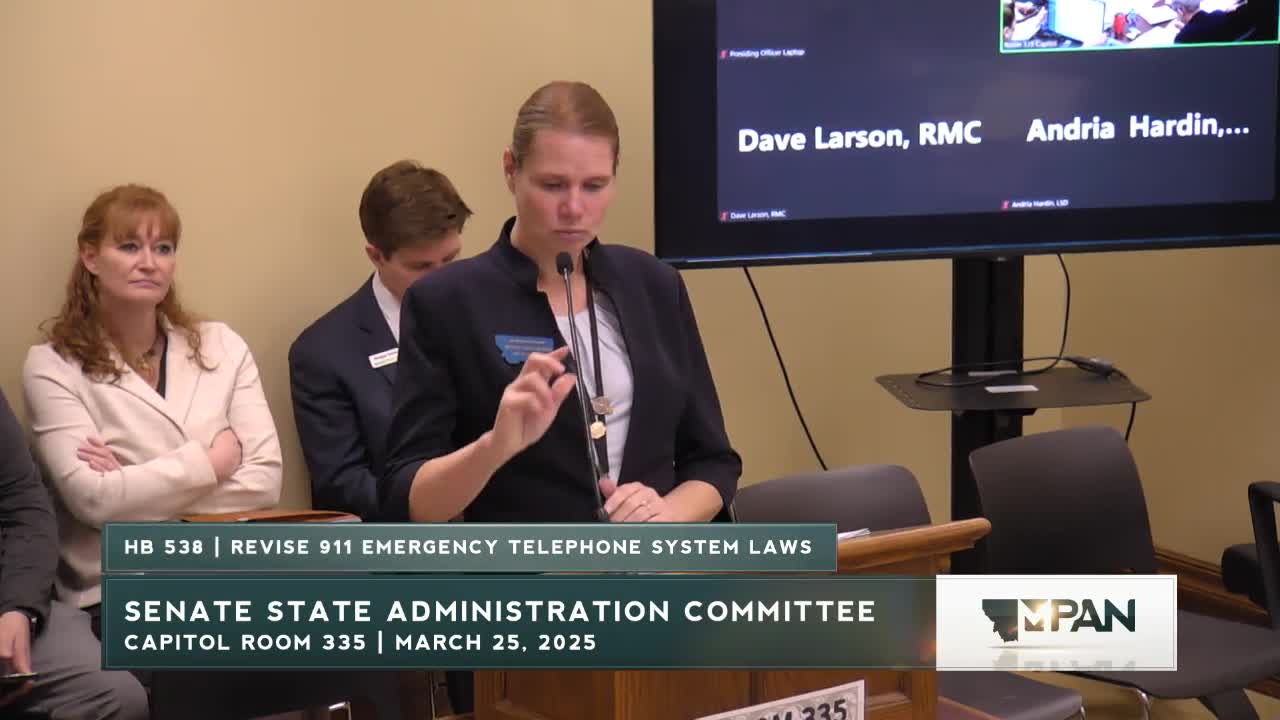
Laura Schultz, interim 9‑1‑1 program manager for the Department of Justice, told the committee the advisory council meets quarterly and that adding a NENA member "would benefit the council just with the expertise that they bring." Schultz described the procurement underway for an emergency services IP network (ESInet) to replace the state’s aging copper-based 9‑1‑1 network, saying the new system will allow more accurate caller location data and multimedia capabilities. She said the fee structure remains unchanged: 75% of collected fees flow back to public-safety answering points (PSAPs), 18% funds the statewide 9‑1‑1 network procurement administered by DOJ, and 7% funds grants with priority to telecommunications providers.
Representatives of public-safety and telecommunications groups voiced support. Zach Slattery, executive council representative for the Montana chapter of the Association of Public-Safety Communications Officials (APCO), said APCO and Montana chapter NENA support the bill. Bridger Mallam of Broadband Montana, who serves on the 9‑1‑1 advisory council, described the advisory work as "a really good experience" and urged passage. Dan Smith of the Montana Police Protective Association and Shelby Demars of L3Harris also registered support.
Schultz emphasized the bill "does not change any of the funding that is going for the 9‑1 program" and urged the committee to concur. The committee heard no opponents.
If enacted, HB 538 would permit the 9‑1‑1 advisory council and Department of Justice to take advantage of call-volume data when the new ESInet makes that information available and would add the Montana NENA representative to the advisory council.