Get Full Government Meeting Transcripts, Videos, & Alerts Forever!
Get email alerts on the Passenger Rail topic
No spam. Unsubscribe anytime.
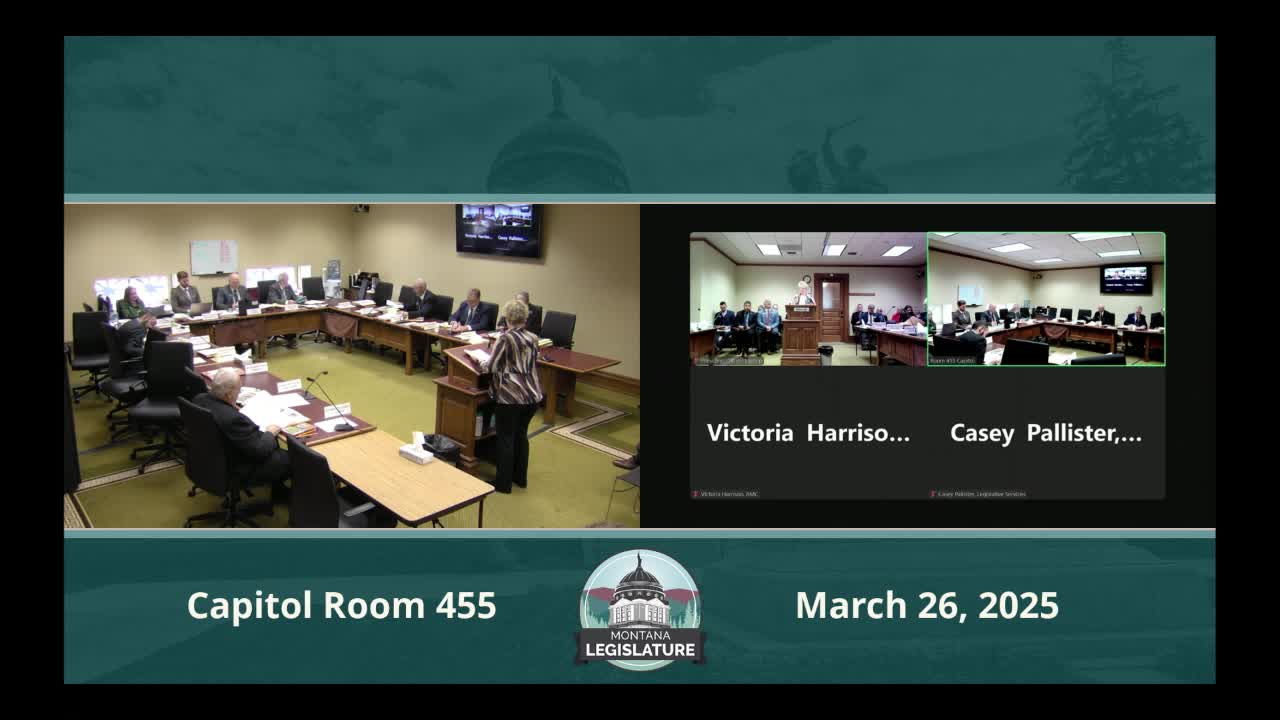
House committee hears proposal to create Big Sky Rail account to fund passenger-rail planning and projects
Summary
House Bill 848 would statutorily appropriate the first $2 million of rail-car tax revenue to a new Big Sky Rail account to support the Big Sky Passenger Rail Authority’s planning, grant matching and project development. Dozens of proponents, local officials, tribal representatives, economic-development groups and transportation experts described
Representative Denise Baum opened House Bill 848 by telling the House Transportation Committee the bill would establish a statewide fund — the Big Sky Rail account — to direct the first $2,000,000 of railroad car tax proceeds each year into a statutory appropriation for passenger-rail planning and related projects. “When we talk about building out passenger rail infrastructure, Montana should not be the caboose,” Baum said, calling passenger rail “critical infrastructure.”
What the bill would do: HB 848 would direct the first $2,000,000 of railroad car taxes, penalties and interest collected into a Big Sky Rail account, a statutory appropriation to the Montana Department of Transportation to be distributed annually. Testimony repeatedly noted that current rail-car tax receipts are distributed to the state general fund and that the bill would instead allocate the first $2 million to the new account.
Support and testimony: The Big Sky Passenger Rail Authority (BSPRA) and a long list of local elected officials, county commissioners, chamber leaders, economic-development professionals, tribal representatives and transportation experts testified in favor. Dave Strohmeyer, chairman of BSPRA’s board, described the authority’s work and said the organization had secured federal planning recognition and grants including an Amtrak partnership to secure $15 million for rail improvements in Malta and Phillips County. “In this age of political rancor, one thing is clear across Big Sky country. Passenger rail is not divided along lines of red or blue,” Strohmeyer said.
Proponents described multiple goals: planning and design for passenger-station infrastructure, grant-writing and administration, providing matching funds to unlock federal grants, workforce development and local economic benefits including tourism and improved access to health care for rural and tribal communities. The bill’s supporters included the Montana AFL-CIO, chambers of commerce, the Montana Economic Developers Association, tribal officials from the Confederated Salish and Kootenai, county commissioners, mayors and numerous downtown and tourism stakeholders.
Fiscal and technical questions: Committee members probed the revenue source and the mechanics of the railroad car tax. Witnesses explained the tax is assessed on the market value of leased railcars and is currently deposited to the general fund; the Legislative Fiscal Division projects railroad car tax receipts of roughly $3.9 million in 2025 and increasing modestly in subsequent years, and HB 848 would allocate the first $2 million of that revenue to the new account. Committee members also asked whether the amount is fixed; the sponsor confirmed the statutory appropriation sets the $2,000,000 figure until the Legislature changes it.
Timing, scope and costs: BSPRA leaders and technical witnesses described the project-development pipeline: BSPRA was accepted into the U.S. DOT Corridor Identification and Development Program and received a $500,000 FRA grant to study restoration of the Southern route (Big Sky North Coast corridor). Strohmeyer said an anticipated next phase (service-development planning) would cost roughly $10–15 million and that full restoration and operations could take years; he estimated, if everything aligns, service could begin in roughly eight to ten years, and total capital costs could run into the billions for a multi-state, long-distance corridor.
Local examples and community interest: Presenters from Glendive, Malta, Miles City, Butte, Livingston, Whitehall, Phillipsburg and other towns described economic and quality-of-life benefits from restored passenger service, including increased tourism, easier access for seniors and veterans to medical care, freight benefits and workforce development. Tribal representatives noted the reservation-level benefits for transport of people and timber and urged support.
Ending: Committee members asked detailed technical questions about route alternatives, station stops under consideration (Glendive, Miles City, Forsyth, Columbus?, Billings, Livingston, Bozeman, Helena, Missoula, Paradise/Thompson Falls as possibilities), and the relationship between passenger and freight infrastructure. No opponents testified. Representative Baum closed urging a do-pass recommendation and cited workforce and grant wins BSPRA had already helped secure. The committee did not take final executive action during the hearing.