Get Full Government Meeting Transcripts, Videos, & Alerts Forever!
Get email alerts on the Water Rights Subdivisions topic
No spam. Unsubscribe anytime.
Montana committee hears bill to coordinate water-rights review for subdivisions
Summary
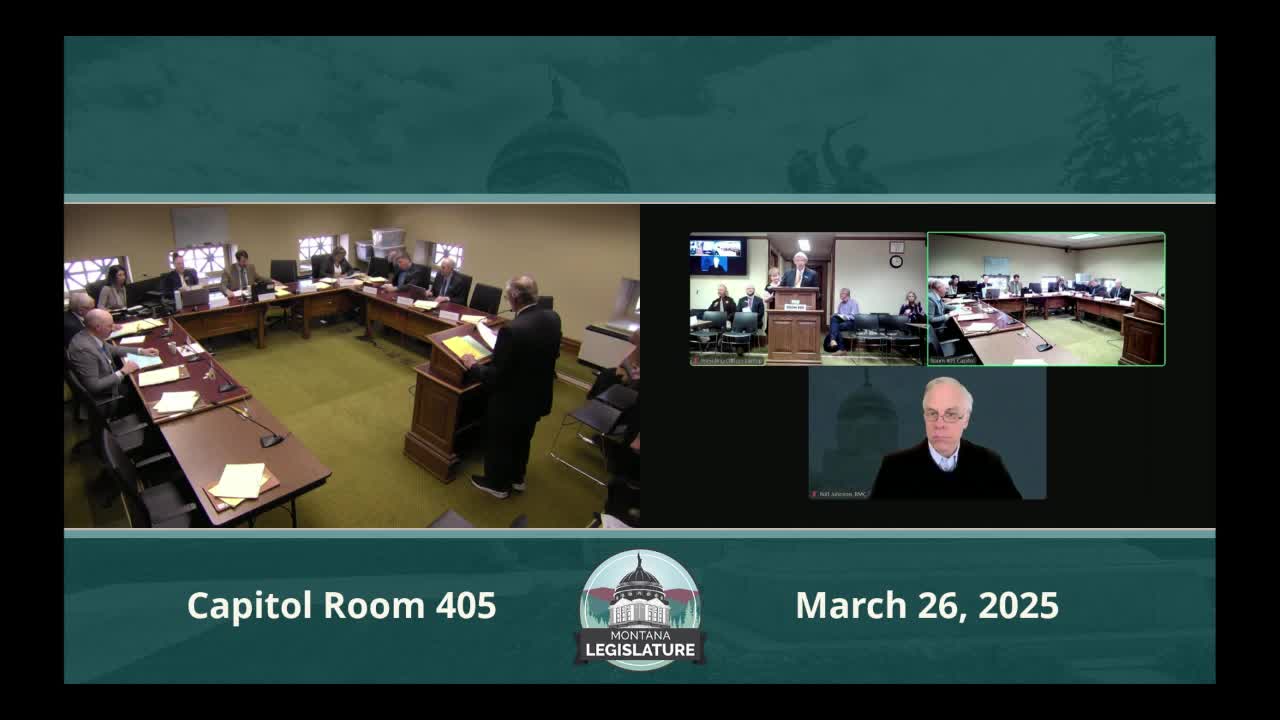
A bill to create an upfront notice-of-intent process for exempt wells and to better align DEQ, DNRC and local subdivision review drew broad support from state agencies, counties and conservation groups and modest opposition from well drillers and realtors concerned about the five-year limit on the notice.
House Bill 681 would add a coordinated, front-end step to subdivision review that gives applicants earlier certainty about exempt-well allocations and lets counties rely on a state review when considering water availability.
Supporters told the Senate Local Government Committee that the bill creates a notice-of-intent process that lets a landowner or developer know, before building, whether exempt-well use is likely to qualify under the Montana Water Use Act and how an allocation would be applied by lot.
The bill matters because, proponents said, current practice forces property owners to build and put water to beneficial use before filing a notice of completion — meaning they may invest heavily without knowing whether DNRC will later find combined appropriation problems. “Today, you divide your land, you put a home on it, you turn on your tap, you then go and file a notice of completion for the use of an exempt well,” said Anna Pakenham Stevenson, water resources division administrator. “At that time, the department will evaluate whether or not you qualify for the exception.”
What the bill does and does not do
Under HB 681, the Department of Natural Resources and Conservation (DNRC) would accept a notice of intent for an exempt well tied to a subdivision review. The notice would create a defined timeline for agency review and an allocation mechanism that can be assigned by lot. Supporters emphasized the change does not remove the statutory authority of DEQ, DNRC, or local governments in their respective review roles.
Proponents and stakeholders
Anna Pakenham Stevenson (DEQ/Water Resources Division) and Lindsey Krivarichka (stakeholder group representative) told the committee the bill arose from a 15-month stakeholder process and restores a coordination touchpoint lost after a recent district court decision. Karen Alley of the Montana Association of Counties said the change puts water-availability information “upfront” and will be “wildly beneficial for counties.” Clayton Elliott of Montana Trout Unlimited said the five-year duration with a possible five-year renewal fits the anti‑speculation principles of the Montana Water Use Act and urged rejection of any amendment to make a notice last indefinitely.
Opposition and concerns
Rhonda Wiggers, representing the Montana Water Well Drillers Association and the Montana Building Industry Association, said industry members worried a five-year term for a notice of intent would not match the long build-out timelines for many subdivisions. “Very seldom…in the rest of the world, those subdivisions sometimes take 10 and 15 and 20 years to get built out,” she said, and asked the committee to consider a longer term or indefinite duration akin to existing COSA allocations. The Montana Association of Realtors likewise urged extending the duration.
Questions from senators focused on how the bill interacts with the Horse Creek Hills district court decision, whether the notice guarantees an exempt well, and how midstream subdivision applications would be treated. Pakenham Stevenson and other witnesses repeatedly said the bill does not guarantee an exemption; the department will still evaluate combined appropriation and qualification when a notice of completion is filed.
Outlook and next steps
Supporters urged the committee to pass HB 681 with the current five‑plus‑five structure, while opponents asked for amendments to lengthen or make the notice indefinite and to address projects already midstream. Committee members discussed potential limited grandfathering for applications already in review; an effective date of 2026‑01‑01 was mentioned during the hearing as the proposed start date for any new requirements.
No formal vote was recorded in the hearing transcript.