Get Full Government Meeting Transcripts, Videos, & Alerts Forever!
Get email alerts on the Ethics Commission It topic
No spam. Unsubscribe anytime.
Rhode Island Ethics Commission warns IT case‑management upgrade needs more funding to finish modules
Summary
The Ethics Commission told lawmakers its FY2026 personnel costs are funded but the planned case‑management and financial disclosure system upgrade may lack sufficient operating funds to finish all modules without additional appropriation or DOIT support.
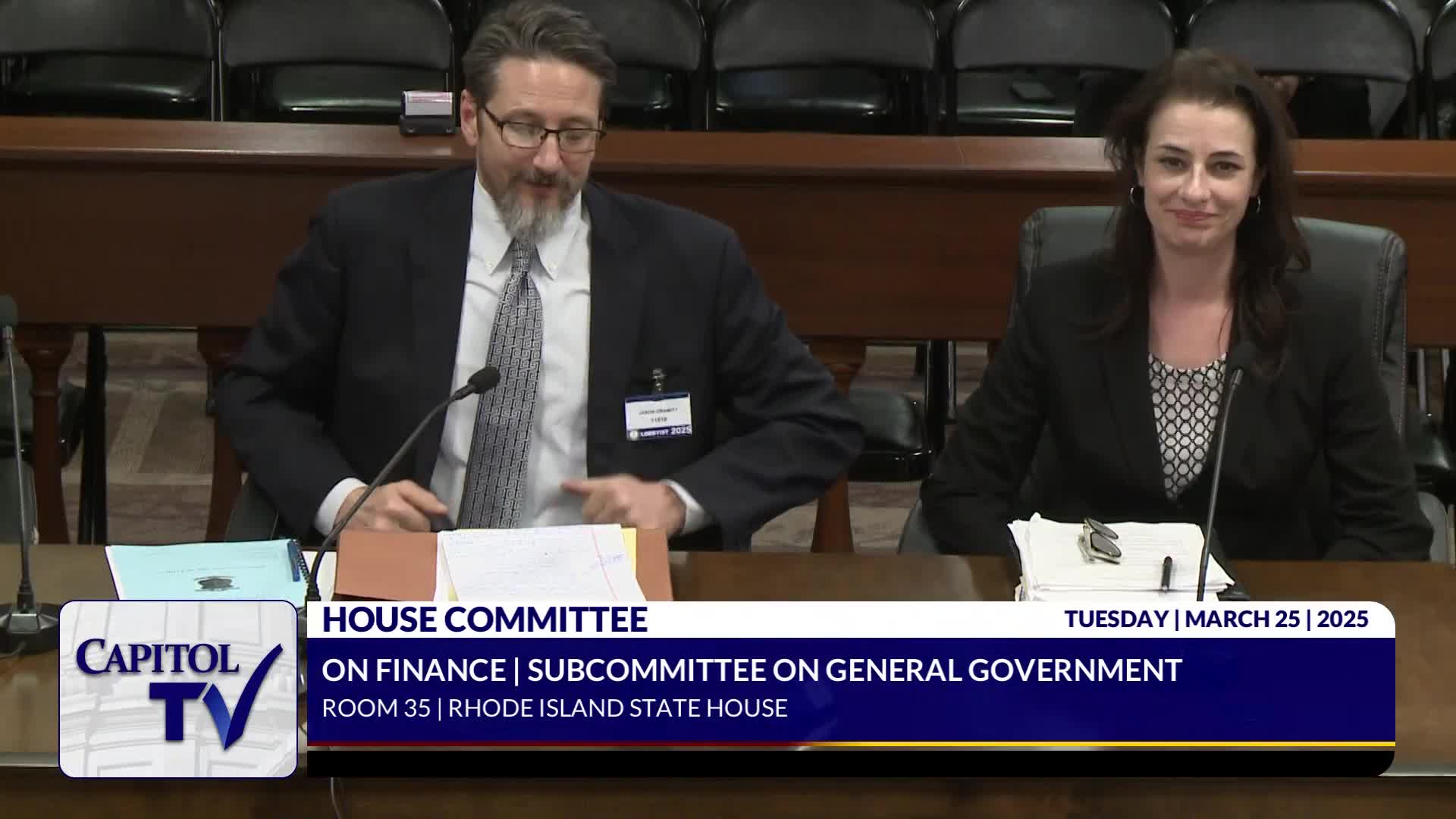
Jason Granite, executive director of the Rhode Island Ethics Commission, told the House Finance Subcommittee that the agency’s personnel budget is covered in the governor’s FY2026 recommendation but that the three remaining information‑technology modules may require additional funding.
Granite said the commission has four core functions — enforcing the code of ethics, issuing advisory opinions, conducting education and training, and administering financial disclosure filings for about 4,500 public officials — and that "our phones ring off the hook in March and April" during the financial‑disclosure filing season.
Why it matters: The commission administers mandatory financial disclosures for thousands of public officials and processes recusals and advisory opinions that support state ethics enforcement. Officials said timely technology upgrades are important to maintain compliance, respond to public records requests and manage complaints and opinions.
What the commission described: Granite and senior staff attorney Catherine D'Arezzo outlined the commission’s multi‑module IT project with DoIT: a completed recusal module, a partially developed advisory‑opinion module, and two larger modules remaining — a complaints/enforcement module and a financial‑disclosure management module. Granite said the project was started in prior fiscal years, some budget lines were reappropriated, and that the agency now expects the current appropriation may be insufficient to finish all work. He said the agency has alerted OMB and DoIT and is scheduling follow‑up meetings to identify a solution.
Operational details: The commission reported that online disclosure filings continue to rise (over 90% filed online in recent years) and that public‑records responsiveness metrics show nearly all requests were answered within 24 hours in fiscal 2024. Granite said nearly all of the agency’s operating budget is personnel costs and that the recent cost‑of‑living adjustments created budget pressures across small agencies.
Ending: Granite asked lawmakers to note the risk that case‑management work might not be complete within current appropriations and to expect follow‑up from the commission and OMB on solutions. He said the commission prefers DoIT as a vendor partner for the upgrade to reduce external contracting costs but will pursue required funding to finish the remaining modules if necessary.