Get Full Government Meeting Transcripts, Videos, & Alerts Forever!
Get email alerts on the Organized Retail Theft topic
No spam. Unsubscribe anytime.
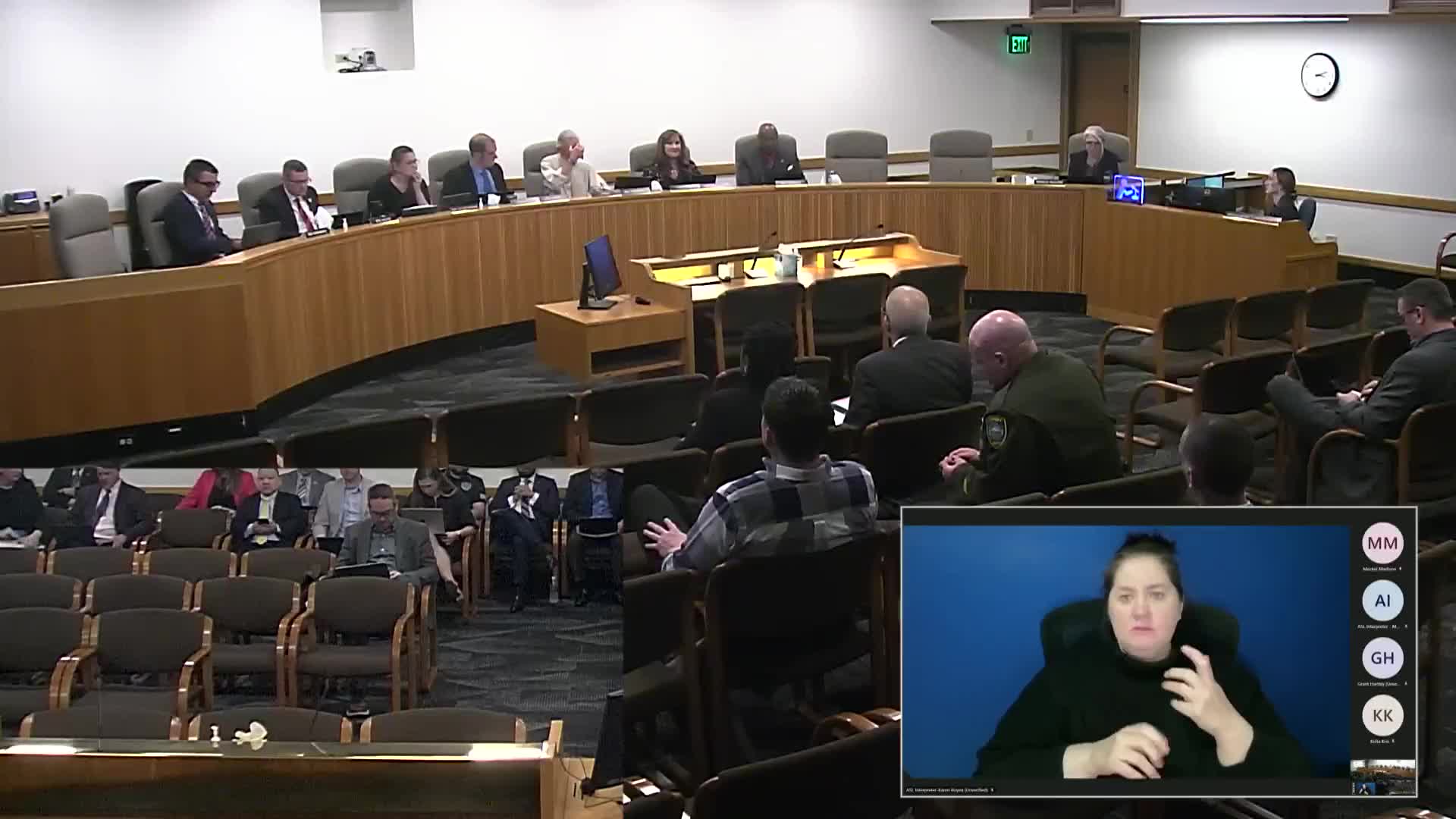
Senate Judiciary committee hears testimony on bill to broaden organized retail theft, computer-crime definitions
Summary
The Senate Committee on Judiciary held a public hearing Wednesday on Senate Bill 275 (dash-1), a measure that would broaden Oregon's organized retail theft and computer-crime statutes and revise the organized retail theft grant program.
The Senate Committee on Judiciary held a public hearing Wednesday on Senate Bill 275 (dash-1), a measure that would broaden Oregon's organized retail theft law, expand the computer-crime statute to cover online buying and selling of stolen goods, and change who may receive organized retail theft grant funds and how those grants may be used.
Proponents told the committee the amendments close investigative gaps that have blocked prosecutions and would strengthen a grant program aimed at disrupting coordinated theft rings. Opponents, largely criminal-defense and public-defender representatives, said the changes risk converting lower-level shoplifting cases into felonies and would sweep in people who sell stolen goods online without evidence they knew the merchandise was stolen.
The bill's dash-1 amendment would: expand the definition of organized-retail-theft to allow charges when an individual sells or resells large quantities of stolen merchandise even if the individual was not part of the initial theft; broaden the computer-crime statute to cover methods of accessing online marketplaces to buy or sell stolen goods; move administration of certain organized-retail-theft grants to the Department of Justice (DOJ) rather than the Oregon State Police or community-based organizations; permit grant funds to be used for theft-detection and surveillance equipment; and require the Oregon Criminal Justice Commission (CJC) to report on the grant program to the committee by Sept. 1, 2027.
Amanda Dalton, president of the Northwest Grocery Retailers Association, said the task force of retailers and law enforcement produced the proposals over eight months. "The DOJ has been a crucial partner for us," Dalton said, and the amendment aligns eligible grant recipients with how the 2023-24 allocations were administered and clarifies equipment purchases as an eligible use.
Derek Singston, policy director and counsel for Oregon Business & Industry, argued the changes would let law enforcement "leverage investments" from earlier legislation and said organized retail theft is a statewide problem. "Organized retail theft is a substantial problem plaguing the entire country," Singston said.
Jeremy Girard, retail president of the Organized Retail Crime Association of Oregon, and a field investigator, said prosecutors and investigators face a common barrier: current law can require proof that a suspect acted "in concert with" another person or with a resale network. "The amendment offers this the opportunity to adjust this gap allowing individuals who are committing theft on large scale to be charged with organized retail crime and align Oregon with many other states," Girard said. He described repeated single-person thefts of high-demand items that are obviously destined for resale, and he said retailers increasingly see coordinated "fire-exit push-outs" where alarmed emergency exits are used to evade front-door security.
Kevin Diemer, a senior deputy district attorney in Multnomah County, urged changes to the computer-crime language. Diemer described case law that, in his view, has narrowed who can be prosecuted for using marketplace websites to monetize stolen goods. "All we're trying to get to is back to where we were with that particular change," Diemer said, summarizing the draft amendment's intent to capture cases where an individual uses online platforms to sell stolen merchandise.
Detective Mike Zacker of the Clackamas County Sheriff's Office, a member of the Organized Retail Crime Task Force, described how individuals can operate as a "sole proprietorship" on peer-to-peer marketplaces using Venmo, Cash App, OfferUp or Facebook Marketplace to post stolen items for sale. "I believe that acting as an individual can be acting in the spirit of organized retail theft," Zacker said, noting investigators frequently see people selling items online at far-below-retail prices.
Teresa Turner, an organized-retail-theft deputy district attorney in Multnomah County, said prosecutors regularly encounter what she called a "sole proprietor" pattern: a single individual repeatedly steals and resells items across counties and on multiple online platforms. Turner said the dash-1 language that would permit charging a person "regardless of whether the person was involved in the initial theft" is needed to close a prosecutorial gap in the statute.
Grant Hartley, director for Metropolitan Public Defenders in Multnomah County, urged the committee to reject the amendment. Citing national reporting on retail-theft statistics, Hartley said the bill would "create more felons" without addressing root causes. He argued the measure narrows a previously legislatively recognized distinction between a fence (someone who intentionally traffics in stolen goods) and a person selling goods they later claim are legitimately obtained. "The modifications ... will do nothing to address this issue and will only serve to create more felons," Hartley said.
Committee members asked several clarifying questions, including whether a buyer on an online marketplace would be criminally liable if they purchased an item later determined stolen. Diemer replied that the bill targets people who knowingly buy or sell stolen goods; "they'd have to know it was stolen," he said. Committee members also queried proposed penalties tied to emergency-exit thefts and whether the change might ensnare low-value or juvenile thefts; proponents said prosecutorial discretion and the totality of circumstances would guide charging decisions.
The committee closed the public hearing and scheduled Senate Bill 275 for a work session on April 2. No committee vote on final passage occurred on March 26.
The hearing record on OLIS includes testimony and the dash-1 amendment language; proponents asked the Criminal Justice Commission to report back on the grant program by Sept. 1, 2027.
What happens next: The committee listed SB 275 for further work on April 2 so members can review proposed statutory language and consider amendments and a recommendation to the Senate floor.