Get Full Government Meeting Transcripts, Videos, & Alerts Forever!
Get email alerts on the Early Childhood Special Education topic
No spam. Unsubscribe anytime.
Families, educators urge legislature to add $24 million for early intervention and boost regional inclusive services funding
Summary
Parents, special‑education providers and regional directors told the Senate Ways and Means education subcommittee during a public hearing on SB 5515 that early intervention and regional inclusive services need substantial increases to avoid service cuts and layoffs.
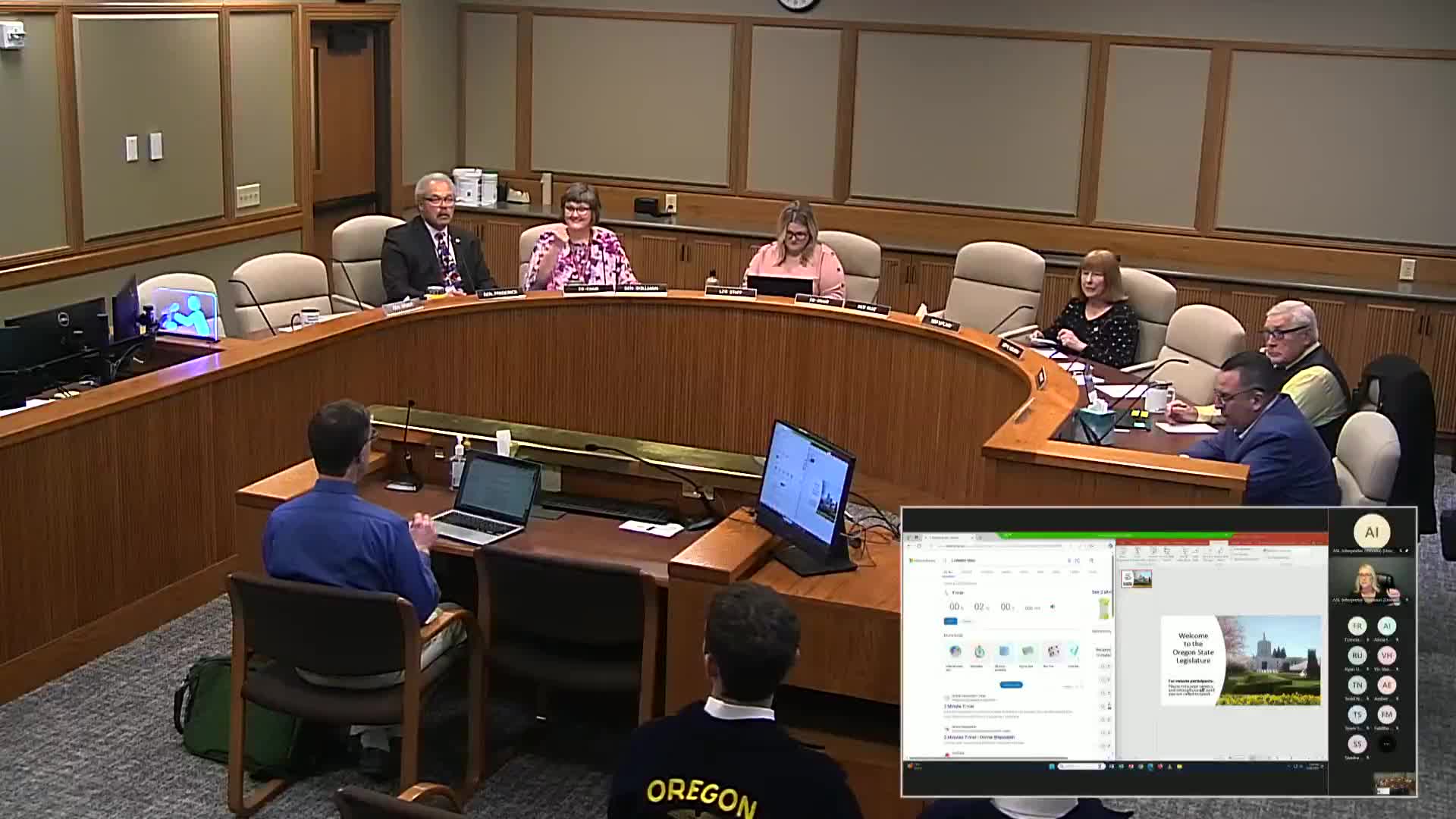
Speakers at a March 26 public hearing on Senate Bill 5515 urged the Legislature to raise funding for Oregon’s early intervention and early childhood special education (EIE/Early Childhood Special Education) and regional inclusive services, saying current proposals fall short of federally mandated service levels.
Kevin Anderson, an administrator with the Multnomah Early Childhood Program, told the committee that EIE programs serve more than 14,500 children statewide and that “we are a federally mandated program, and we are not allowed to have any wait list or delays.” He described strict federal timelines for service delivery and said the governor’s recommended budget would require an additional $24,000,000 to meet adequate service levels.
That request was echoed by multiple presenters. Lisa McConachie, director of Columbia Regional Inclusive Services, said the governor’s proposed $69,000,000 allocation “is woefully inadequate” for services that provide braille materials, amplification systems, mobility equipment and autism supports. She cited a prior legislative assessment recommending $122,000,000 and asked the committee to raise funding by $50,000,000.
Parents and educators described concrete impacts of underfunding. Beatrice Clifton, manager of early intervention and early childhood special education evaluation for Northwest Regional ESD, said staff layoffs and eliminated preschool placements have already harmed access and inclusion. “The lack of funding has also meant that last June, multiple staff members were laid off by our agency,” she said.
Teachers and service providers gave examples of the programs’ effect. Scott Unrein, an early childhood special education teacher, said training pipelines are undermined when positions are cut: he completed a Grow Your Own master’s program and was laid off immediately upon finishing. Brad Hendershot, a speech-language pathologist with Columbia Regional Inclusive Services, recounted cases in which assistive technology and training allowed students to rejoin neighborhood schools, and urged full funding for regional services after 15 years of declining per‑student support.
Multiple groups asked the subcommittee to fund EIE at an “adequate service level” figure of $432,800,000 and regional inclusive services at $122,000,000. Morgan Allen of the Coalition of Oregon School Administrators and Chrissy Wright of the Oregon School Boards Association supported those targets and urged restoration of technical assistance funding for Education Service Districts that help districts implement state accountability plans.
The testimony also emphasized the downstream cost of underinvesting. Matthew Sears of the Oregon Council for Developmental Disabilities cited research indicating early intervention yields long‑term public savings and urged the committee to treat EIE investments as preventive spending.
The hearing was a public testimony session; committee members did not vote on SB 5515 during the hearing. Speakers repeatedly asked the subcommittee to restore or increase the governor’s proposed amounts to avoid service disruption, layoffs and reduced access for young children with developmental delays and low‑incidence disabilities.
Looking ahead, witnesses asked the Legislature to include higher EIE and regional inclusive services funding in the final budget so programs can meet federal requirements and avoid wait lists.