Get Full Government Meeting Transcripts, Videos, & Alerts Forever!
Get email alerts on the Community Solar Sunset topic
No spam. Unsubscribe anytime.
Senate committee votes to send bill to sunset community solar to Senate floor after contentious debate
Summary
After hours of testimony from developers, utilities, advocacy groups and senators, the Energy Committee voted 8–3 to recommend passage of Senate File 2855, a bill that would sunset Minnesota's community solar garden program; the vote will now go to the Senate floor.
The Minnesota Senate Energy, Utilities, Environment and Climate Committee voted 8–3 to recommend passage of Senate File 2855, a bill that would sunset the state’s community solar garden (CSG) program in three years. The vote followed several hours of testimony from utilities, developers, labor and community organizations and wide-ranging questions from senators on cost, equity and reliability.
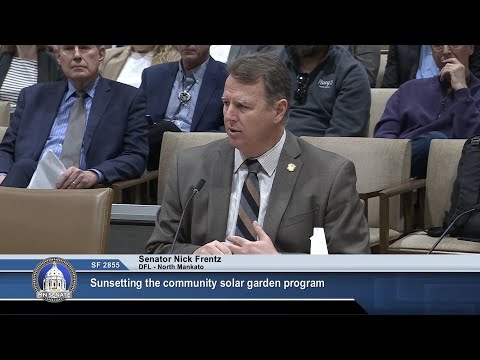
Senator Frentz, who presented the bill, told the committee that his central concern is the program’s cost and the subsidization of non-subscribing ratepayers. "The cheaper the energy is, the more we will build," he said, urging senators to consider removing a program that he argued now imposes above-market costs on all ratepayers. Frentz cited the fuel clause totals from Xcel Energy reporting and said roughly $262 million of fuel-clause costs were associated with community solar even though the resource represented only a small share of total generation.
Opponents urged caution. Xcel Energy's Rick Evans described the program’s history and its effects on the company’s distribution grid, noting 900 megawatts of legacy CSG projects and congestion at interconnection points. He told the committee the program was uncapped initially, produced unexpectedly large development activity and placed stress on distribution infrastructure. Mr. Evans and several other witnesses said that the 2023 overhaul capped the program and added protections for low- and moderate-income subscribers but that community solar energy still can be more expensive than some other carbon-free resources.
Commerce Department staff urged the committee not to sunset the newer low- and moderate-income CSG program, calling it premature. Department witness Mr. Wyckoff said the program had delivered savings for qualified households, approved about 81 megawatts with some generation already online, and that the state had newly available federal Solar for All funds that could deepen bill savings for income-eligible customers.
Industry leaders, developers and community groups warned that a sunset would create market uncertainty and cause financial losses for local businesses that have already invested in projects requiring multi-year development timelines. Opponents noted a Department of Commerce study that found the CSG program delivered net benefits to Minnesota. Proponents pointed to the program’s higher per-unit cost and the transfer of those costs to nonparticipating ratepayers.
After extensive discussion, Senator Frentz asked the committee to recommend passage and send the bill to the Senate floor. The clerk conducted a roll-call vote; the motion that Senate File 2855 be recommended to pass as amended and be sent to the Committee on the Senate Floor carried 8–3. Recorded yes votes included Chair Frentz, Senator Matthews, Senator Green, Senator Greenhagen, Senator Hoffman, Senator Klein, Senator Rarick and Senator Weber; no votes were recorded by Senator Jeong, Senator Dibble and Senator McKeown. The committee’s roll-call record was entered into the minutes and the bill will now be considered on the Senate floor.
What the committee decided: the bill moves forward with a committee recommendation to pass and be sent to the floor; that recommendation does not by itself become law and can be amended, debated or reversed on the Senate floor. The vote and public record mean the policy debate will now proceed in full chamber consideration.