Get Full Government Meeting Transcripts, Videos, & Alerts Forever!
Get email alerts on the Education Policy Omnibus topic
No spam. Unsubscribe anytime.
Senate Education Committee walks through "delete‑everything" education policy omnibus; debate spans algebra II, literacy (REED Act), charters, special education
Summary
Committee counsel and staff walked members, line by line, through the education policy omnibus "delete‑everything" amendment (SCS 1748‑2), covering attendance and PSEO changes, academic standards and graduation requirements, charter school oversight, literacy training under the REED Act, special education, school facilities and nutrition, and other agency changes.
The Minnesota Senate Education Policy Committee conducted a structured walkthrough of the delete‑everything amendment to the education policy bill (SCS 1748‑2), reviewing multiple articles that collectively revise PSEO eligibility, academic standards and benchmarks, charter school governance, special education processes, literacy training under the REED Act, school nutrition and facilities rules, and other statutory provisions.
Senate counsel and staff walked members through Article 1 (attendance and PSEO clarifications), Article 2 (education excellence, standards, and graduation requirements), Article 3 (charter school oversight and procurement), Article 4 (REED Act/literacy professional development), Article 5 (special education), Article 6 (school nutrition and facilities, including landfill proximity language), and Article 7 (agency and administrative provisions including catastrophic insurance for the Minnesota State High School League).
Major items highlighted during the walkthrough and subsequent public testimony included:
Algebra II and graduation requirements: Counsel noted language from a Senator Farnsworth provision that "algebra 2 must not be required as an academic standard" in the next standards cycle and that credit for algebra II or higher would not be required for graduation. Education advocates and teachers raised concerns that removing the algebra II requirement could track low‑income students, students of color, students with disabilities and English learners into lower‑level math pathways and could affect college admission eligibility. Matt Shaver of ED Allies warned that removing algebra II "will lead to tracking" and said changes could close doors for students who decide to pursue college later in life. Casey Rutherford, a high‑school math teacher, urged maintaining rigorous math expectations to preserve future opportunities for students.
REED Act literacy and licensure: Article 4 includes multiple changes to implement the REED Act, expands professional development timing and training expectations for teachers leading reading instruction, and ties specific structured literacy training to licensure renewal for Tier 1 and Tier 2 teachers. Supporters, including district associations and union representatives, commended the additional training time and the alignment measures but asked for implementation flexibility and clarity about district and department capacity to deliver required training.
Charter school accountability and procurement: Article 3 includes a suite of charter provisions proposed by the Minnesota Department of Education (MDE) and the author. Key elements require authorizers to report performance, require finance committees and financial oversight for charter boards under corrective action, require video recording and archiving of charter board meetings for at least one year, require authorizers to publicize performance and contracting information, and set procurement policy standards and potential state aid reductions for noncompliant purchases. Proponents called the changes "financial transparency and accountability" measures; charter stakeholders requested continued dialogue about thresholds and operational impact.
Special education and language access: Article 5 codifies aspects of prior‑written notice, state complaint procedures aligned with federal practice and creates a developmental delay age‑limit working group. Testimony from disability advocates and family representatives praised codification of IDEA‑aligned processes but urged stronger enforcement language for language access plans — calling for a named process and remedies if plans are not followed.
High school extracurricular catastrophic insurance: A provision (from Senator Dibble’s package) would require the Minnesota State High School League to contract for catastrophic injury insurance with specified coverage levels for high school extracurricular participants. Roger Aronson of the State High School League supported mandated catastrophic coverage in principle but urged against a narrow statutory definition of "catastrophic insurance" or overly prescriptive line‑item mandates that could restrict the League’s ability to secure appropriate coverage; he also highlighted tradeoffs between coverage amounts and duration of benefits.
School start date and Labor Day exemption: Language permits school districts to begin school on or after August 30 for specified years (2026–2028) in place of a strict post‑Labor Day requirement. This generated mixed reactions: K‑12 representatives argued for local flexibility to plan calendars, while tourism and resort representatives urged preserving the long‑standing post‑Labor Day rule because their seasonal businesses rely on that window.
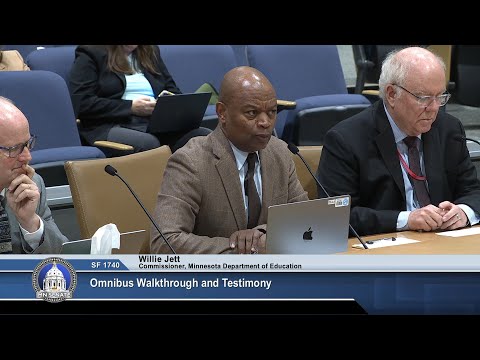
Department of Education remarks: Commissioner Willie Jett thanked the committee for including many agency proposals and highlighted the department’s support for student voice, American Indian education provisions, charter oversight improvements and literacy work. He also reiterated concerns about resourcing, noting attendance solutions will require targeted investments to be implemented at scale.
Committee process and next steps: Chair Switzinski said the committee will take the walkthrough material into consideration and allow testifiers; the committee expects markup and a final vote at a later meeting (markup scheduled next Wednesday). Several senators asked for additional technical language fixes, clearer definitions (for example, of when employees are "paid to supervise or provide services" for attendance reporting) and attention to implementation capacity for department responsibilities.
Quotes from the hearing included: Commissioner Willie Jett — "Combining many of the proposals put forward by the Senate with the agencies provides a bill with many common sense solutions that advance priorities, create clarity, and enhance opportunities for students, families, and educators." Roger Aronson (State High School League) — "When you do the mandate for us like this, then that is a permanent ongoing cost that we would have to incur every year" describing fiscal implications of mandated catastrophic insurance.
The walkthrough covered numerous cross‑referenced Senate files and agency proposals; several members asked to revisit specific lines in later markup sessions. The committee adjourned with plans to reconvene for bill markup and further amendment.