Get Full Government Meeting Transcripts, Videos, & Alerts Forever!
Get email alerts on the Road Usage Charge Evs topic
No spam. Unsubscribe anytime.
Committee advances bill proposing road-usage charge for all-electric vehicles; debate centers on data and fairness
Summary
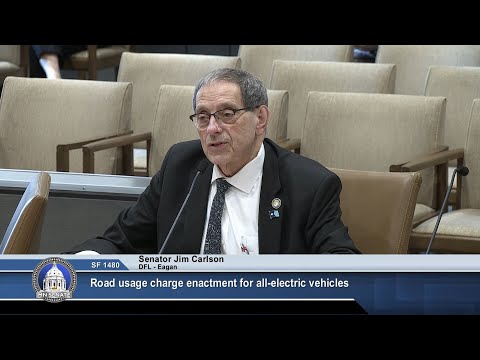
St. Paul — The Senate Transportation Committee on March 26 advanced Senate File 1480, a proposal to impose a road-usage charge on all-electric vehicles based on miles driven reported by vehicle systems and confirmed through an account-provider system.
St. Paul — The Senate Transportation Committee on March 26 advanced Senate File 1480, a proposal to impose a road-usage charge on all-electric vehicles based on miles driven reported by vehicle systems and confirmed through an account-provider system. The bill was moved to the Taxes Committee without recommendation.
Sponsor Sen. John Carlson offered an A1 author’s amendment to ensure the revenue would be deposited in the Highway User Trust Fund and to address a drafting oversight. Carlson said the proposal would apply only to all-electric vehicles, not hybrids, and would rely on vehicle telematics and odometer data to separate miles driven in Minnesota from miles driven elsewhere.
Nut graf: Committee members and testifiers broadly agreed road-user fees merit study as fuel-tax revenue declines, but they raised concerns about administrative complexity, data privacy and fairness. Several witnesses and senators urged consideration of broader, technology-neutral approaches that include all vehicles and fuel types.
Key points and testimony
Carlson told the committee the bill would require owners to report miles driven and enter an agreement with one or more account providers to manage reporting and payment to the commissioner. Carlson said vehicle systems already store relevant data and that manufacturers report similar data for other purposes.
Nick Hague, senior associate for electric vehicles at Fresh Energy, testified against SF 1480. He said while distance-based fees address part of the highway-funding problem, focusing only on EVs “misses an opportunity to address deeper issues impacting roadway funding” and risks discouraging EV adoption. Hague noted EVs accounted for less than 1 percent of passenger vehicles in Minnesota and that EVs already contribute via higher motor vehicle sales taxes and tab fees.
Committee questions and concerns
Members asked how the system would distinguish in-state from out-of-state miles and whether odometer or telematics reporting would be intrusive. Carlson said geofencing programming could differentiate miles by state borders. Several senators said they supported the concept of aligning road use with costs but wanted either a statewide, vehicle-type-neutral approach or additional study, including the University of Minnesota telematics research referenced in testimony.
Outcome and next steps
After discussion, Carlson moved the amended bill and the committee recorded a voice vote to move SF 1480 as amended to the Taxes Committee without recommendation. The committee did not record a roll-call tally on the floor.
Ending: Senators said further work is needed on technical details, privacy protections and whether a mileage-based fee should apply to all vehicles; the University of Minnesota study and other pilot programs were cited as resources to refine any future statewide policy.