Get Full Government Meeting Transcripts, Videos, & Alerts Forever!
Get email alerts on the Nursing Home Ownership Transparency topic
No spam. Unsubscribe anytime.
Senate advances bill to tighten rules on for‑profit and private‑equity nursing home takeovers
Summary
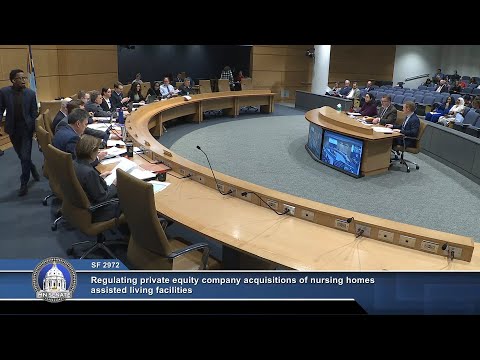
Senate File 29 72, a bill tightening oversight of for‑profit and private‑equity purchases of nursing homes and assisted‑living facilities, passed out of the Minnesota Senate Human Services Committee on a voice vote after several hours of testimony and debate.
Senate File 29 72, a bill tightening oversight of for‑profit and private‑equity purchases of nursing homes and assisted‑living facilities, passed out of the Minnesota Senate Human Services Committee on a voice vote after several hours of testimony and debate.
The bill, carried by Sen. Scott Dibble, seeks to require 120 days’ written notice before a nonprofit facility is sold to a for‑profit buyer; expand financial and ownership disclosures; define controlling interest; prohibit asset stripping and certain related‑party transactions; require a minimum share of public receipts be spent on care; and give the attorney general enforcement authority for violations.
Supporters — including the state long‑term care ombudsman and advocates — said the legislation responds to patterns observed after recent takeovers: reductions in staffing, declines in care quality and increases in complaints. Parichā Rudina of the Office of Ombudsman for Long‑Term Care told the committee, “Residents have reported to us an overall reduction in quality of care after a takeover of their facility by a for profit entity,” and said complaints to the office sometimes rose “by as much as 100% in the months following such a takeover.”
Sen. Dibble cited research linking private‑equity ownership to lower cash on hand, reduced staffing hours and worse clinical outcomes. He described the bill as a transparency and accountability measure, saying it does not prevent sales but sets conditions and prohibitions to protect residents and public dollars.
Industry witnesses and association representatives urged caution, saying the proposal could discourage investment that keeps facilities open. Kyle Berndt of the Long Term Care Imperative told the committee the proposal “could result in increased costs, administrative complexity, and reduced flexibility in managing facilities” and said the sector needs access to capital to maintain infrastructure and avoid closures. Several providers and industry groups expressed concern that added regulatory uncertainty would make it harder for struggling facilities to find buyers and stay open.
Committee members pressed both sides on trade‑offs: whether the policy would prevent closures, how regulators would use the new data, and whether the Department of Health should be the primary reviewer. Lisa Timmy, legislative director at the Minnesota Department of Health, told the panel the department had not completed a full analysis and asked for time to work with authors and stakeholders.
After extended questioning and amendment, the committee adopted an author’s amendment and approved the bill as amended. Sen. Foung Hawj (mover recorded in the hearing as Senator Fattie) moved passage to commerce; the motion carried by voice vote.
The bill sponsor said he will work with industry, regulators and advocates as the language proceeds through commerce and later conference rooms. Supporters said the bill is intended to ensure public funds paid to facilities result in commensurate care, while opponents urged careful calibration to avoid accelerating closures in rural or financially fragile communities.