Get Full Government Meeting Transcripts, Videos, & Alerts Forever!
Get email alerts on the Worker Misclassification topic
No spam. Unsubscribe anytime.
Minn. committee hears testimony on two bills to measure and deter worker misclassification
Summary
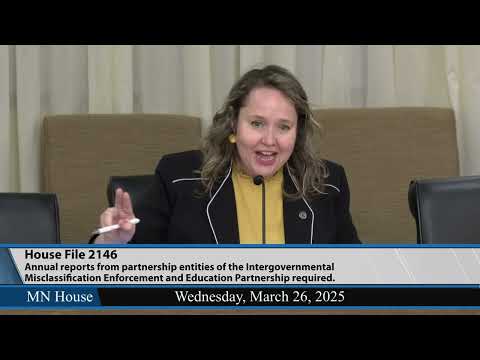
The House Workforce Development Committee heard testimony on House Files 2145 and 2146, a pairing of bills that would require regular measurement of worker misclassification and raise penalties to deter employers who misclassify employees as independent contractors.
Representatives and witnesses told the House Workforce Development Finance and Policy Committee on April 1 that worker misclassification is widespread and costly to workers and state programs, and they described two bills intended to measure the problem and strengthen penalties.
Representative Heather Greenman, sponsor of the bills, said the measures come from the attorney general's task force on misclassification and aim to both quantify the scale of misclassification and raise penalties where enforcement has been weak. "They come as a larger set of recommendations," Greenman said, describing the package as intended to "strengthen our efforts to prevent misclassification fraud and the impact it has on our public coffers and on workers."
The first bill before the committee, House File 2145 as amended, would direct state agencies to develop an ongoing estimate of misclassification and its fiscal effects on state programs such as unemployment insurance, the Workforce Development Fund and workers' compensation. The second bill, House File 2146, focuses on penalties and enforcement and would raise the potential consequences where the Office of Legislative Auditor warned existing penalties were inadequate.
Jake Schweitzer, executive director of Northstar Policy Action, summarized a September study his organization produced estimating misclassification's economic effect. "Approximately 316,000 individuals, or 9.4 percent of all private sector workers, experienced misclassification fraud in 2019," Schweitzer said, adding his group's estimate that working Minnesotans lost between $2.9 billion and $6.2 billion in compensation and that state government lost between $506 million and $1.3 billion in revenue in 2019. Schweitzer emphasized limitations in his group's data and urged a state-run, recurring analysis to provide accountability and better enforcement.
Business and labor witnesses described how misclassification affects different sectors. Jesse Madison, founder and CEO of Purple Tally Productions, said production and live-event businesses face competition from employers who treat workers as independent contractors and can undercut law-abiding firms. "When they do that, they can undercut us by 30 to 40 percent," Madison said. Alana Olson, a stagehand and IATSE Local 13 member who described a workplace injury she suffered, said workers often perform the same duties as employees yet are told they are independent contractors and therefore denied protections. Tony McGarvey, a union organizer and city council member, testified that the practice depresses wages, undercuts employers who follow the law and is increasingly part of an exploitable business model.
Committee members discussed the bills at length. Some raised concern that increasing penalties could unintentionally affect legitimate subcontracting and small employers, and others pushed for better agency data-sharing and use of existing reporting (for example, 1099 filings) before adding more penalties. Representative Greenman and other supporters said that the bills were a response to multiple OLA audits and task force recommendations and that the reporting bill is necessary to know how large the problem is before determining the appropriate level of investment in enforcement.
The committee adopted the DE1 amendment to House File 2146 and laid over both House File 2145 (reporting) and House File 2146 (penalties) for future consideration.
The committee's next steps will be to reconcile member concerns about scope and enforcement resources and to await the agencies' ability to supply the data the reporting bill requests.