Get Full Government Meeting Transcripts, Videos, & Alerts Forever!
Get email alerts on the Supported Decision Making topic
No spam. Unsubscribe anytime.
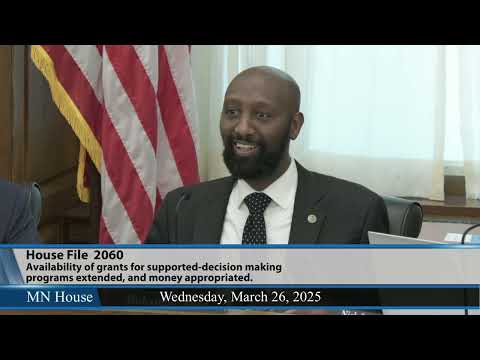
Committee hears bill to extend funding for supported decision-making grants
Summary
House File 2060 would extend funding for supported decision-making grants and add $2 million to continue services that help adults with cognitive disabilities make decisions without guardianship, the committee heard.
House File 2060, a bill to continue and expand supported decision-making grants, was introduced and laid over for possible inclusion in a future omnibus bill after testimony from a self-advocate and a county provider.
Representative Do introduced the bill, describing supported decision making as “an approach to decision making for adults with intellectual or developmental disabilities or other cognitive impairments that provides them the support that they need to be the ultimate decision makers in matters concerning their own lives.” The bill would transfer an unexpended appropriation from the prior biennium to the next and add $2,000,000 to the current biennium to continue grant awards through the Department of Human Services.
Rochelle Lauer, a self-advocate from Saint Paul who said she co-facilitates a supported decision-making course at RISE in Crystal, described how the class supports participants’ autonomy and ability to make choices about daily matters. “I believe that this program could help empower and give some of the participants their power back that they may have felt that they have lost,” Lauer said, and asked the committee to support HF 2060 so the grant work can continue across Minnesota.
Hannah Dietrich, department administrator at Hennepin County Adult Representation Services, testified the county used $770,000 in state grant funds to connect low-income patients with health care agents and to provide outreach and language access. Dietrich said the county’s work has reduced petitions for guardianship and sped decisions in hospital settings: “With this partnership, however, we can connect patients with a healthcare agent in 2 to 7 days at no cost to the individual or the hospital.” She described outreach to families whose children have individualized education programs and efforts to translate materials into multiple languages.
Members who spoke in favor described the bill as a way to promote autonomy and reduce unnecessary, costly guardianships. Representative Medot called it “a great example of how state resources are leveraged at the local level to create new innovative programs,” and Representative Hicks said supported decision making “is a way that we can really instill autonomy and fight back against ableism.”
The committee adopted an A1 author’s amendment and then laid HF 2060 over for possible inclusion in a future omnibus bill. No final funding decisions were made at the hearing.
Charges, technical details and program administration remain with DHS; the 2023 legislative authorization for grants to support decision making was referenced during testimony.