Get Full Government Meeting Transcripts, Videos, & Alerts Forever!
Get email alerts on the Midwifery Licensure topic
No spam. Unsubscribe anytime.
Committee refers bill to license certified midwives after testimony on maternal health access
Summary
The Minnesota House committee voted to refer House File 1010, the Minnesota Certified Midwife Act, to the judiciary, finance and civil law committee after testimony highlighting maternity care shortages, racial disparities and workforce pressures. Lawmakers asked for additional detail on training and scope.
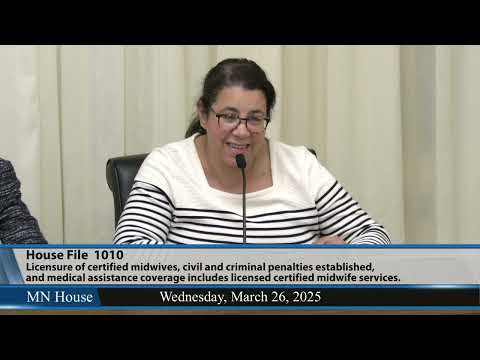
The House Health Finance and Policy Committee voted to refer House File 1010, the Minnesota Certified Midwife Act, as amended to the judiciary, finance and civil law committee on a voice vote after more than an hour of testimony and member questions.
The bill would create a pathway to licensure for certified midwives in Minnesota, allowing individuals who complete a certified midwife graduate program and pass the same certification exam used for certified nurse midwives to practice with a scope of care similar to certified nurse midwives but without first holding a nursing license.
Supporters told the committee the measure would expand access to maternal care in rural areas and communities of color. "Today I'm presenting House File 1010, which is the Minnesota Certified Midwife Act. It's a bipartisan bill in both chambers establishing a new pathway for midwifery in Minnesota," Representative Agbaje said. She described the licensure as an "evidence based strategy" to increase the midwifery workforce and its diversity.
Mandy Huber, a certified nurse midwife and member of the board of the Minnesota affiliate of the American College of Nurse Midwives, told the committee the certified midwife pathway would let students enter graduate midwifery education without first completing a nursing degree and could reduce pressure on nursing programs. "With certified midwife licensure, Minnesotans could instead pursue graduate midwifery education directly after completing the necessary components of the undergraduate education, saving themselves and the state valuable time and funds," Huber said.
Dr. Siri Feibiger, representing the Minnesota section of the American College of Obstetricians and Gynecologists, said certified midwives meet the same competencies and certification standards as certified nurse midwives and that expanded midwifery access has been associated in other states with lower cesarean and preterm delivery rates. "States that have expanded midwifery care have lowered their C-section and preterm delivery rates," Feibiger said.
Rebecca Polston, a certified professional midwife and founder of Roots Community Birth Center in North Minneapolis, told the committee her birth center treats a majority of Medicaid clients and achieves low preterm birth rates under the midwifery model. She said Minnesota's racial disparities in maternal outcomes make expanding midwifery important: "Black women in Minnesota are two to three times more likely to die in childbirth than white women," Polston said.
Kylie Saari, a certified nurse midwife practicing in Fairmont, described taking nine years to become a CNM because she first needed a nursing degree and said that delay can mean trained midwives leave rural communities. "If the certified midwifery licensure was in place, I could have graduated and begun practicing midwifery earlier," Saari said.
Members pressed for details on training and scope. Representative Liebling asked about entry requirements and how the bill's definition of "women's primary health care" would operate in practice. Huber said prerequisites mirror other health science programs—an undergraduate degree, basic science coursework and graduate midwifery education—and that graduate midwifery training for certified midwives and certified nurse midwives would be identical. The committee was told graduate midwifery programs typically run two to three years depending on whether a student completes a master's or doctoral degree.
Liebling expressed continued concern about allowing midwives without prior nursing experience to provide broad primary women's health services and to prescribe independently. "So these are not nurses. They haven't necessarily worked in a health-care setting before," Liebling said. Feibiger responded that midwives diagnose and refer conditions outside their scope and that women seek midwifery care because of the time and listening they provide.
Supporters noted workforce pressures and access gaps. The committee heard that a 2023 March of Dimes report identified roughly 19.5% of Minnesota counties as "maternity deserts," and that Minnesota Department of Health data for 2017–18 showed about 48% of pregnancy-related deaths occurred in rural parts of the state despite smaller birth counts there. Witnesses said roughly one-third of the midwifery workforce is expected to retire in the next five to ten years and that the University of Minnesota plans a certified midwife program but will not start it until state licensure exists.
After discussion and a voice vote, the committee "renewed the motion that House File 1010 as amended be referred to the judiciary, finance, and civil law committee." The chair announced, "The motion prevails and House File 1010 as amended is referred to the judiciary, finance, and civil law committee."