Get Full Government Meeting Transcripts, Videos, & Alerts Forever!
Get email alerts on the Childcare Licensing Reform topic
No spam. Unsubscribe anytime.
Committee adopts amendment to HF 2617 aiming to narrow child-care licensing to health and safety
Summary
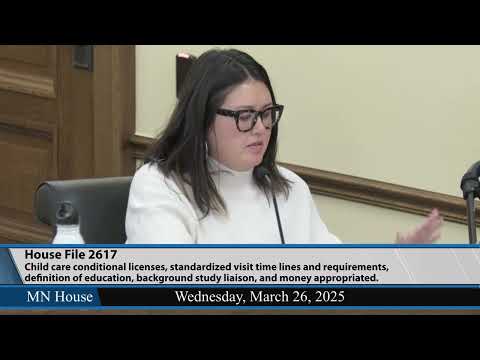
Representative Coulter moved House File 2617 and the DE1 amendment, which the committee adopted by voice vote. The bill would narrow state child-care licensing to core health and safety requirements while encouraging accreditation or professional standards to address program quality.
Representative Coulter moved House File 2617 and the DE1 amendment, which the committee adopted by voice vote. The bill would narrow state child-care licensing to core health and safety requirements while encouraging accreditation or professional standards to address program quality.
The measure, described by Representative Coulter as “a game changer,” drew testimony from three child-care directors who told the committee that the current licensing system often penalizes providers for administrative or cosmetic technicalities unrelated to child safety. Kayley Spencer, director of Lakeside Early Learning in Duluth, said her center received a citation for a clerical omission on a staff orientation record even though the staff member had completed required training. “The current licensing system often distracts us from this mission by focusing on technicalities that have little to no impact on child safety,” Spencer said.
Karen Swenson, executive director of Meadow Park Preschool and Child Care Center in Rochester, recounted being cited because an emergency-preparedness plan was temporarily out of its indexed binder during an inspection and for omitting a filled-in time box indicating 30 minutes of abusive head trauma training. Swenson said those citations are published on the state site and can influence families’ perceptions. “Our current system too often operates under a got-you mentality,” she said.
Christina Killian Valdez, director of Listos Preschool and Childcare in Rochester, urged the committee to take the bill’s approach as Minnesota shifts certain responsibilities from the Department of Human Services to the new Department of Children, Youth and Families. Valdez said Minnesota’s rules “haven’t kept up with BRAIN research” and described licensing as “excessive paperwork, inconsistent rule interpretations and inflexible policies.”
Bridal Moss of Think Small explained the bill’s intended structure: licensing would focus on foundational health-and-safety elements such as ratios, background checks and sanitary conditions, while quality measures (for example, the nature of adult–child interactions and curricular rigor) would be validated through accreditation from professional organizations like the National Association for the Education of Young Children or the National Family Child Care Association. “There are better, more holistic ways to look at quality in a childcare program than looking whether there are these particular materials present,” Moss said.
Providers and advocates also described operational changes included in the bill: a background-study liaison office to give providers better visibility into the status of out-of-state or pending background checks, and a requirement for standardized operating procedures for licensing visits so providers know what to expect. Courtney Griner, a center owner from Esco, said the liaison would not eliminate waiting but would “give us an idea of where we are in line and where we are in that hopper.”
During member questions, representatives repeatedly emphasized support for narrowing licensing to health and safety and for creating clearer processes that reduce punitive enforcement of non-safety technicalities. Representative Sensimura and others asked whether other states use a similar separation; Moss cited Connecticut and Indiana as examples where licensing was narrowed and accreditation used to define program quality.
The committee adopted the DE1 amendment by voice vote; the clerk recorded, “The motion prevails, the amendment is adopted, the bill is in the shape the author would wish it.” Representative Coulter then renewed his motion to lay over House File 2617 as amended. The provided transcript ends with the renewal of the layover motion and does not record a subsequent committee vote on that motion.
Background: House File 2617 (as discussed in committee) is presented as part of an effort to modernize Minnesota’s child-care licensing. Testifiers cited examples of citations that they said were administrative or cosmetic (missing date or signature on training paperwork; a missing knob on a play kitchen; a preparedness plan temporarily removed from a binder), and said such citations can appear on the DHS site for years. Supporters asked the committee to move licensing toward a health-and-safety baseline and to rely on accreditation and coaching to validate program quality.
Votes at a glance: DE1 amendment — adopted by voice vote (aye); layover motion — renewed by Representative Coulter, vote not recorded in provided transcript.
Ending: Committee discussion emphasized reducing punitive enforcement and improving clarity and support for providers; supporters said the bill aims to keep more providers in the field by letting them focus on children’s care rather than technical paperwork. Representative Coulter renewed his motion to lay over HF 2617 as amended; the transcript does not record the result of that layover motion.