Get Full Government Meeting Transcripts, Videos, & Alerts Forever!
Get email alerts on the Optometry Scope topic
No spam. Unsubscribe anytime.
House committee advances bill to expand optometrists’ scope of practice amid safety debate
Summary
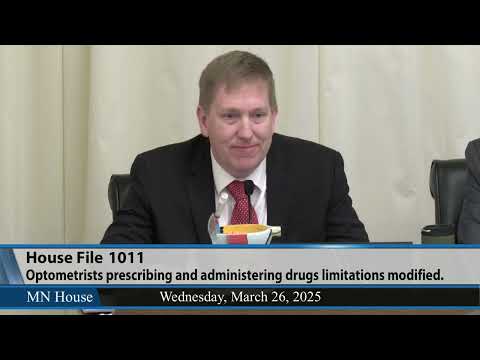
The Minnesota House Health Finance and Policy Committee on March 26 recommended House File 10‑11 to the general register, moving forward a measure that would expand optometrists’ authority to prescribe certain oral medications and perform limited injections.
The Minnesota House Health Finance and Policy Committee on March 26 recommended House File 10‑11 to the general register, moving forward a measure that would modernize the scope of practice for doctors of optometry in Minnesota.
Supporters told the committee the bill would align Minnesota with many other states and increase access to timely eye care, particularly in rural and underserved areas. Opponents — primarily ophthalmologists — urged the committee to reject the bill, citing patient-safety concerns and asking for clearer training and definitional language.
House File 10‑11 would remove some limits on oral medications and permit a narrowly defined set of injections in tissues around the eye while excluding intravitreal and certain surgical injections, supporters said. Representative Bierman, sponsor of the bill, described the proposal as a “compromise” that is more restrictive than earlier versions and said Minnesota’s scope has not been updated in more than two decades. “This bill will put us in alignment with our neighboring states and the rest of the nation,” Bierman said.
The Minnesota Board of Optometry and practicing optometrists who testified said contemporary optometry education and testing include injectable medications and other treatments that the bill would allow. Tina McCarty, public policy and planning committee chair for the Minnesota Board of Optometry, said the board “has no hesitation in complete support of House File 10‑11” and described outdated scope limits as a growing public‑health concern that harms access and workforce retention.
Multiple optometrists told the committee that training and board testing now include injectables. Dr. Stacy Hinkenmeyer, a past president of the Minnesota Optometric Association, said optometrists complete “10,000 hours of training, including ocular health, pharmacology and systemic disease, plus 2,000 patient encounters before board certification.” Dr. Bridget Axelson, also a past association president, said the bill excludes intravitreal and other injections done in surgical settings and restricts injections to eyelid and other anterior structures.
Ophthalmologists who testified described injections and eyelid procedures as surgical and said the bill’s language is vague and could enable procedures that require extensive surgical training. Dr. David Volman, a comprehensive ophthalmologist, told the committee that a commonly used definition of surgery from the American Medical Association emphasizes “structurally altering the human body” and warned that the bill’s changes could be interpreted to permit surgical practice by providers without surgical residency training. Dr. Natalia Danielkova, an ophthalmologist practicing in Mankato, said she has seen misdiagnoses and complications and urged members to “protect patient safety and maintain the current standards by rejecting House File 10‑11.”
Committee members pressed witnesses on the practical training for injections and the number of injections trainees receive. Witnesses said injectables have been included on the National Board of Examiners in Optometry exam since about 2013 and that practitioners who graduated before that date would need additional training and testing set by the state board. Representative Liebling repeatedly asked for precise counts of hands‑on injection training during optometry education; witnesses said exact counts vary by program and clinical rotation site and that they would follow up with specific numbers.
Several members expressed support for improving access to care, citing neighboring states that allow similar procedures. Critics said the bill’s current language is too broad and lacks explicit, enforceable training pathways and statutory definitions that would limit higher‑risk procedures. The bill’s supporters said the measure is a narrowly tailored update intended to expand non‑surgical, office‑based treatments and increase workforce retention.
The committee approved a motion to recommend House File 10‑11 to the general register by voice vote after a brief procedural exchange about a roll‑call request; the motion prevailed and the bill was recommended to move forward.
Votes and formal actions recorded in the committee include adoption of the recommendation to place House File 10‑11 on the general register. The committee did not adopt amendments to change the bill text during the hearing.
The committee hearing record includes extended testimony from both optometry and ophthalmology representatives and multiple members’ questions about training standards, definitions of invasive procedures, and whether additional statutory clarifications are needed before the bill reaches the House floor.
As the measure advances, committee members requested follow‑up information on specific training counts, the Board of Optometry’s proposed post‑licensure requirements for practitioners who graduated before injectable training was tested, and comparisons to neighboring states’ statutory language.
House File 10‑11 was recommended to be placed on the general register; no effective‑date changes were discussed at the hearing.