Get Full Government Meeting Transcripts, Videos, & Alerts Forever!
Get email alerts on the Jaywalking Decriminalization topic
No spam. Unsubscribe anytime.
Committee lays over Rep. Jones' bill to narrow jaywalking penalties after broad testimony
Summary
Representative Jones' proposal to decriminalize certain forms of jaywalking was laid over for possible inclusion after testimony from disability advocates and bicycling groups, and concerns from police organizations were noted.
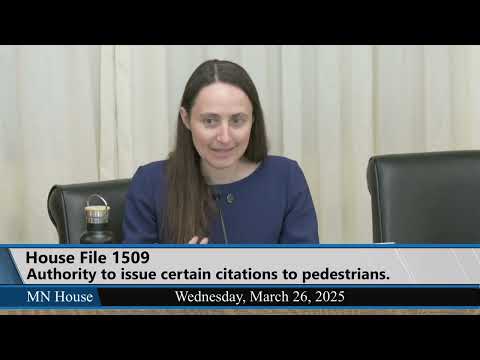
The House Transportation Finance and Policy Committee on March 26 laid over House File 1509, a bill from Representative Jones that would limit law-enforcement citation authority for some jaywalking behaviors.
Representative Jones told the committee the intent is to "right size" the statute so ordinary, low-risk pedestrian crossings are not criminalized: "If literally everyone is breaking the law and subject to enforcement, I think something is fundamentally wrong," she said. The bill would decriminalize three scenarios specified by the author: crossing during steady yellow or red traffic signals, entering a crosswalk with a flashing "don't walk" pedestrian signal, and crossing between operating signals (midblock) where no safety hazard exists. The bill text retains law enforcement's ability to investigate or charge people in the case of hazard, criminal liability, or a safety incident.
Testimony came from disability advocates and active-transportation groups. Michael Wojcik, executive director of the Bicycle Alliance of Minnesota, described the proposal as "common sense" and said in some cases following jaywalking laws strictly can make people less safe; he noted the advisory council on traffic safety's review of crash locations. Bryce Maples, who uses a wheelchair, said blocked or impassable sidewalks often force people with disabilities into the roadway, and current law can criminalize those actions: "This is a crime. I am committing a crime by trying to get around as a person with disability," Maples said.
Committee members raised data questions and safety concerns. Representative Joy asked whether ticket totals were available; staff suggested DPS could follow up. Several members called attention to letters in the packet from the Minnesota Police Chiefs Association and the Police Officers Federation opposing the bill; Representative Kasnik read excerpts that said removing enforcement authority risks pedestrian and officer safety. Representative Murphy asked about liability in crashes; Mr. Wojcik answered that the bill preserves existing liability rules and would not remove culpability for unsafe conduct.
Representative Jones said she is committed to working with law enforcement on the proposal; she renewed the motion to lay the bill over for possible inclusion and the committee agreed to keep the bill in committee for further work.