Get Full Government Meeting Transcripts, Videos, & Alerts Forever!
Get email alerts on the Public Art Entry Monuments topic
No spam. Unsubscribe anytime.
Cathedral City studies standardized entry monuments; staff outline sizes, cost ranges and possible locations
Summary
At a study session, city staff reviewed options for a standardized entry-monument program — presenting size options, preliminary cost estimates, potential locations across the city and funding approaches. No formal decision was made; staff were asked to refine estimates and incorporate the program into capital planning and the budget process.
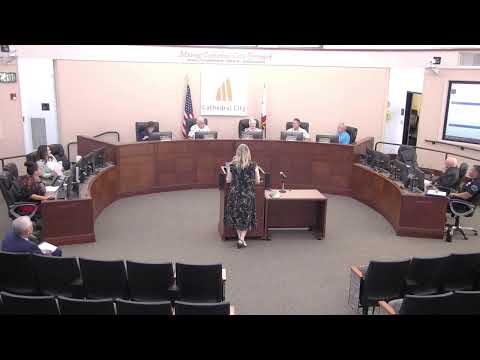
City staff presented a proposal for a standardized entry-monument program for Cathedral City during a City Council study session, describing background, possible sizes and preliminary cost estimates and identifying potential locations for installations across the city.
John Corella, a city staff member who led the presentation, said the proposal builds on prior Public Arts Commission work and the city’s five-year strategic plan action to develop an “entryway, median and lighting master plan.” Corella said the city already owns the original Mountains Cathedral sculpture outright, including copyrights, from a 2005 purchase from artist Michael Paul Thierry, who has since died.
Corella described four size concepts derived from the original sculpture. He said the largest, the full-scale sculpture, is roughly 12 feet tall and would be challenging to site in many medians. A quarter-scale mockup was described as about 3 feet tall, 1 foot wide and 3.5 feet deep (above the base). A half-scale example was described as roughly 6 feet tall, 2 feet wide and 6.5 feet deep (not including the base). Corella said a one-third-to-one-half scale may be the right compromise for many locations.
On costs, Corella emphasized the figures were preliminary estimates from multiple fabricators and excluded base construction. He reported the bidders’ ranges varied widely by size: the half-scale example was described in the presentation as roughly $74,000 to $148,000 (fabrication only, per the estimates shown), while other intermediate estimates for smaller scales varied across multiple ranges presented to council. Corella said base construction costs were separate and gave differing figures during the presentation; he described base estimates as being in the low five-figure range but noted the estimates provided were preliminary and location-dependent.
Corella recommended exploring alternative materials — for example, aluminum instead of brushed stainless steel — to reduce fabrication cost and ease manufacturing. He also said costs could fall if a fabricator re-used templates across multiple monuments.
Staff identified about 11 potential entryway locations around Cathedral City that could host monuments or signage, including East Palm Canyon, West Palm Canyon, Dinah Shore (near Plumlee), Gerald Ford (west of Plumlee), the Cathedral Canyon/Dinah Shore gateway, Ramon Road (West Entry / Landau area), Vista Chino at the west border, Varner Road, Palm Drive, Mountain View Drive and Bob Hope Drive. Councilmembers also suggested adding Deep Palm north of I‑10 (near the freeway off-ramp) as an additional potential location.
Councilmembers and commenters raised several practical questions. Concerns included vandalism or vehicle collisions, the city’s insurance deductible and possible subrogation, and whether smaller monuments would be visible enough to serve as consistent branding. City staff noted the city’s self-insured retention would affect replacement costs and that a special insurance rider for artwork could be investigated.
Several councilmembers urged a staged rollout rather than installing all monuments at once. Corella and other staff suggested integrating monuments into planned capital projects where feasible (for example, median work tied to the undergrounding/MUP and Ramon Road widening projects) and programming installations incrementally in future budgets or the CIP. Councilmembers also recommended involving the Public Arts Commission in design and siting decisions and exploring mixed funding sources including general funds, council district funds, CIP allocations, art grants and private donations or crowdfunding for bases or plaques.
Public commenter Alan Carvalho praised other recent city efforts and expressed support for the monument program, saying the city’s amphitheater events “are really getting a lot of buzz. A lot of people are loving it.”
The study session produced no formal vote or adoption of a program. Staff were asked to refine size and site measurements for specific medians, return with firm cost estimates (including bases and site preparation), investigate materials and insurance implications, consult the Public Arts Commission on design and report back as part of the upcoming biannual budget and CIP planning process.