Get Full Government Meeting Transcripts, Videos, & Alerts Forever!
Get email alerts on the Committee Votes Roundup topic
No spam. Unsubscribe anytime.
Committee advances more than 40 bills in rapid vote session; most measures moved favorably
Summary
The Health and Government Operations Committee on March 26 moved a large slate of Senate and House bills favorably (many unanimously), including measures on telehealth reimbursement, behavioral health reforms, procurement and licensing compacts. Most items were acted on with little debate; the committee recorded several unanimous votes.
The Health and Government Operations Committee advanced more than 40 bills on March 26 in a fast-moving session that largely approved cross-filed Senate measures with little discussion.
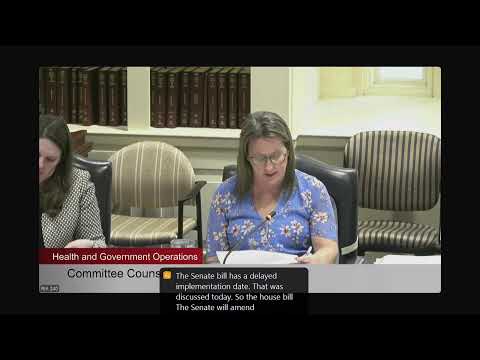
After extended consideration of House Bill 962 (pediatric hospital overstays), the committee proceeded through a lengthy consent-style series of bills. Committee chair Jocelyn Pena Milnek and committee staff read bill captions, noted cross-files and whether prior votes in the House were unanimous, and identified amendments when a Senate or House version required conforming language.
Bills approved favorably (many “identical to its cross file” and many by unanimous voice vote) included measures addressing telehealth reimbursement and audio-only telehealth permanence; the Maryland 9-1-1 and emergency management boards; behavioral health workforce and access reforms; the interstate social work licensure compact; procurement and state leasing clarifications; expanded hearing-aid coverage; revisions to abandoned-property rules; opioid-restoration-fund uses; a work group on newborn home visiting services; and establishment or revision of several work groups and boards (for example, a forensic review board, a public access ombudsman delegation of powers, and a cemetery inventory working group).
Several bills were noted as having amendments that conformed Senate language to House versions or that added specific members to work groups. A number of bills were identified as having unanimous House votes previously, while others were recorded as non-unanimous. Where staff or the chair noted a fiscal change (for example, a corrected fiscal note or budget language), the committee accepted the conforming amendment and voted the bill forward. The committee frequently moved and seconded bills and used voice votes (“all those in favor say aye”), with most items passing.
Examples of bills the committee moved favorably (not an exhaustive list from the transcript): Senate Bill 5 (state-based young adult health insurance subsidies; cross-file H.B. 297), Senate Bill 36 (988 suicide prevention hotline fund; cross-file H.B. 421), Senate Bill 43 (forensic review board), Senate Bill 72 (nursing licensure provisions), Senate Bill 372 (Preserve Telehealth Access Act of 2025 — audio-only telehealth and reimbursement parity, as amended to allow certain Schedule II prescriptions when an established in-person relationship exists), and Senate Bill 900 (behavioral health crisis response system integration with 988 and outcome evaluation; sponsor agreed to delayed implementation language). Several departmental and administrative housekeeping bills (for example, boards and membership changes, cybersecurity and procurement clarifications, and military code modernization) were also approved.
When the transcript recorded specific non-unanimous opposition, staff noted the delegates who opposed or abstained on those items; the session transcript often names opposing delegates immediately after the voice vote. Several bills were explicitly noted as having non-unanimous support in the House earlier; others were recorded as unanimous there. A small number of bills included amendments that were not unanimous in the committee but were adopted and then the bills were moved as amended.
The committee concluded the recorded session after voting on the final slate of bills and directing staff and members to next steps where needed. The transcript contains no numeric roll-call tallies for the majority of these quick voice votes; where a roll-call was not recorded the committee used voice approval.