Get Full Government Meeting Transcripts, Videos, & Alerts Forever!
Get email alerts on the Pediatric Hospital Overstays topic
No spam. Unsubscribe anytime.
Maryland panel backs bill to speed placement of pediatric hospital overstays, funds two coordinators
Summary
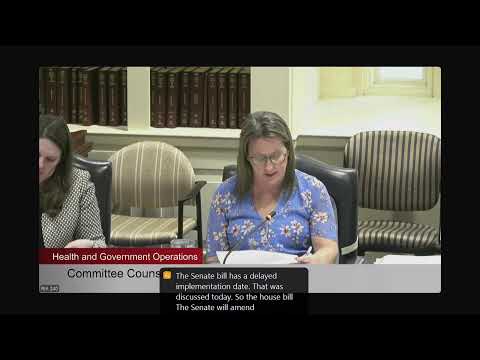
The Health and Government Operations Committee voted March 26 to move House Bill 962 — Public Health — Pediatric Hospital Overstay Patients — favorably with amendments, directing state agencies to coordinate placement of pediatric hospital overstays and creating two pediatric overstay coordinator positions.
The Health and Government Operations Committee voted March 26 to move House Bill 962 — Public Health — Pediatric Hospital Overstay Patients — favorably with amendments, approving language that directs state agencies to coordinate placement and creates two pediatric overstay coordinator positions to help transfer children out of hospitals when clinically appropriate.
Committee chair Jocelyn Pena Milnek opened discussion by saying the panel had already examined the legislation in prior meetings and described it as a negotiated compromise. “These are children that are abandoned at the hospitals as young as 6 years old,” Pena Milnek said. “This is simply, as we like to say here, the right thing to do. These kids deserve more than they're getting from us.”
The bill, as amended and explained to the committee, requires the Maryland Department of Health, in coordination with the Department of Human Services, to ensure a pediatric hospital overstay patient is transferred to and treated in the least restrictive setting when clinically indicated and when possible. The amendments: clarify the definition of “pediatric overstay patient”; require hospitals to seek transfer if a patient remains in the hospital for more than 48 hours and the bed registry shows an appropriate inpatient bed; establish pediatric overstay coordinator positions in MDH and DHS (rather than in the governor's office for children); require those coordinators to coordinate between hospitals, state agencies and providers; expand the state mental health and substance use disorder registry and referral system to include private and state inpatient and outpatient mental health and substance use services; strike certain prior reporting and appropriation requirements tied to Regional Institutes for Children and Adolescents (RICA); and establish a work group on children in unlicensed settings and pediatric overstays.
Committee members asked for details about who would house the coordinators, where children would go after discharge and how the bill would be funded. A committee staff summary read aloud to the panel said $3,000,000 is included in the budget to pay for the two coordinator positions and to assist with hiring staff and wraparound services at receiving centers. The chair said additional funding beyond the $3,000,000 is indicated as potential May 2026 funding in the governor's materials but not guaranteed. The chair said the $3,000,000 “will help pay for the 2 coordinators in addition to the placement to hire the staff that is needed.”
Members pressed on age and placement details. The bill sets the pediatric definition to go “up to age 22,” interpreted in committee as through age 21 under the DLS drafting convention. When asked where children placed in hotels — described in the bill as “unlicensed settings” — would be sent, the chair and staff said that the work group language directs a study of those placements (for example, children currently living long-term in hotels) and is separate from the bill's operative mandates to secure appropriate care for pediatric overstays.
Several delegates raised questions about bed availability and the state bed registry. A member noted the committee previously passed bed-registry legislation (house bill cited during discussion as passed in prior years) and said disagreements remain about how hospitals report whether beds are truly available. Committee members also asked why hospitals are not required to maintain pediatric behavioral-health beds; answers from members and staff described reimbursement and capacity issues and noted that some hospitals have reopened units while no statewide requirement exists to maintain behavioral-health beds.
The committee also added a work-group amendment to include a foster parent representative; that amendment was adopted. Delegate Griffith requested and was added as a sponsor, the chair said. Committee members discussed whether the bill should be an emergency measure but the chair said she would not recommend that step because of funding timing.
The bill was moved and seconded as amended and the committee voted in favor; the transcript does not record a numeric tally. The committee requested the work group convene quickly and produce the required report, with one member noting the bill’s schedule requires the group to report by October.
The bill’s language also removes a prior requirement that MDH review certain reimbursement rates and removes a governor-specified appropriation trigger for RICA positions; instead the enacted language focuses on coordinators, the bed-registry transfer trigger after 48 hours, and the new work group on children placed in unlicensed settings.
The committee chair and members repeatedly framed the bill as a long-standing issue, one they said had been discussed under multiple administrations and that the bill represents a first substantial statutory step to address pediatric overstays.
The committee moved on to other bills after the favorable vote.