Get Full Government Meeting Transcripts, Videos, & Alerts Forever!
Committee reviews wide-ranging amendments to HB1035 covering generation procurements, ratepayer protections and expedited siting
Summary
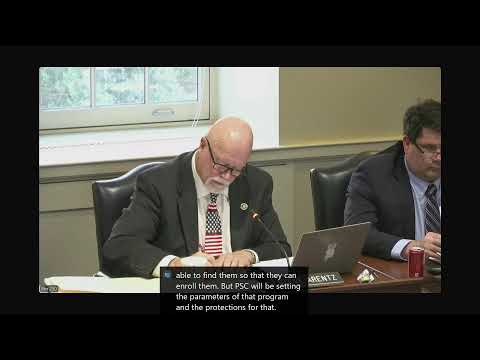
A work group of the Economic Matters Committee on Wednesday reviewed a suite of amended provisions being folded into House Bill 10-35 that would direct procurements for large generation and storage, create a zero-emission credit for new nuclear projects, accelerate CPCN reviews for selected projects, and add multiple ratepayer protections and utility-cost restrictions.
A work group of the Economic Matters Committee on Wednesday reviewed a suite of amended provisions being folded into House Bill 10-35 that would direct procurements for large generation and storage, create a zero-emission credit for new nuclear projects, accelerate certificate-of-public-convenience-and-necessity (CPCN) reviews for selected projects, and add multiple ratepayer protections and utility-cost restrictions.
The amended bill, described to the committee as reprints and amendment sets (for example HB1035 233,226 and HB1035 563,326), would: require the Public Service Commission (PSC) to run a solicitation for roughly 3.1 gigawatts of dispatchable energy generation and a separate solicitation for up to 1.6 gigawatts of transmission-level battery storage; authorize an expedited CPCN process for projects selected in those solicitations; establish a ratepayer-funded zero-emission credit for new nuclear generation; and add new evidentiary and reporting requirements intended to limit certain costs recovered from ratepayers.
Committee staff explained the procurement elements and the expedited CPCN timeline. Under the solicitation process described, PSC and the PPRP (project planning/review program referenced by staff) would identify winning proposals within a short timeline: PPRP would recommend proposals within 45 days after the solicitation closes and the commission would notify applicants within 15 days thereafter. The expedited CPCN timeline for approved projects was described as shortening the usual pre-application and approval sequence to a more accelerated schedule (staff noted a target process on the order of several months rather than a year, with a cited illustrative timeframe of about 385 days from pre-application through approval in some iterations of the draft).
The amendment text as presented also sets selection priorities and reporting requirements. Staff described an…
Already have an account? Log in
Subscribe to keep reading
Unlock the rest of this article — and every article on Citizen Portal.
- Unlimited articles
- AI-powered breakdowns of topics, speakers, decisions, and budgets
- Instant alerts when your location has a new meeting
- Follow topics and more locations
- 1,000 AI Insights / month, plus AI Chat