Get Full Government Meeting Transcripts, Videos, & Alerts Forever!
Get email alerts on the Chemical Weapons Research topic
No spam. Unsubscribe anytime.
Commerce, MDE and proponents seek permitting path for chemical‑warfare research at Aberdeen; lawmakers press for contingency planning
Summary
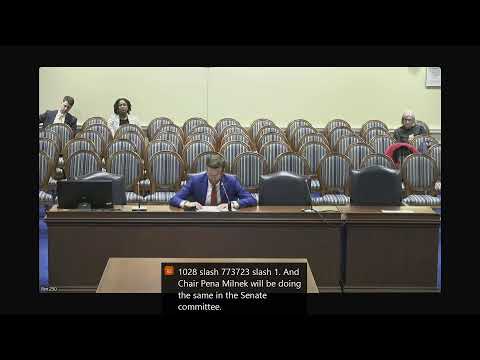
Secretary Harry Coker of the Maryland Department of Commerce told the House Environment and Transportation Committee on March 26 that Senate Bill 253 would permit narrowly defined research and development work on chemical warfare materials at designated research facilities, including Aberdeen Proving Ground’s Chemical Biological Center, under a new RDD (research, development and demonstration) permit process tied to existing controlled hazardous‑substance rules.
Secretary Harry Coker of the Maryland Department of Commerce asked the House Environment and Transportation Committee on March 26 to give Senate Bill 253 a favorable report, saying the bill would authorize narrowly tailored research, development and demonstration (RDD) permits to allow limited thermal treatment for chemical warfare materials at research facilities designated by the U.S. Department of Defense, including Aberdeen Proving Ground’s Chemical Biological Center (CBC).
The bill, Coker said, was amended in the Senate after a work session with Commerce, the Maryland Department of the Environment (MDE) and outside stakeholders. He said the Senate amendments strengthen environmental protections by tying the RDD permit process to existing controlled hazardous substance facility requirements and by preserving near‑real‑time emissions monitoring and public participation in permitting. “The amendments actually made the bill stronger,” Coker said.
Committee members pressed agency witnesses on safety planning, oversight and the sources of the chemical samples that could be studied under the bill. Delegate Dahlia Healy asked why the bill did not explicitly require an emergency‑management or contingency plan; Coker replied, “We are on board with having explicit requirement for a contingency plan,” and said the facility already maintains contingency arrangements but the bill could be amended to spell out the requirement. MDE technical staff said contingency/ emergency planning is part of existing practice and would be reinforced in permitting.
Edward Hammerberg, a technical specialist in MDE’s Land and Materials Administration who handles hazardous‑waste permitting, told the committee MDE has engineering expertise to evaluate plans and access to federal subject‑matter experts when specialized chemical‑weapons questions arise. He said that MDE has staff with relevant experience, including at least one person with prior experience at Aberdeen, and that the department has coordinated with EPA and counterparts in other states on similar work.
Lawmakers pressed whether some materials reviewed under the proposed RDD authority could be imported from other jurisdictions or countries. Hammerberg said that possibility depends on the threat being investigated and the Department of Defense’s needs; if material is brought to Aberdeen for analysis, the DoD would coordinate with state regulators. Multiple members asked for documentation referenced in earlier briefings; Delegate Jay Jacobs said he wanted a copy of the treaty that permits a single designated research site. Hammerberg and other witnesses identified the Chemical Weapons Convention as the international treaty that allows each signatory one designated site for limited defensive research. “Aberdeen Proving Ground is the designated site in the United States under that treaty for those activities,” MDE staff said.
Several lawmakers noted public concern about past chemical‑agent storage and demilitarization activities at Aberdeen (historic mustard‑agent disposal was referenced) and asked about prior incidents and whether any off‑site impacts had occurred. MDE staff said they were not aware of off‑site incidents and emphasized that existing Army and facility emergency procedures would be supplemented by permit‑specific contingency requirements.
Commerce and MDE witnesses said the bill requires annual reporting to MDE and biennial assessments of operations’ effects on local ecosystems, air quality and public health. Coker said that federal partners, including DoD, have offered subject‑matter support and operational training that had helped reduce the bill’s fiscal note.
No formal committee vote on SB 253 was recorded in the transcript; the sponsor and agency witnesses requested a favorable report. Several members asked for follow‑up: copies of the Chemical Weapons Convention text and additional briefings with Baltimore County legislators who represent parts of Aberdeen’s downwind area.
Ending: Committee members closed the hearing after further questions and pledged follow‑up briefings; the transcript records agency agreement to consider an explicit contingency/emergency‑planning requirement and to provide additional information to legislators.