Get Full Government Meeting Transcripts, Videos, & Alerts Forever!
Get email alerts on the University Audit Procurement topic
No spam. Unsubscribe anytime.
Senate bill would tighten oversight of university-linked "HIDAs" after audit finds multimillion-dollar losses
Summary
Sen. Clarence Lam presented legislation requiring the University System of Maryland Board of Regents to report on and adopt policies governing High-Impact Economic Development Activities after an audit found major spending and oversight failures at UMGC-linked entities.
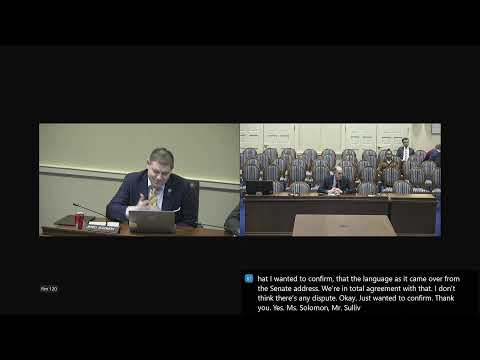
Sen. Clarence Lam urged the Appropriations Committee to approve Senate Bill 439, a bill directing the University System of Maryland Board of Regents to report expenditures and adopt accountability rules for university-created business entities known as High-Impact Economic Development Activities (HIDAs).
The bill stems from a legislative audit of the University of Maryland Global Campus (UMGC), Lam said, which found that UMGC provided roughly $25 million in state funding to create two HIDA entities and later spent about $26 million on a single IT project that proved nonviable. "Of this $26,000,000 in state funding that was spent by UMGC on these IT projects, dollars 22,000,000 was lost and irrecoverable," Lam said during the hearing.
The audit, Lam told the committee, found that UMGC had spun internal functions such as its IT unit into separate HIDAs and then contracted directly with those entities, often without competitive procurement. The auditors also reported that HIDA leadership and UMGC leadership overlapped and that auditors were at times told they could not audit the HIDA entities despite state law requiring auditability for entities that receive state funds.
"These HIDAs were supposed to be independent from the entity that created them, in this instance, UMGC, but they weren't," Lam said. SB 439 would require the Board of Regents to report how state money is being spent on HIDA activities, assess net benefits to the state, adopt policies to ensure HIDAs operate with appropriate oversight, and make explicit that HIDAs are not a vehicle to reduce university staff through cost-savings transfers.
Lam also described proposed changes that would remove HIDA exemptions from standard state procurement rules, so that in the future University System institutions would need to use competitive procurement rather than treating a HIDA as a sole-source contractor.
Lam said he and audit staff met with University System leadership, including President Perman and Board Chair Gooden, and that system officials "are comfortable with these reforms and they're actually working on implementing some of the changes currently." He asked the committee for a favorable report.
No formal vote was recorded during the hearing. Committee members did not register opposition at the time of the presentation.
Ending — The bill is presented as a response to specific audit findings about UMGC's use of state funds and aims to clarify audit authority, procurement rules and Board of Regents oversight to prevent similar outcomes in the future.