Get Full Government Meeting Transcripts, Videos, & Alerts Forever!
Get email alerts on the Community Violence Intervention And Referrals topic
No spam. Unsubscribe anytime.
Advisory council debates CVI models, police community units and workforce referrals for at-risk youth
Summary
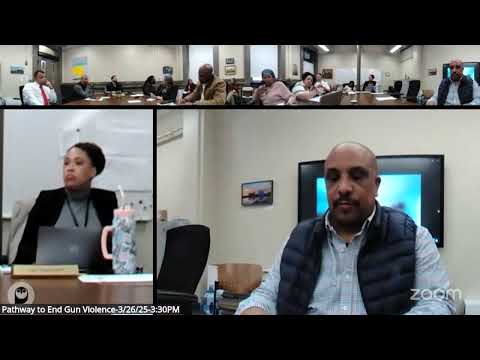
Council members compared local policing units and Baltimore's community-violence-intervention (CVI) approaches, discussed the role of trust and street outreach workers, and proposed employer-connected workforce referrals and family supports as parts of a broader strategy.
Council members spent a substantial portion of the meeting comparing community-violence-intervention (CVI) strategies and policing models and discussing nonpolice interventions, workforce referral systems and family-level supports.
Participants reviewed what they described as Baltimore’s recent model — reallocating responsibilities for a small group of officers to specialize in handoffs to community providers — and weighed it against Providence’s current structure. Providence police representatives described two local units: the Violent Crime Task Force and a Community Response Team (CRT). The meeting recorded that the violent crime task force operates with about six officers and a sergeant; the CRT was described as a flexible unit with a mix of uniformed and plain-clothes officers.
Several speakers emphasized that CVI success depends on trust. "It's very hard to expect...that volunteers and police and community groups will just work perfectly together," said Lisa Pino Warren, who described long-term trust-building between outreach workers and community members. Meeting participants pointed to the Nonviolence Institute and other street outreach workers as critical actors who can de-escalate imminent incidents and make connections that permit later referrals to jobs, training and services.
Members proposed practical steps: a referral pathway for young people at risk, employer outreach to recruit trainees, periodic job fairs at downtown sites such as Kennedy Plaza, and coordination with the Department of Labor and Training (DLT) to bring recruiters into community programs. One participant outlined existing state-level workforce resources and training dollars: "over $11,000,000 in job training, $6,000,000 in WIOA and $3,400,000 in Youth WIOA," and argued those funds should be funneled to local recruitment and placement efforts.
Council members also discussed structural barriers: housing instability, the limits of local relocation resources, and the need for family therapy and mental-health wraparound services for younger children. Some attendees said a subset of youth are so deeply embedded in violent networks that only extreme interventions (including out-of-area relocation) might change their trajectories; others urged earlier prevention in elementary grades.
Participants agreed on two immediate follow-ups: (1) explore a call with Baltimore to ask technical questions about their policing/CVI coordination and (2) develop a pilot referral system that connects outreach workers to DLT recruiters and local employers for monthly or quarterly hiring events.