Get Full Government Meeting Transcripts, Videos, & Alerts Forever!
Get email alerts on the Catfa Sales Use Exclusion topic
No spam. Unsubscribe anytime.
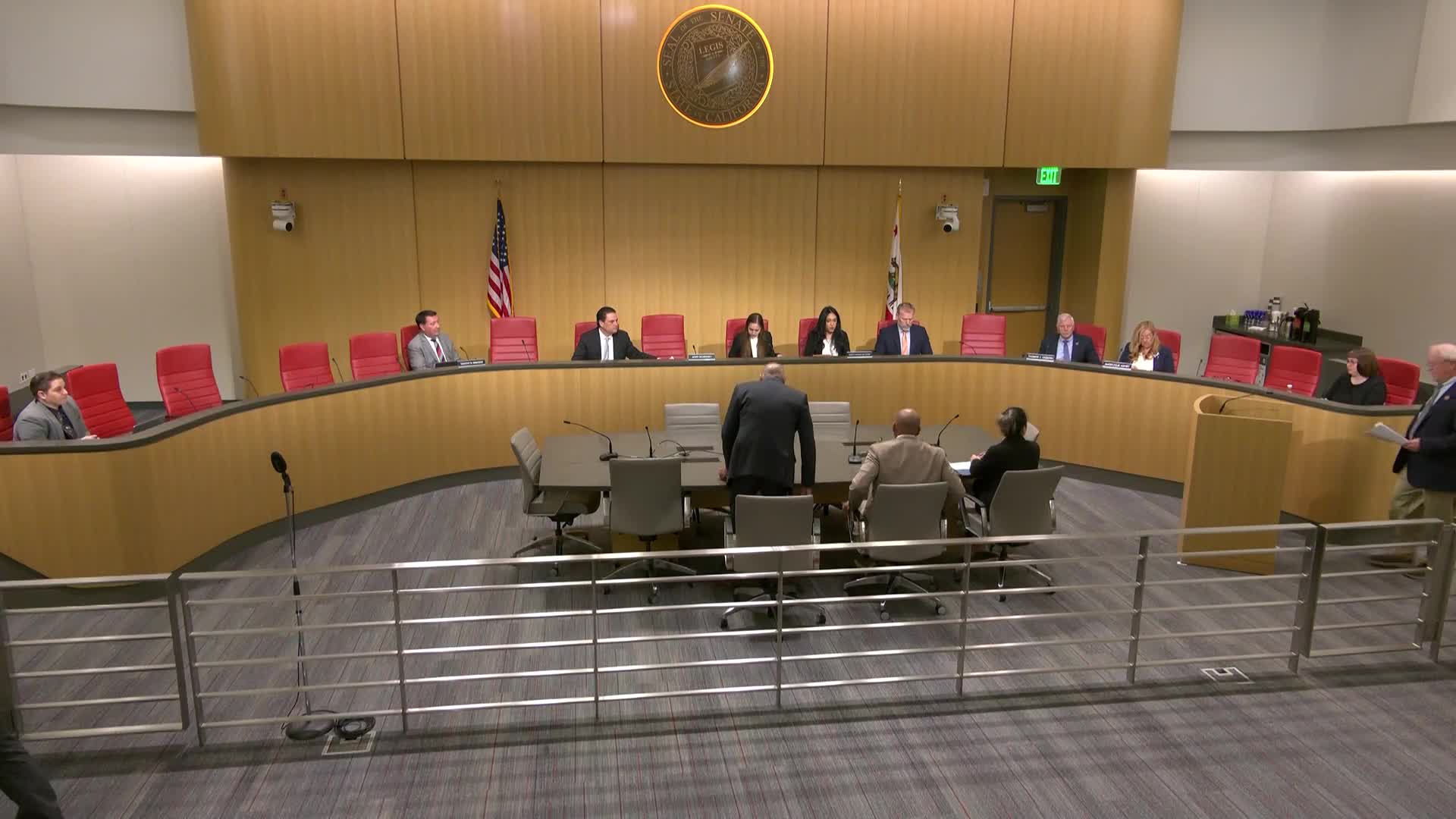
Committee advances SB 86 to reauthorize and expand CATFA sales and use tax exclusion for clean‑tech manufacturing
Summary
Senate Bill 86, authored by Senator McNerney, would reauthorize and expand the California Alternative Energy and Advanced Transportation Financing Authority (CATFA) sales and use tax exclusion program, increase program caps and include additional technologies; the Revenue and Taxation Committee unanimously moved the measure to Appropriations.
Senate Bill 86, presented by Senator McNerney, would indefinitely reauthorize the CATFA sales and use tax exclusion program, raise program caps and expand eligible technologies to include emerging areas such as fusion energy and advanced manufacturing. The Revenue and Taxation Committee voted to pass the bill to the Committee on Appropriations.
Deputy Treasurer Cam Morton, representing State Treasurer Fiona Ma in her role as chair of CATFA, described the sales and use tax exclusion (SEUE) program as a long‑running tax‑based incentive that has supported clean‑tech manufacturing since 2010. Morton said the program has incentivized over $15.4 billion in projects across more than 41 counties, funded over 354 projects and supported the creation or retention of over 136,000 jobs according to the authority’s net benefits test. Morton told senators the program is fee‑supported and not expected to impact the general fund.
Sanjeev Malhotra, CEO of Sparks (a battery manufacturer), testified that CATFA incentives were a major factor in the company’s decision to locate an end‑to‑end lithium‑ion phosphate battery factory in Sacramento’s Metro Air Park that he said would create roughly 250 union jobs and include a workforce training center. He said the company considered other states for manufacturing but decided to locate in California because of programs like CATFA.
Supporters included labor organizations, trade associations, manufacturing and clean‑tech firms and local economic development representatives. Representatives of the California State Association of Counties and the League of California Cities did not take a formal position but raised concerns about reduced sales and use tax revenue to local governments; a witness cited an estimate of up to $300 million in ongoing state and local sales tax revenue loss annually if the program is expanded (that estimate was mentioned in opposition testimony as a fiscal concern for local governments).
Senators from Sacramento and other regions expressed support and several offered to co‑author. Committee members asked for and the author accepted to work on reporting language so the legislature can review program effectiveness periodically. The committee moved SB 86 to the Committee on Appropriations; the motion passed on a recorded vote and the bill was reported out with a final committee tally recorded as 5‑0.
Key clarifications recorded in committee: CATFA’s SEUE program is administered by CATFA under the State Treasurer’s office; it uses a net‑benefit evaluation, considers location and workforce partnerships, and is supported by program fees rather than an ongoing general fund appropriation per the treasurer’s testimony.
SB 86 now proceeds to the Committee on Appropriations for further fiscal review and potential amendments.