Get Full Government Meeting Transcripts, Videos, & Alerts Forever!
Get email alerts on the Traffic Calming topic
No spam. Unsubscribe anytime.
Committee reviews speed‑management, traffic‑calming plan with pilots, bulb‑outs and tactical urbanism
Summary
Staff presented an eight‑corridor speed‑management shortlist and a toolbox emphasizing quick‑build pilots (tactical urbanism), bulb‑outs and neighborhood gateway features; the committee discussed piloting measures on Bolivar, Sycamore and Fry corridors and asked for data behind the shortlist.
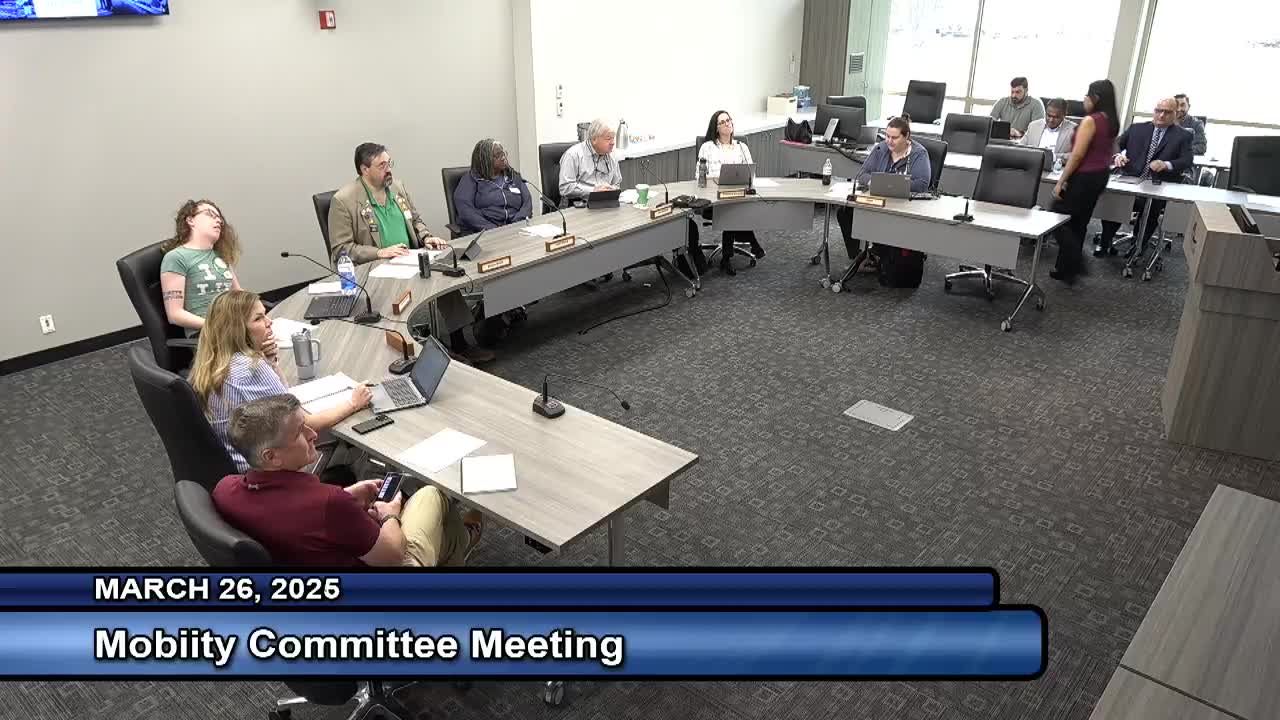
The Denton City Mobility Committee spent 30 minutes on March 26 reviewing a speed management and traffic calming action plan that emphasizes "quick build" demonstration projects and community engagement to reduce vehicle speeds and improve conditions for pedestrians and bicyclists.
Roy Scott, Transportation Services, said the project list was developed from prior speed studies, input from traffic enforcement and engineers and a survey of community support, constructability and coordination opportunities. "It certainly hits the highest, the highest priority is human life over all road decisions," Scott said, summarizing the plan’s guiding principle.
The staff plan presented a toolbox that prioritizes narrowing the roadway, curb extensions and medians, and small roundabouts or chicanes where appropriate. A short video narrated by Alexis Pickering explained one of the recommended elements: "Full bouts are an essential part of traffic calming ... it actually decreases the length that pedestrians and bicyclists have to cross, into an intersection," the video said.
Committee members discussed three near‑term corridors that staff flagged: Bolivar Boulevard (a neighborhood corridor intended as a bike boulevard / low‑stress route), Sycamore (gateway treatments and short medians), and a larger Fry Street area. Staff recommended tactical urbanism pilots to test curb extensions, bollards, lane striping and temporary separators before committing to permanent construction.
Public comment from neighborhood resident Lauren Penn tied to the traffic‑calming discussion. Penn said she led a walking audit in North Lakes and urged that the city include walking audits as part of the traffic‑calming planning process. "Our neighborhood wants to walk more. We want to walk to businesses," Penn said, noting missing sidewalks and wide intersections that make crossings feel exposed. Committee members responded that walking audits and community pilots were appropriate next steps.
Several members asked staff to provide the underlying data that produced the prioritized shortlist and to consider how the city’s Vision Zero and Complete Streets policies would integrate into design standards. Staff said they will return with more detailed speed studies, prioritization data and recommended engagement plans. They also noted potential midterm updates to the mobility plan and transportation criteria manual to give designers more flexibility to treat streets by context rather than only by functional classification.
Ending: Staff will perform speed studies on selected corridors, advance quick‑build pilots with public outreach, and provide the committee with the data and prioritization rationale for the shortlisted corridors for further review.