Get Full Government Meeting Transcripts, Videos, & Alerts Forever!
Get email alerts on the Dual Enrollment Ccap topic
No spam. Unsubscribe anytime.
Committee advances bill to align CCAP instructional-minute rules with early and middle college models
Summary
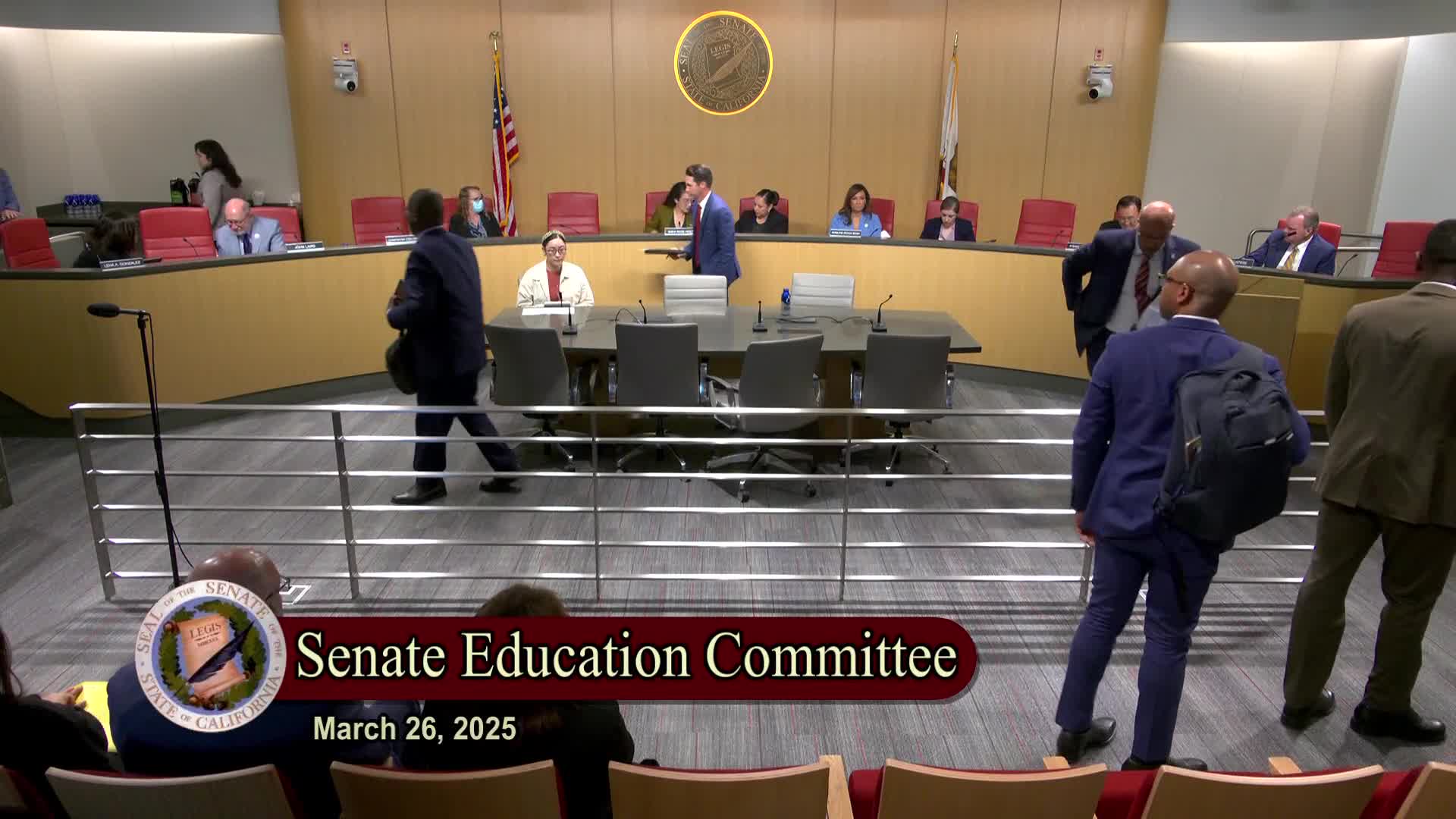
SB 438, authored by Senator Cabaldon, would reduce the instructional-minute threshold for the College and Career Access Pathways (CCAP) dual-enrollment program to match early and middle college high school standards; the Senate Education Committee sent the bill to the Appropriations Committee, 7-0.
The Senate Education Committee voted to pass SB 438, authored by Senator Cabaldon, to the Senate Appropriations Committee after hearing testimony from educators and dual-enrollment practitioners about expanding access for underserved students.
SB 438 would align the instructional-minute apportionment requirement for the College and Career Access Pathways program with the lower threshold used by early college and middle college high schools. Supporters told the committee that the change would remove a scheduling and funding barrier that discourages some school districts from offering CCAP courses and can limit participation by students who face transportation, work or family constraints.
Senator Cabaldon described CCAP as an effective intervention for equity in California, citing a Public Policy Institute of California finding that 82 percent of program participants enroll in college within a year compared with 66 percent of nonparticipants. He said properly designed dual-enrollment courses can reduce time-to-degree and avoid duplicative college tuition costs.
Ron Carruth, executive director of the California High School Coalition and a retired superintendent, said reducing the required minutes from 240 to 180 would “have a profound impact on the students in California in every single community,” particularly those that are underserved. Elizabeth On, a dual-enrollment practitioner in the San Gabriel Valley, described local data showing 91 percent of participating students earned college credit with a grade of A, B or C last year but said scheduling barriers disproportionately affect Hispanic and other underrepresented students.
Supporters included school district officials, education nonprofits and charter-school advocates who said the bill would help districts maintain ADA funding while allowing broader access to college courses for high school students. No lead opposition witnesses appeared before the committee.
Senator Laird moved the bill; the roll call vote was recorded as Perez — aye; Ochoa Bog — aye; Cabaldon — aye; Choi — aye; Cortese — aye; Gonzales — aye; Laird — aye. The motion carried unanimously, 7-0, and SB 438 was referred to the Senate Appropriations Committee.