Get Full Government Meeting Transcripts, Videos, & Alerts Forever!
Get email alerts on the Clean Energy Tax Conformity topic
No spam. Unsubscribe anytime.
Committee backs bill to conform California code to federal clean‑energy tax transfer rules
Summary
Senate Bill 302, presented by Senator Padilla, would align California tax law with the federal Inflation Reduction Act to allow transfer or sale of certain federal clean‑energy tax credits without state tax penalties; committee voted to pass the measure to appropriations as amended.
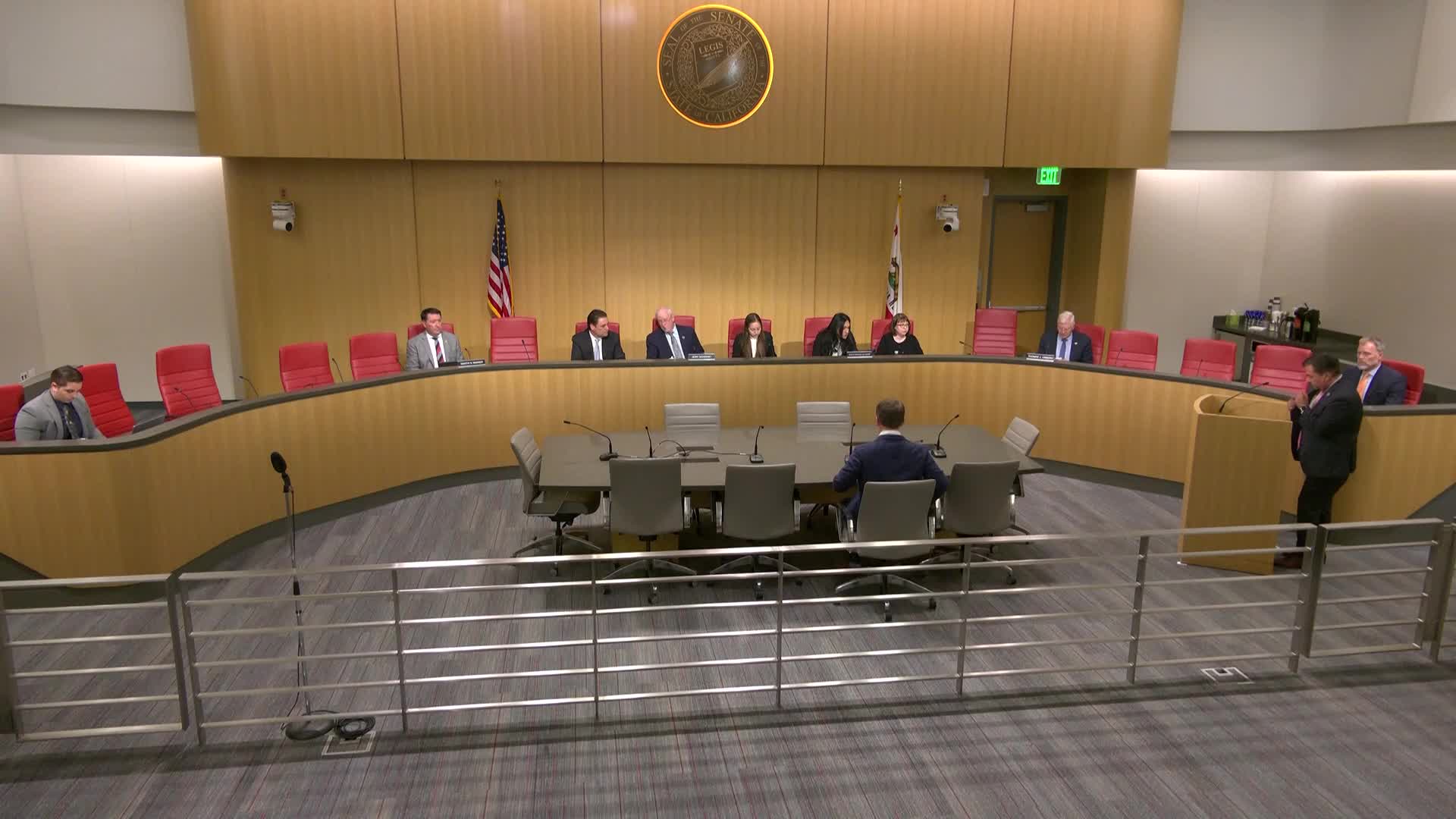
Senate Bill 302, authored by Senator Alex Padilla, was advanced by the Senate Revenue and Taxation Committee to the Committee on Appropriations after widespread support from clean energy industry groups and trade associations.
Padilla described SB 302 as a conformity bill that updates California law to reflect mechanisms in the federal Inflation Reduction Act allowing eligible taxpayers to monetize or transfer certain federal clean‑energy tax credits. He told the committee that without conformity California businesses that sell federal energy tax credits could be required to include the sale proceeds in gross income for state tax purposes, reducing the value of the federal incentive and raising costs for clean‑energy projects.
A representative of the American Clean Power Association, Alex Jackson, testified that the bill would remove a state tax on the sale of federal tax credits used to finance clean‑energy projects and that nonconformity has made California an outlier among states competing for clean‑energy investment. Jackson cited an independent analysis showing that conformity could lower residential rates for customers of investor‑owned utilities by as much as about 3 percent (roughly $50 annually by 2040 in the study’s baseline), by enabling lower project costs.
Multiple industry groups gave testimony in support, including the Large Scale Solar Association, the Solar Energy Industries Association, the California Taxpayers Association, the California Energy Storage Alliance, and several developers and trade groups. Supporters framed the bill as an affordability measure for ratepayers and a competitiveness tool to attract clean‑energy investment to California.
No witnesses spoke in recorded opposition at the hearing. Committee members praised the bill’s incentive structure and bipartisan appeal; a senator offered to co‑author the measure. The committee voted to pass SB 302 as amended to the Committee on Appropriations. The motion carried on the record and the committee reported the bill out by a vote recorded as 5‑0.
Padilla and witnesses emphasized that the bill concerns federal tax credits and not state tax credits and that conformity was intended to allow California taxpayers to utilize federal incentives as intended.
SB 302 proceeds to the Committee on Appropriations for further review.