Get Full Government Meeting Transcripts, Videos, & Alerts Forever!
Get email alerts on the Transportation Funding topic
No spam. Unsubscribe anytime.
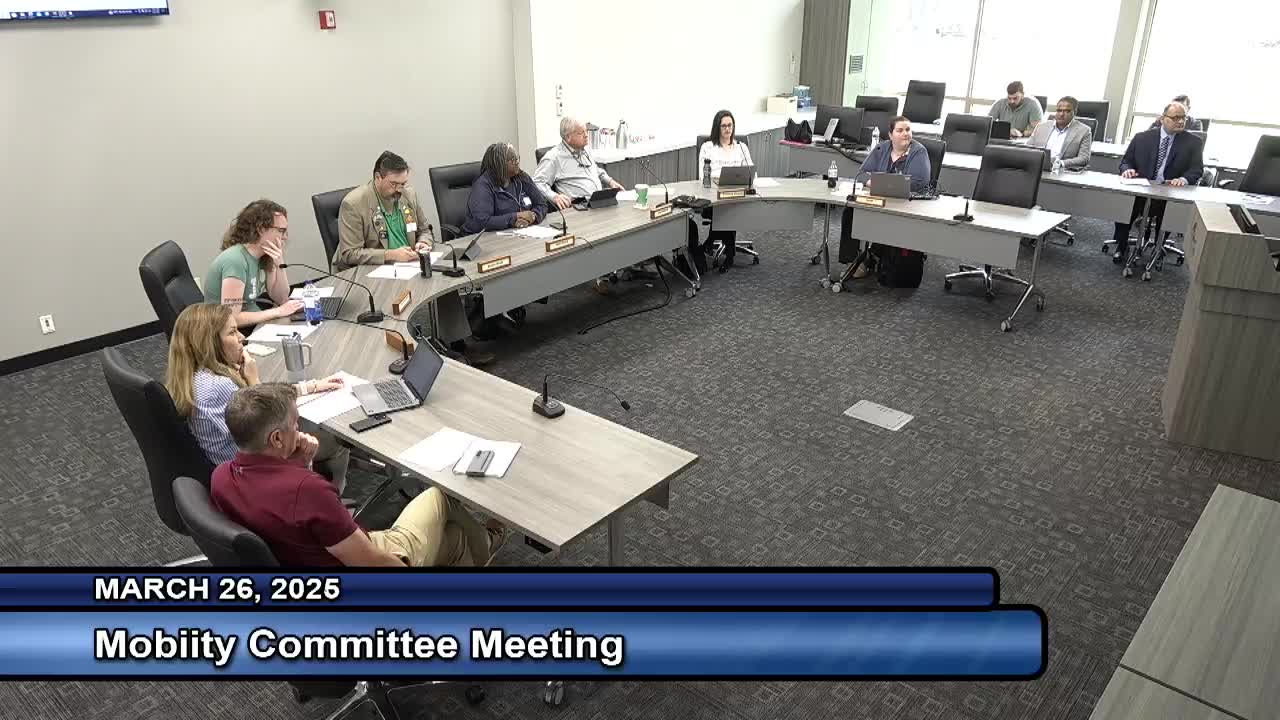
Mobility committee backs TRIP funding package for sidewalks, Katy Trail bridge and quiet-zone work
Summary
The Denton City Mobility Committee on March 26 reviewed a FY2025 TRIP funding application to support sidewalk completion on Colorado Boulevard, multimodal work in the Frye District, a Katy Trail extension requiring a pedestrian bridge and pedestrian improvements tied to a downtown UPRR quiet‑zone.
The Denton City Mobility Committee on March 26 reviewed a proposed FY2025 Transportation Reinvestment Program (TRIP) funding application that would direct DCTA-associated funds toward sidewalk and multimodal work, a Katy Trail extension and pedestrian improvements tied to a downtown Union Pacific Railroad (UPRR) quiet‑zone effort.
Greg Scott, Transportation Services, briefed the committee on staff’s recommended package and said the city proposes three new projects for TRIP funds plus two adjustments to earlier (2022) projects. "We are assuming that we will eliminate the gap, the sidewalk gaps on the South Side Of The of Colorado and we will, bring all of the South Side Of Colorado up to ADA standards," Scott said.
Seth Garcia, interim director of Capital Projects, outlined the largest items discussed at the meeting. Garcia said the Katy Trail extension now requires a pedestrian bridge at a large floodway, which has driven up costs in the design phase and is a main reason the project’s budget request is larger than typical trail fixes. "Ultimately, safety is the key there," Garcia said of the redesign that would move the pedestrian route to the north side of the railroad tracks and close the existing at-grade crossing.
Garcia also said staff wants to expand the scope for Moore Street work to include tactical urbanism and planning, not only design and construction as originally funded through DCTA. He said the change is a scope revision rather than a net increase in the TRIP request. In addition, about $480,000 in savings from a prior all‑way crossing project has been proposed for reallocation to three downtown pedestrian crossings (Hickory, McKinney and Sycamore) that connect to the DCTA station and Katy Trail.
Committee members pressed staff on prioritization and funding rules for TRIP money. One member asked whether TRIP money was being used for street repairs rather than transit improvements; Scott and Garcia explained that TRIP funds are placed in a project “bucket” that supports multimodal elements, including sidewalks and rail crossing work, while other funding sources cover larger street infrastructure. Garcia noted rail crossing work requires extending track panels and specialized construction, which increases per‑linear‑foot costs for sidewalk work adjacent to tracks.
Farhan (deputy director, Transportation Services) said the TRIP package will go to City Council and to the DCTA board as part of the formal application and resolution schedule. Staff said they will return to council on April 27 with the resolution and will present the proposals to the DCTA board.
As part of the TRIP discussion, committee members and staff flagged coordination needs: design and public engagement for Colorado Boulevard (south side sidewalk and on‑street bike accom modations), Fry District improvements around Mulberry and Frye, and the Katy Trail work east of Edwards where a new pedestrian bridge is now included in the plan. Staff said some sections of Colorado Boulevard cross county property and that planned improvements will involve coordination with Denton County and adjacent developers.
No final construction contracts were authorized at the committee meeting; staff sought direction and approval to proceed with the TRIP application and scope adjustments that will be considered by council and the DCTA board.
Ending: Staff said they will return with a resolution for council consideration, provide DCTA with the package for its board review and continue public engagement on design details and tactical urbanism pilots prior to permanent construction.