Get Full Government Meeting Transcripts, Videos, & Alerts Forever!
Get email alerts on the Genealogy Verification For Reparations topic
No spam. Unsubscribe anytime.
Senate committee approves bill to have CSU develop genealogical eligibility standards for reparations
Summary
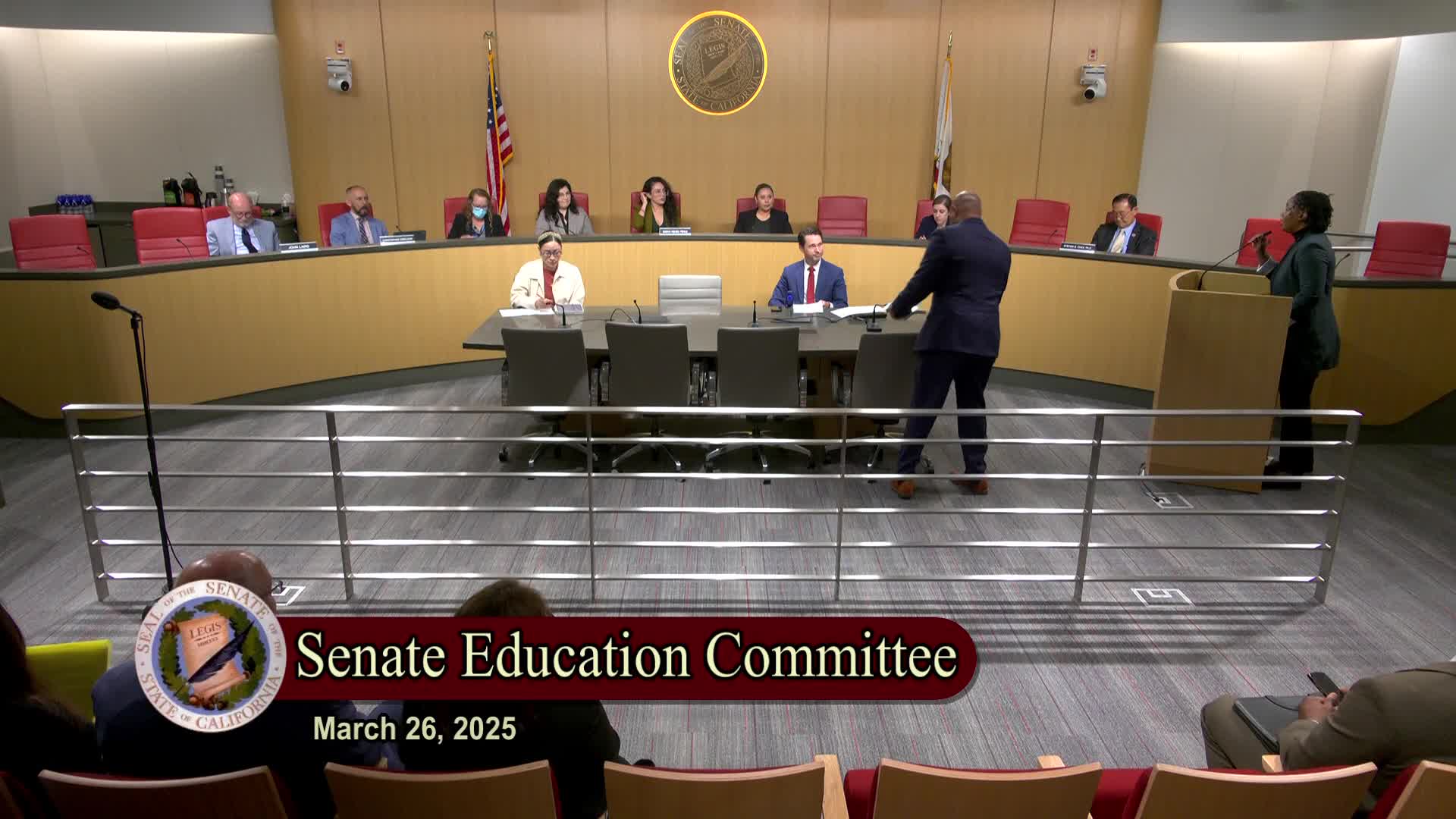
The Senate Education Committee voted to send SB 437, which would direct the California State University (CSU) to research and develop standards for verifying descent from victims of American chattel slavery, to the Senate Judiciary Committee after hearing both support and opposition.
The Senate Education Committee voted to forward SB 437, authored by Senator Weber Pearson, to the Senate Judiciary Committee after testimony for and against creating a state-backed process for verifying genealogical claims tied to reparations.
SB 437 would direct the California State University to research and develop eligibility standards and an evidence-based process to determine whether an individual is a descendant of a person who was a victim of American chattel slavery. The bill’s author said the measure responds to a recommendation in the California Reparations Task Force report for improved access to expert genealogical research and would place the research and methodology work within a public institution to ensure accountability and limit commercial exploitation of data.
Senator Weber Pearson, the bill’s author, told the committee the 1,100-page task force report did not specify how to determine lineage and said SB 437 “follows the recommendations from the task force, by allowing the ability to figure out how we determine one’s eligibility.” She also said the bill requires the CSU to report annually so the Legislature and stakeholders can track progress.
Supporters said a publicly administered verification process could help ensure reparative programs reach intended recipients. Dwayne Crenshaw, president and CEO of the Greater Sacramento Urban League, said, “Establishing a fair research based lineage verification process is critical to ensuring that resources meant to address historical inequities reach the right communities.” Michael Willis, board chair of the African American Genealogical Society of Northern California, described standard genealogical methods and said professionals can trace many families back to the 19th and 18th centuries using documentary sources and commercial databases.
Opponents said the bill would duplicate existing work, redirect implementation funds, and delay reparative programs. Chris Lausch, lead volunteer organizer and advocate with the Coalition for Just and Equitable California, said the proposal “directly contradicts the recommendations of the California Reparations Task Force” and warned it would “direct millions of taxpayer dollars originally budgeted for reparations implementation to a multimillion dollar genealogy research project with no start date and no end date to the research.”
A representative of the California State University, Mary Moyle, told the committee the CSU was still finalizing a position but thanked the author for working with the system. The author said CSU would have flexibility to use internal resources or partner with outside organizations or institutions with genealogical expertise.
The committee recorded a motion by Senator Cortese to pass the bill to the Senate Judiciary Committee. The roll call vote was Perez — aye; Ochoa Bog — no; Cabaldon — aye; Choi — no; Cortese — aye; Gonzales — aye; Laird — aye. The motion carried, 5 ayes and 2 noes. The committee analysis and testimony noted ongoing questions about start and end dates, potential cost, and how the CSU would select campuses or partners to carry out the research.
SB 437 drew a mix of institutional and grassroots support and opposition and will next be considered by the Senate Judiciary Committee.