Get Full Government Meeting Transcripts, Videos, & Alerts Forever!
Get email alerts on the State Budget Mva topic
No spam. Unsubscribe anytime.
Assembly panel examines patchwork plan to cover motor vehicle account shortfall
Summary
Assemblymembers and analysts urged caution about a proposed one-time transfer and warned the motor vehicle account has a long-running structural shortfall that will recur without ongoing revenue or expenditure changes.
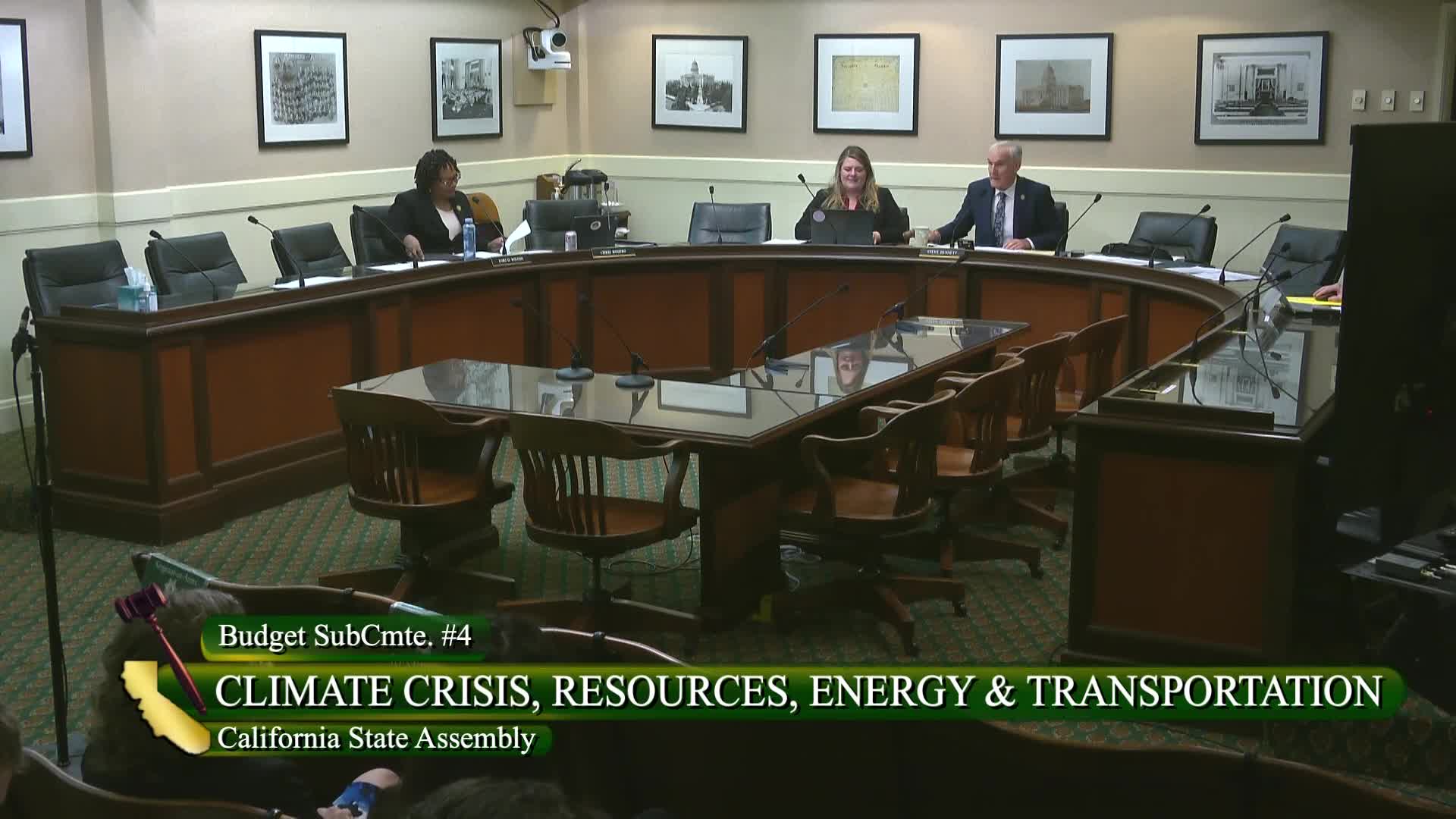
Assemblymember Steve Bennett, chairing a California State Assembly informational hearing on transportation funding, opened the meeting by placing one item at the center of the day’s discussion: the motor vehicle account (MVA) shortfall and the administration’s proposal for a one‑time transfer.
The Legislative Analyst’s Office told the committee the administration’s one‑time solution is “not unreasonable but it does have trade offs associated.” Rachel Ehlers of the LAO said the proposal relies in part on shifting funds that have been used for clean energy (including Proposition 4/GGRF‑related transfers) and warned that the Greenhouse Gas Reduction Fund’s receipts have been tracking below prior projections. “Fundamentally this represents a one time solution to an ongoing problem,” Ehlers said, adding that expenditures are growing faster than revenues and that “eventually this is going to keep coming back before you.”
The administration’s presenter outlined the current fiscal picture for the account, saying total revenue for 2025–26 is expected at about $5,000,000,000 and expenditures around $5,200,000,000. The presentation attributed the principal revenue sources to a $71 vehicle registration fee and a $32 California Highway Patrol fee and noted CHP and DMV expenditures of about $3,200,000,000 and $1,400,000,000 respectively. To close part of the shortfall the budget proposes a one‑time $166,000,000 transfer in 2025–26 from the Air Pollution Control Fund and the Greenhouse Gas Reduction Fund to offset costs linked to the California Air Resources Board’s mobile source program.
Committee members repeatedly pushed back on the idea of using GGRF or Proposition 4 bond‑related funds to backfill the MVA. Assemblymember Conley and others framed the issue as systemic and longstanding: the LAO told the committee it has published on the account’s structural imbalance almost annually for the past 20 years. Bennett and several colleagues emphasized that the central drivers are not temporary and that a recurring revenue source should match recurring expenditures.
Members asked for specificity about the largest cost drivers. The administration said statutory employee compensation increases are the largest contributor to expenditure growth and estimated roughly 70% of recent growth is attributable to compensation. Other drivers raised in the hearing included Real ID implementation and DMV modernization work. The administration told the committee that from 2016–17 to 2024–25 roughly $591,500,000 funded Real ID implementation — of which $300,000,000 was general fund and the remainder was from the MVA — and that DMV has not received federal funds specifically for Real ID workload.
When asked whether the administration had used GGRF, Prop 4, or Air Pollution Control funds before to balance the MVA, staff answered that they were not aware of prior uses and that the proposal would set new precedents. Multiple members said that fact underscores the seriousness of the shortfall.
The LAO and members urged development of an ongoing solution rather than repeated one‑time patches. The administration said it is “evaluating different solutions” and committed to share a long‑term plan once it is finalized. Members pressed the administration for data and for options on both revenue and expenditure sides; several cautioned that ruling out revenue options entirely would limit possible durable fixes.
The committee did not take votes during this informational hearing; members requested follow‑up data and said they expect more detailed proposals in the coming months.