Get Full Government Meeting Transcripts, Videos, & Alerts Forever!
Get email alerts on the Veterans Services Federal Cuts topic
No spam. Unsubscribe anytime.
California lawmakers and veteran groups warn federal staffing, benefit cuts would disrupt care and housing
Summary
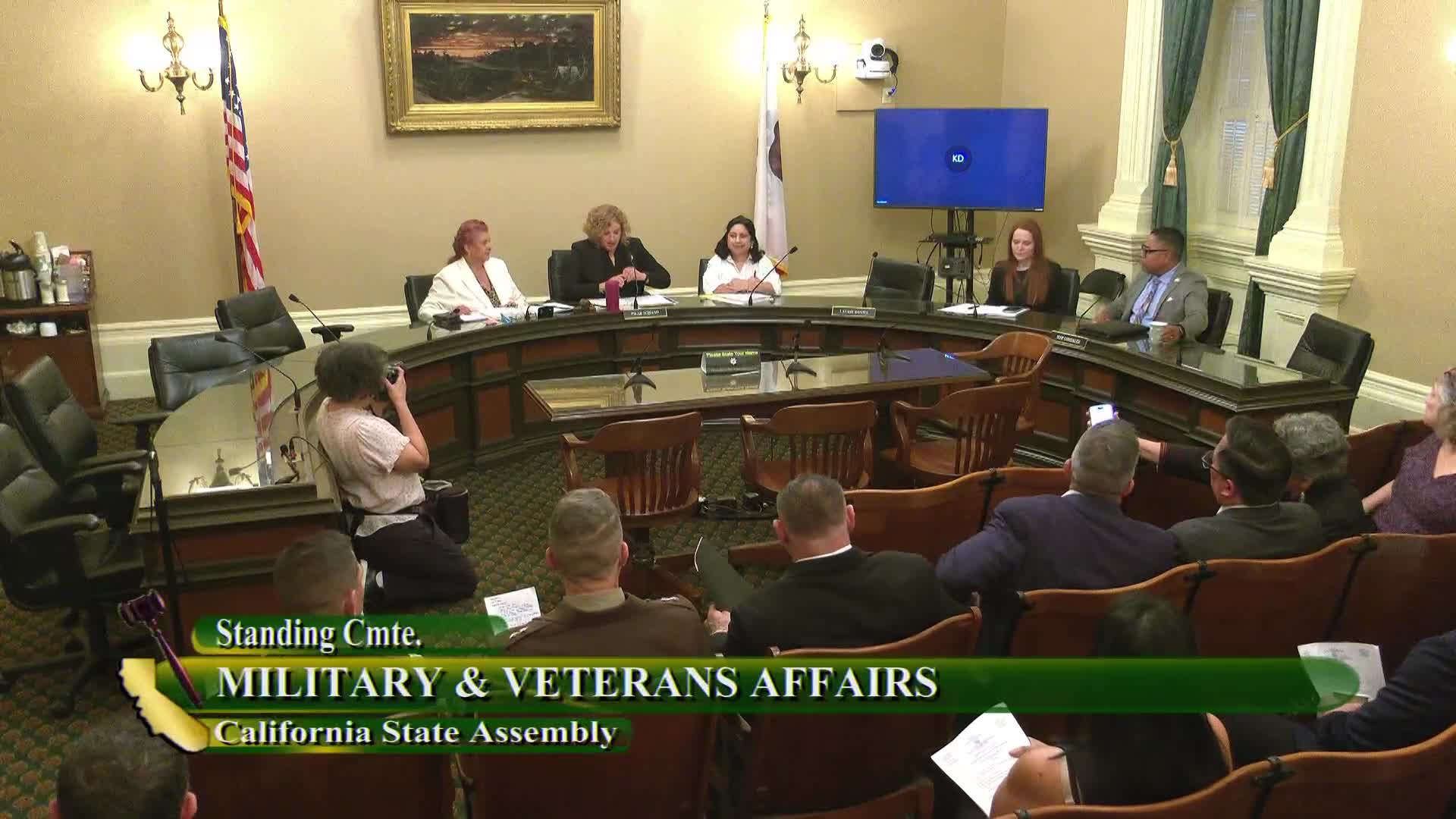
SACRAMENTO — At an informational hearing of the Assembly Committee on Military and Veteran Affairs, military leaders, state officials and veterans service organizations warned that recent and proposed federal staffing and benefit cuts to the Department of Veterans Affairs and other programs threaten veterans’ access to health care, benefits, housing and legal assistance.
SACRAMENTO — At an informational hearing of the Assembly Committee on Military and Veteran Affairs, military leaders, state officials and veterans service organizations warned that recent and proposed federal staffing and benefit cuts to the Department of Veterans Affairs and other programs threaten veterans’ access to health care, benefits, housing and legal assistance.
“These men and women have risked their lives to keep us safe, and now the benefits they’re owed are being stripped away,” Assemblymember Schiavo, chair of the Assembly Committee on Military and Veteran Affairs, said in opening remarks. She and witnesses emphasized the potential local impact if federal staffing reductions and budget cuts proceed.
The hearing brought together the Adjutant General of the California Military Department, the state’s deputy secretary for veteran services, county veteran service officers, legal advocates and nonprofit providers. Testimony described on-the-ground consequences: longer waits for VA claims and appointments, potential layoffs at county veteran service offices (CVSOs), fewer legal advocates to help veterans secure benefits, and added pressure on community programs that place veterans in housing and deliver mental-health services.
Why it matters: Witnesses said disruptions at the VA and other federal agencies would reverberate through California’s network of county and nonprofit providers. Roberto Herrera, deputy secretary of veteran services at the California Department of Veterans Affairs (CalVet), told the committee that CalVet and the CVSOs are already handling record claim volumes and rely on federal dollars and partnerships to connect veterans to benefits and care.
Major General Matthew Beavers, the Adjutant General leading the California Military Department, told the committee the department employs about 18,500 service members across the Army and Air National Guard, the State Guard and youth programs, and warned that cuts at the federal level could reduce readiness by curtailing training, flying hours and equipment recapitalization. “If you reduce our readiness, you reduce our funding, you reduce the types of equipment we have, we are less ready and we’re less well prepared,” Beavers said.
County veteran service officers and nonprofit legal providers emphasized the role they play in securing federal benefits that support veterans’ housing, health care and incomes. Jim Zenner, director of the Los Angeles County Department of Military and Veterans Affairs, said CVSOs furnish intensive outreach and benefits work: “We’re going out there and trying to set up referral processes to get veterans identified and have them referred over to us.” Zenner described CVSOs’ role in diverting veterans from county safety nets by helping them obtain VA compensation or other benefits.
Legal advocates asked the Legislature to expand state funding for no-cost legal representation for veterans pursuing VA claims. Moe Seider, legal director at Swords to Plowshares, and Amy Fairweather, the organization’s director of policy, said attorney representation increases the odds of timely and favorable claims decisions and that community legal programs have limited capacity. Fairweather described grant-funded projects that helped veterans win back pay and steady monthly benefits; she urged California to expand such funding to offset anticipated federal delays and staffing reductions.
Providers of housing and mental-health services described state pilot programs intended to fill gaps, and warned that those programs are vulnerable without sustained funding. CalVet officials and nonprofit partners outlined two California initiatives: the Veterans Support Self-Reliance (VSSR) pilot, providing on-site clinical and supportive services in permanent supportive housing, and the California Veterans Health Initiative (CVHI), a grant program to expand community-based mental-health counseling for veterans. CalVet reported early VSSR results including fewer missed medical appointments, greater specialty-care use and lower emergency visits at participating sites, and said CVHI will add tens of thousands of no-cost counseling appointments across the state.
Housing agencies and operators noted long-term federal and state partnerships that reduced veteran homelessness by about 45 percent, but warned of risks if federal rental vouchers or supportive services are cut. Jennifer Seager of the California Department of Housing and Community Development summarized state housing programs targeted to veterans, including the Veterans Housing and Homelessness Prevention Program (VHHP) and Homekey Plus, and said the state is pursuing construction and acquisition resources while coordinating with counties on behavioral-health services tied to Homekey projects.
Several witnesses cited concrete figures raised during the hearing: the PACT Act’s screening of millions of veterans for toxic-exposure conditions; CalVet’s report that county veteran service officers generated roughly $580 million in new and recurring payments for veterans in a recent year; and provider reports of program-level impacts and caseload increases. Chair Schiavo and witnesses also pointed to reports of federal personnel reductions (witnesses cited an administration proposal to cut 83,000 VA positions and news of thousands already let go), and to national and state-level statistics for veteran suicide and homelessness raised during testimony.
Assembly members asked panelists for specific steps the Legislature could take. Witnesses suggested: (1) increased state funding for CVSO operations and for no-cost legal assistance for benefit claims; (2) continued and sustained support for state pilots such as VSSR and CVHI; (3) improved data sharing between state VetPro and county health information exchanges to identify and reach veterans who use county services; and (4) active advocacy with California’s congressional delegation to protect federal funding for readiness, equipment and VA staffing.
What was not decided: The hearing was informational. No motions or votes were taken. Committee members requested additional data from panelists, including county-by-county veteran population and program performance metrics, and urged continued committee follow-up as federal actions unfold.
The committee scheduled additional panels during the hearing on mental health, suicide prevention, and housing to gather further testimony.
Two attendees described how nonprofit and county programs helped them get off the street and into housing. Michael Harris, a client of Nation’s Finest and a Nations Finance program participant, told lawmakers that local providers “saved my life.” Several panelists and members concluded the hearing by urging continued state action to shore up programs that funnel federal dollars to veterans and to expand state investments where gaps emerge.
Assemblymember Schiavo closed by stressing California’s intent to protect veterans’ access to care and benefits and to press federal officials on the impacts of proposed cuts: “California has made significant strides in supporting veterans,” she said, and warned that federal actions could undo that progress. The committee will continue oversight and follow-up briefings as the state and providers track federal developments.