Get Full Government Meeting Transcripts, Videos, & Alerts Forever!
Get email alerts on the Budget Military Veterans topic
No spam. Unsubscribe anytime.
Governors' budget hearing: National Guard seeks tuition and reenlistment funding; veterans affairs asks for operating increases to staff new homes
Summary
Department of Military Affairs and the Department of Veterans Affairs presented House File 2444 on March 26, requesting increases for tuition reimbursement, reenlistment bonuses, cyber coordination, H2F, and operating funds to staff new veterans homes.
Department of Military Affairs and the Minnesota Department of Veterans Affairs presented budget requests contained in House File 2444 at the March 26 division hearing. Department officials asked lawmakers to consider multiple increases for state fiscal years 2026–27 to support National Guard enlistment incentives, cyber coordination, and programs to maintain and staff new veterans homes.
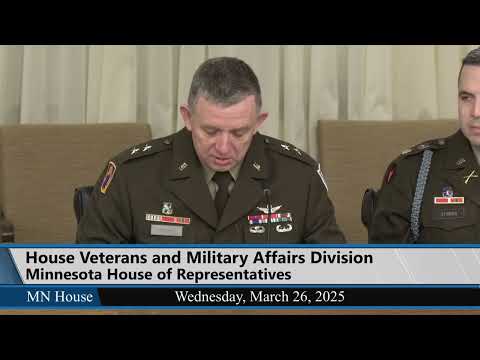
Major General Sean Manky, Adjutant General and Commissioner of the Department of Military Affairs, told the committee the agency is requesting increases for state tuition reimbursement and reenlistment bonuses — figures cited were a $2.2 million increase for fiscal 2026 and a $6.0 million increase for fiscal 2027 — and funding for a cyber coordination cell (a $353,000 increase for fiscal 2026 and roughly $3.97 million for fiscal 2027, as presented). He also requested $800,000 for the Holistic Health and Fitness (H2F) program for fiscal 2026 and described plans to pursue federal cooperative agreements beginning in federal fiscal 2027.
Manky described the state reenlistment bonus program as a retention tool that had to be paused earlier this year because the appropriation risked exhaustion. "Because of the success of this program, we actually shut this program off the first of the year because we ran risk of potentially running out of money to sustain this program," he said. He said Camp Ripley and other training demands make the retention incentives important to preserve investments in trained personnel.
Lieutenant Colonel Eric Athalman, director of operations for the Department of Military Affairs, answered members' questions about program design, carryover authority and differences between state and federal benefits. He said federal processes for funding H2F are uncertain and the department seeks one more year of state support while federal cooperative agreements are pursued.
Brad Lindsey, commissioner of the Minnesota Department of Veterans Affairs, described requests to address operating costs for state veterans homes and programs. Lindsey said Minnesota opened three new state veterans homes and a new veterans cemetery in recent years and that the department faces staffing gaps at the new homes. The department requested increases — for example, $7.93 million for fiscal 2026 and $21.25 million for fiscal 2027 in healthcare operational funding as presented — to bring the homes to full staffing and capacity. Lindsey said filling beds and maximizing federal per‑diems and benefits would increase revenue and cited a roughly 33% increase in revenues in the first two quarters after filling new beds and increasing claims work.
Committee members asked about veteran suicide prevention, the balance between homeless‑veteran services and suicide prevention funding, and how increased federal per‑diems will affect the state's budget burden. Lindsey said the department has a claims team working to maximize federal reimbursements and described the 50,000 to $222,000 per‑veteran annual federal reimbursement range depending on service‑connected disability status.
Committee members did not move House File 2444 at the hearing; testimony was presented for the committee’s consideration in the budget process.