Get Full Government Meeting Transcripts, Videos, & Alerts Forever!
Get email alerts on the Work Projects And State Grants topic
No spam. Unsubscribe anytime.
Michigan LEO explains multi‑year "work projects," seeks funding for Going Pro; MSHDA unveils $10M employer housing pilot
Summary
Members of the Michigan Department of Labor and Economic Opportunity and MSHDA told the House Appropriations Subcommittee on Labor and Economic Opportunity that “work projects” let one‑time appropriations and some federal awards be carried forward and spent over multiple fiscal years, and they detailed program outcomes and funding requests for workforce and housing initiatives.
Members of the Michigan Department of Labor and Economic Opportunity (LEO) and the Michigan State Housing Development Authority (MSHDA) told the House Appropriations Subcommittee on Labor and Economic Opportunity that “work projects” allow one‑time appropriations and certain federal awards to be carried across fiscal years and provide time to obligate and reimburse grantees.
LEO Chief Administrative Officer Greg Rivitt said the authority for the accounting construct comes from state statute, and that work projects give agencies up to 48 months to complete one‑time efforts. He and MSHDA Executive Director Amy Hovey emphasized that many state housing and workforce grants are reimbursement‑based and require additional time and matching funds to draw down federal dollars.
Rivitt defined the mechanism and provided program totals. “In accordance with MCL 18.1451a, a work project is a one‑time, nonrecurring effort designed to achieve specific goals,” he said. Rivitt told the committee LEO placed 21 new work projects last fiscal year; of those funds 70% are obligated, 22% expended and the remainder unobligated and in procurement or RFP processes. He described the work project vehicle as necessary where grantees need multi‑year timing to deliver outcomes and to support reimbursement invoicing processes.
Rivitt reviewed major work projects and agency requests. He said the Going Pro Talent Fund — grants to employers for training current and new workers in high‑demand industries — had $54 million in a 2023 work project that is fully expended and $49 million in FY 2024 that is obligated but largely pending invoicing. The department is requesting $54.8 million in the next executive recommendation to continue Going Pro. Rivitt said the Going Pro program has produced more than 8,000 awards and trained about 221,000 workers, with an average reported wage increase of 7.2%.
On registered apprenticeships, Rivitt cited a 94% employment rate for program completers and a reported median annual post‑completion earnings figure of $80,700; the department is seeking $19 million in the next executive recommendation to continue apprenticeship supports. On barrier removal — supportive services covering transportation, housing assistance, legal services, childcare and similar needs — Rivitt said LEO had $14 million allocated for FY 2025, with roughly 90.9% of that obligated and 24% expended; the executive recommendation seeks $7.5 million to continue the program.
Rivitt also described a statewide blight elimination investment of $150 million that LEO said was made possible by a 2023 public act and federal ARP funding; he said $75 million was general fund and $75 million ARP, with the ARP portion already allocated and competitive grants underway. The department reported 98 grants funded across 69 communities, and 569 ARP‑supported projects in 39 counties.
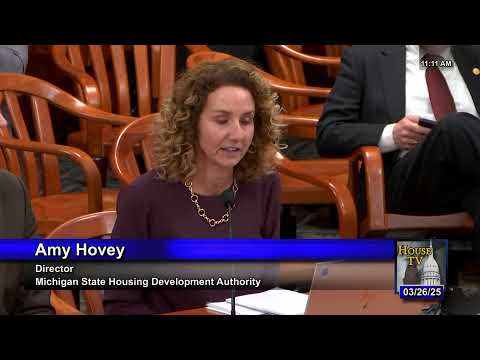
Amy Hovey, MSHDA executive director, told the committee that state appropriations in FY 2023 and FY 2024 are fully obligated to housing projects across Michigan and that developers typically layer state funds with federal and private financing. She described the My Neighborhood program, funded from the housing community development fund to implement regional housing plans produced by 15 regional housing partnerships. Hovey said the Housing Readiness Incentive provided $50,000 grants to local governments to update land‑use policies to encourage housing development.
Hovey outlined a newly launched Employer Assisted Housing Fund: a $10 million pilot using FY 2025 state appropriations that operates as a dollar‑for‑dollar match to employer contributions and other eligible inputs (including donated land). “We already have committed $6,500,000 of the $10,000,000 that we started,” she said, and the governor’s recommended budget proposes a $25 million expansion. Hovey said the program is designed to be flexible: most employer participants are contributing funds or land and partnering with developers rather than acting as developers themselves; where employer‑owned housing is involved, MSHDA requires protections so employees are not displaced if their employment ends.
LEO staff described enhancement grants (one‑time, legislatively sponsored grants) and reporting plans. Rivitt said LEO placed 151 FY 2024 enhancement grants into a work project; those grants are fully executed and about 28% of funds have been disbursed. For FY 2025, LEO reported 207 enhancement grant awards in the pipeline: 48 fully executed and 86% of legislative sponsor packets received. LEO said it will publish a publicly accessible dashboard showing geographic distribution and grant details.
On federal funding and matching, Rivitt said roughly 65% of LEO’s budget is federal; the department manages more than two dozen federal awards across eight program areas, and workforce development accounts for 21 federal programs. He explained that nonfederal match is required to access certain federal dollars and that the department typically seeks state general fund match because each dollar of state investment can leverage several dollars in federal revenue. For one example he presented, LEO is seeking authorization to spend $40 million in federal dollars and requested $8.4 million in state general fund match to access that federal vocational rehabilitation funding.
The committee questioned LEO on accountability, auditing and staffing. Rivitt described internal controls, invoice review before reimbursement to grantees, compliance audits, and state and federal auditor reviews. On staffing, Rivitt said LEO’s total authorized FTE count is 2,180 and that the department had 2,067 positions filled on the most recent report, leaving 113 vacancies. He explained that newly hired or limited‑term employees are often defaulted to administrative lines in state reporting systems and that some FTE authorizations are handled in boilerplate language and therefore do not appear in appropriation line snapshots.
Committee members pressed MSHDA on attracting development in rural areas; Hovey described two initiatives under development: free consulting through a nonprofit (Great Lakes Housing Services) to build local capacity and a “housing‑ready” checklist and developer contact list for municipalities. She said those tools were in draft and expected to be rolled out within about 30 days.
Committee members also asked about a small negative balance shown on a Michigan infrastructure grants line; Rivitt said that was a coding error related to the Michigan Economic Development Corporation adjustments and not a program overspend.
There were no roll‑call votes on new appropriations during the hearing. The committee approved routine minutes and excused absent members by unanimous consent before adjourning.