Get Full Government Meeting Transcripts, Videos, & Alerts Forever!
Get email alerts on the Budget Deficit topic
No spam. Unsubscribe anytime.
Audit firm identifies about $63.1 million in potential annual savings for Austin ISD
Summary
Greg Gibson, president of Gibson Consulting Group, presented the results of an internal cost-savings audit to the Austin Independent School District Board of Trustees and its audit committee, identifying roughly $63,100,000 in potential annual general fund savings; the meeting date was not specified in the transcript.
Greg Gibson, president of Gibson Consulting Group, presented the results of an internal cost-savings audit to the Austin Independent School District Board of Trustees and its audit committee, identifying roughly $63,100,000 in potential annual general fund savings; the meeting date was not specified in the transcript.
The audit, which the firm completed in March 2025 after beginning work in August 2024, summarized multiple opportunities the district could consider to reduce recurring costs. "The total annual estimated savings of the identified opportunities is $63,100,000," Gibson said during the presentation. The auditors noted their work was collaborative with district administration and that the administration used the findings when developing its own recommendations.
Why it matters: Austin ISD faces a projected fiscal-year 2026 budget deficit, and the audit identifies a range of operational changes and program adjustments that could reduce annual general fund spending if implemented. The presentation emphasizes that some savings are more immediately realizable while others will require longer-term work or depend on external events.
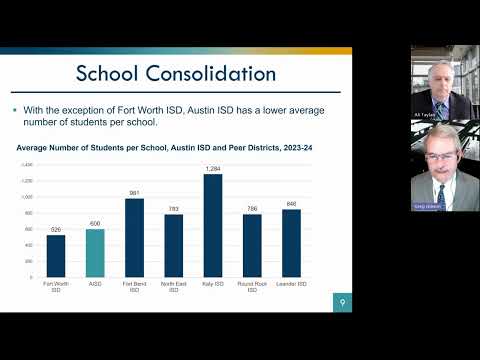
The audit highlights five principal opportunity areas and provides estimated annual savings for each. School consolidation. The largest category is consolidating underused schools. The auditors said Austin ISD's enrollment declined from about 80,000 students to about 70,000 students over seven years, producing widespread underutilization. By applying operating-expenditure differences between larger and smaller schools, the audit estimates consolidation-related annual savings of about $43,600,000 ($30,100,000 at the elementary level and $13,500,000 at the middle-school level). Gibson explained the methodology as applying the per-student operating-expenditure difference between schools with 500 or more students and those under 500 at the elementary level, and a similar comparison for middle schools.
Portables disposal. The audit reports the district has 535 portable buildings and that 305 of those (57%) sit on campuses with less than 85% utilization. The auditors estimated that removing those 305 portables could save about $1,700,000 annually from reduced electricity and custodial costs.
Indirect cost recovery. The audit found the district applies the lower, "restricted" indirect cost rate to federal programs but does not apply the higher, "unrestricted" rate that can include certain operational costs for programs such as student nutrition services. As a result, the firm estimated Austin ISD foregoes approximately $2,000,000 a year in reimbursements the district could claim under federal rules; the transcript notes that all federal programs charge the applicable maximum indirect cost rate except student nutrition services at Austin ISD.
Master-scheduling efficiencies. Ali Tylan, chief information officer and senior technology consultant with Gibson Consulting Group, described opportunities in master scheduling (the process that assigns students to classes and teachers). The audit identified teachers in elementary and secondary schools serving fewer than 15 students in one or more class periods. The auditors excluded higher-need Tier 1 and Tier 2 campuses from that portion of the analysis; among Tier 3 and Tier 4 campuses, 28 elementary schools and 15 secondary schools had teachers serving small classes for at least part of the day. Counting elementary and secondary positions together, the audit found 329 teachers who serve fewer than 15 students during at least a portion of the day and applied a conservative 33% probability factor to estimate schedule-optimization savings of about $9,200,000 annually.
Senior leadership positions. The audit examined the district's senior leadership layer (the top third layer of the organizational chart) and reported an increase in full-time equivalents (FTEs) in positions with the word "director" from 65 in 2018–19 to 114 in 2020–24, later decreasing to 107 in 2024–25. The net increase of 42 director FTEs represents a 64.6% rise over seven years while student enrollment declined by about 10,000. Using the 2018–19 student-to-director ratio applied to 2024–25 enrollment and average director salary and benefits, the auditors estimated potential annual savings of $6,600,000 from reducing director-level FTEs toward earlier ratios.
Methodology and limits. The auditors said they used a fall PEIMS snapshot for staffing data and that most analysis was completed in December 2024; they cautioned that fall snapshot data may differ from later-year fiscal-year 2025 figures and that some savings estimates are more susceptible than others to state and local policy changes. "Some of the opportunities we identified are less susceptible to these changes than others. Our assessment of this susceptibility is reflected in the full report," Gibson said. The auditors also created a data dashboard that they gave to district administration to support future budget planning and efficiency measurement.
Next steps. The presentation notes the administration received a draft report in December and that Gibson Consulting Group would attend the upcoming board meeting to answer questions. The transcript indicates the audit contains no formal "findings" or required recommendations; the firm framed its work as identifying opportunities the administration could incorporate into its budget planning.
The transcript does not record any formal board action, motion, or vote on the audit findings during the presented segment; the district administration's formal decisions or selections from the list of opportunities were not specified in the transcript.