Get Full Government Meeting Transcripts, Videos, & Alerts Forever!
Get email alerts on the Taxes Committee Roundup topic
No spam. Unsubscribe anytime.
Senate Taxes Committee hears TIF-extension and sales-tax exemption requests; bills laid over
Summary
The Minnesota Senate Taxes Committee heard a slate of tax-related bills on March 26 that would extend deadlines for tax-increment financing (TIF) districts or create/refine sales- and use-tax exemptions for construction materials and public infrastructure. Committee members laid each bill over for further consideration.
The Minnesota Senate Taxes Committee heard a slate of tax-related bills on March 26 that would extend deadlines for tax-increment financing (TIF) districts or create/refine sales- and use-tax exemptions for construction materials and public infrastructure. Committee members laid each bill over for further consideration.
The largest development discussed was Senate File 2,407, a measure to extend a statutory five-year rule for a single TIF district covering the Highland Bridge (formerly the Ford Site) in St. Paul. Melanie McMahon, deputy director of the Department of Planning and Economic Development for the City of St. Paul, told the committee the site’s plan “supports nearly 4,000 housing units, 20% of which will be affordable,” and said the site’s horizontal infrastructure work — streets, utilities and stormwater systems for 120 acres — began before the COVID-19 pandemic and slowed because of higher construction costs and market conditions. McMahon said the bill would extend the 5-year rule by an additional five years and applies only to that one TIF district.
Also before the committee were several smaller TIF-extension requests from cities seeking more time to use unobligated TIF increment created or extended by a 2021 session law. Senator Shaw presented Senate File 2,083 on behalf of the City of Oakdale; John Stark, special projects manager for the City of Oakdale, said the Tanner’s Lake redevelopment would include “26 apartment units and 12 townhomes” with trails and lakeshore amenities and that “this project would not be feasible without the use of tax increment financing.” Oakdale requested an extension of the statutory deadline from Dec. 31, 2025, to Dec. 31, 2027, to allow for additional technical work on utilities, road alignment and easements.
Senate File 2,463 would allow the City of Marshall to loan, invest or spend transferred increment through Dec. 30, 2027. Mayor Bob Burns and Lauren Deitz, director of economic development for Marshall, testified that the extension would support a two-phase affordable housing project — a 60-unit affordable apartment phase and a 65-unit senior housing phase — and that roughly $500,000 in pooled TIF would be used for a street extension and utilities to serve the site. Deitz told the committee those Low-Income Housing Tax Credit application points tied to local funding were critical to move the project forward.
Bills seeking sales- or use-tax relief on construction materials and equipment were also presented from several school districts, cities and utilities. Senator Nelson presented Senate File 2,049 for Rochester Public Utilities; Tim McCullough, general manager of Rochester Public Utilities, said the utility is updating electric and water meters to a next-generation advanced metering infrastructure and requested that certain electric meters and software be exempt (purchase date after June 30, 2024, and before March 31, 2029). McCullough noted Rochester Public Utilities is “the largest municipal utility in the state of Minnesota” and asked the committee to consider exempting the electric portion of integrated metering equipment so the water and electric systems could be treated consistently.
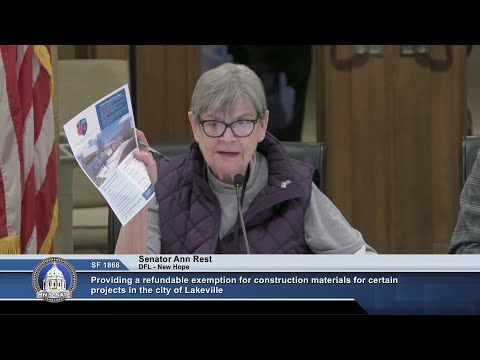
Lakeville officials and Senator Duckworth presented Senate File 18-68, a sales-and-use tax exemption for construction materials on a new regional first-responder training facility called the FIRST Center. Dan Walter, a Lakeville City Council member, described the facility as including immersive-reality training, a two-story flexible training space and a tactical range and said the project has state support and a federal earmark but leaves roughly $18 million to be financed locally; Lakeville estimates the exemption would save more than $425,000.
Senate File 23-78 from Albert Lea (sponsored by Senator Dornick) would exempt materials, supplies and equipment used on a two-rink municipal arena renovation; Ian Rigg, Albert Lea city manager, said cost estimates had changed during bidding and asked the committee for the sales tax exemption to help cover an overrun on the refrigeration system. The committee’s Department of Revenue staff noted discrepancies between the city’s handout and Revenue’s estimates and asked the city to reconcile those numbers.
Other construction-related exemption requests included: - Senate File 19-17 (Aiken Public School District): Superintendent Dan Stifter said the district seeks a refundable sales-and-use tax exemption on construction materials to stretch local dollars for a facilities plan that includes new roofs, HVAC, and consolidated campus planning. - Senate File 19-81 (Ramsey water project clarification): Bryan Hagen, Ramsey city administrator, said the original legislation referenced the water treatment facility but was not explicit enough to include the connecting trunk main; he asked language be clarified so the water-main work would be eligible for sales-tax reimbursement. - Senate File 20-14 (Cottonwood County): Nick Klitsch, Cottonwood County public works director, sought a refund of sales tax on building materials for a new county public works facility costing over $12 million; the county said the exemption would protect road-and-bridge revenues that also fund equipment such as plow trucks. - Senate File 1-58 (Ellsworth School District): Senator Weber described an exemption request covering HVAC, windows, roof replacement and other renovation work; the Department of Revenue’s revenue estimate accompanies the bill. - Senate File 19-69 (snowmobile clubs): Senator Hauschild described a bill to broaden existing exemptions so materials and supplies used in construction, reconstruction, maintenance and improvement of state or grant-aid snowmobile trails would qualify.
Throughout the hearing Revenue staff repeatedly asked testifiers to reconcile differing project-cost figures provided to the committee and to Revenue so the committee could consider consistent estimates of fiscal impact. In many cases witnesses said project bids and costs changed during the post-pandemic construction market and that those changes motivated requests for further relief.
No bill was taken up for final passage; committee members laid each bill over for additional consideration. Committee staff scheduled the committee to meet again at 9 a.m. the following day.
Ending: Committee members thanked witnesses and closed the hearing after laying over the day’s bills for later action.